Can a Mechanical Stopper Protect My Apartment Door from Intruders?

  • Thread starter Thread starter chirhone
  • Start date Start date
  • Tags Tags
    Mechanical
Click For Summary
SUMMARY

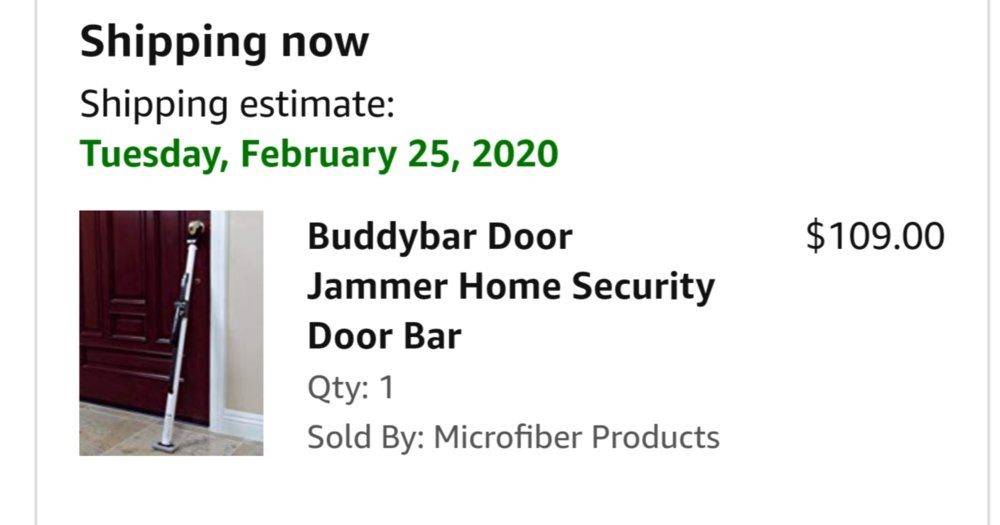
The discussion centers on securing an apartment door against potential intruders, particularly in a high-rise setting. Participants recommend using a "security bar door jammer" or similar mechanical devices that do not require drilling into the concrete, making them suitable for renters. A combination of high and low placement of security devices is emphasized for maximum effectiveness, as well as the importance of reinforcing existing locks. The consensus is that while no solution is foolproof, these measures significantly enhance door security.

PREREQUISITES
  • Understanding of basic door security mechanisms
  • Familiarity with mechanical door stoppers and jammers
  • Knowledge of apartment rental regulations regarding modifications
  • Awareness of crime statistics in residential areas
NEXT STEPS
  • Research "security bar door jammer" options and reviews
  • Explore how to reinforce door locks with longer screws
  • Investigate the installation of a steel plate for added door protection
  • Learn about the effectiveness of various door security devices
USEFUL FOR

Apartment renters, security-conscious individuals, and anyone looking to enhance their home security against intruders.

  • #31
Hope this will work (8 pounds steel):

20200225_100935.jpg


My concern is what if someone would just insert a tiny long blade from outside and push the bottom?

What mechanical principle would prevent that?

Any alarm that would trigger off when someone tries to insert something in the floor gap? And how do you secure the floor gap?
 
Engineering news on Phys.org
  • #32
This works. My friend couldn't open the door from outside. But I wasn't able to test it by him pushing very hard on the door or running into the door. Would the testing damage the door?

received_546098366258942.jpeg


Next to arrive would be the 8 pound all steel door bar. Again I don't know how to test them without damaging the door I just rented.
 
  • Like
Likes   Reactions: Lnewqban
  • #33
chirhone said:
But I wasn't able to test it by him pushing very hard on the door or running into the door. Would the testing damage the door?
Quite possible to inflict damage on the door.
 
  • #34
This 8-lb door bar works better than the tiny one, but what would stop a person from inserting something flat at the bottom gap to push it? Is there a mechanical gap filler of some kind you can install too that can't be moved from outside?

received_801764763663644.jpeg


I hope robbers don't read physics forums and learn about my devices.
 
  • Like
Likes   Reactions: Lnewqban
  • #35
Start looking for an apartment with steel framed door. Most braces won’t stand up to this

 
  • #36
received_197371845007625.jpeg


I still have 3 months of rent left (I may leave early though if COVID-19 transmission is confirmed).

I want to take this opportunity to learn mechanical principles and create a competent defence capability.

In the picture above. Would it be better to get a pole (shown in orange line) to brace against the door bar, or would it be better to put the orange pole directly on the door (without any door bar, I can sell it)? But what would prevent the orange pole from sliding if it is put directly on the door? I can't put any screws or alter the door in any way.

This is the full perspective, and another option:

received_179640413485976.jpeg


I can put two poles and a metal plate brace against the door. But how do you design it such that you can disassemble and assemble it easily? without creating a solid welded connection that you would have difficulty removing in the day?
 
  • #37
chirhone said:
But how do you design it such that you can disassemble and assemble it easily?
Truckers use "load bars" inside the trailer. These are adjustable-length cam-lock devises. Maybe you could put one pad against the door, and the other against your interior door frame. Once the length is adjusted, you just squeeze the lever to extend the pad a little bit to create the tension.

https://www.amazon.com/slp/load-bars/apr3amdx7tquuv6&tag=pfamazon01-20
 
  • Informative
Likes   Reactions: Tom.G
  • #38
gmax137 said:
Truckers use "load bars" inside the trailer. These are adjustable-length cam-lock devises. Maybe you could put one pad against the door, and the other against your interior door frame. Once the length is adjusted, you just squeeze the lever to extend the pad a little bit to create the tension.

https://www.amazon.com/slp/load-bars/apr3amdx7tquuv6&tag=pfamazon01-20

Before I order these load bars (note your url is wrong). I'd like to know if anyone owns one. How strong is it when pressed from the longitudinal side or axis (or when the door is pushed against it)? Remember it is designed for side restraint.

Meanwhile I have temporary solution.

received_331367344487191.jpeg


I'd like to compute it. Say a person of 160 lbs run into the door from 10 meters away. What is the force of impact. What units do you use? Joules or KiloNewton? And what Joules/KiloNewton before the door hinges and bar would yield? Can someone give a sample computation? And all formulas involved?

Thank you.
 
  • #39
If you're worried about people shoulder-barging the door, then you could always hammer some nails through it from your side. Just so they poke through a little.

They won't do it twice.
 
  • #40
there is grove in the middle door, make brace with 2x4 wood, add rubber on the wood witch make contact with floors
 
  • Like
Likes   Reactions: Tom.G

Similar threads

  • · Replies 6 ·
Replies
6
Views
8K
  • · Replies 6 ·
Replies
6
Views
3K
  • · Replies 5 ·
Replies
5
Views
3K
  • · Replies 44 ·
2
Replies
44
Views
15K
  • · Replies 1 ·
Replies
1
Views
4K
  • · Replies 42 ·
2
Replies
42
Views
7K
  • · Replies 1 ·
Replies
1
Views
10K
  • · Replies 1 ·
Replies
1
Views
4K