Can a Non-Constant Holomorphic Function Equal Zero Everywhere?

Click For Summary

Homework Help Overview

The discussion revolves around the existence of a non-constant holomorphic function that equals zero everywhere while also being expressed in the form 1/n, where n is a natural number. This is situated within the context of complex analysis, particularly focusing on properties of holomorphic functions and their zeros.

Discussion Character

  • Exploratory, Conceptual clarification, Assumption checking

Approaches and Questions Raised

  • Participants explore the implications of a function being both zero everywhere and non-constant, questioning the validity of the problem statement. Some suggest that a function could be defined to be zero on a subset of the plane with a limit point, while others propose using the identity theorem to argue that a holomorphic function with zeros at specific points must be identically zero.

Discussion Status

The discussion is active, with participants questioning the clarity of the problem statement and exploring various interpretations. Some have offered potential approaches to finding such a function, while others express confusion about the requirements and implications of the problem.

Contextual Notes

There are indications of translation issues and confusion regarding the problem's phrasing, which may affect participants' understanding of the requirements. The nature of holomorphic functions and their zeros is central to the discussion.

OhNoYaDidn't
Messages
25
Reaction score
0

Homework Statement


With
Screen_Shot_2015_07_12_at_00_07_03.png
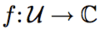
. Give an example, if it exists, of a non constant holomorphic function

Screen_Shot_2015_07_12_at_00_07_24.png
that is zero everywhere and has the form 1/n, where n € N.

Homework Equations


So.. This was in my Complex Analysis exam, and i have no idea what to do. I always seem to get stuck at these more abstract questions.
 
Physics news on Phys.org
It seems like your problem statement must be wrong. How can a function be zero everywhere and nonzero at some points? Am I reading it wrong?
 
Just declare the function to be $0$ on a subset of the plane that has a limit point. But yes, the statement is kind of confusing.
 
OhNoYaDidn't said:

Homework Statement


With
Screen_Shot_2015_07_12_at_00_07_03.png
. Give an example, if it exists, of a non constant holomorphic function
Screen_Shot_2015_07_12_at_00_07_24.png
that returns zero in all points, and has the form 1/n, where n € N.
Homework Equations


So.. This was in my Complex Analysis exam, and i have no idea what to do. I always seem to get stuck at these more abstract questions.
I tried to fix it.
I'm so sorry, but i translated this. But even in my mother togue it's confusing.
 
The only way I can make sense of it is this: find an analytic function that has zeros at all points ##1/n, n=1,2,## and so that ##f(0)=0##. And then you use the identity theorem to conclude f must be identically ##0.##
 
Last edited:
I bet they want a function that is zero at the points 1/n, analytic on the right half plane, and not constant.
 
This must be some kind of a trick, right? So satisfy the conditions one by one, and then satisfy the "every point" condition by making it the limit of some sequence.
1) Holomorphic - start thinking sine / cosine
2) looks like 1/n at x = n, so maybe ##\frac{1}{x} ## times some sine or cosine function
3) returns zero at every point, maybe the limit of your frequency component of the sine or cosine, so that at every point, you will have a vertical line from -1/x to 1/x.
 

Similar threads

  • · Replies 1 ·
Replies
1
Views
1K
  • · Replies 3 ·
Replies
3
Views
3K
Replies
3
Views
2K
  • · Replies 16 ·
Replies
16
Views
2K
  • · Replies 6 ·
Replies
6
Views
3K
  • · Replies 6 ·
Replies
6
Views
2K
Replies
8
Views
3K
  • · Replies 3 ·
Replies
3
Views
2K
Replies
7
Views
3K
  • · Replies 2 ·
Replies
2
Views
2K