Can I Use Logarithms to Solve Exponential Equations?

  • Context: High School 
  • Thread starter Thread starter Kevin Licer
  • Start date Start date
  • Tags Tags
    Logarithms
Click For Summary
SUMMARY

This discussion focuses on the use of logarithms to solve exponential equations, specifically addressing the misconception that one can take the logarithm of both sides of an equation involving sums. It is established that the logarithm of a sum cannot be simplified into the sum of the logarithms of individual terms. The correct approach involves transforming the equation into a polynomial form, particularly a sextic equation, and utilizing techniques such as the Rational Root Theorem and synthetic division to find solutions. Ultimately, the discussion concludes that while logarithms can assist in solving exponential equations, they cannot simplify sums directly.

PREREQUISITES
  • Understanding of logarithmic properties, specifically the logarithm of sums
  • Familiarity with exponentiation rules, such as ab+c = ab · ac
  • Knowledge of polynomial equations and their degrees, particularly sextic and quintic equations
  • Experience with the Rational Root Theorem and synthetic division techniques
NEXT STEPS
  • Study the Rational Root Theorem for identifying potential rational solutions to polynomial equations
  • Learn synthetic division to simplify polynomial equations efficiently
  • Explore Decartes' Rule of Signs for determining the number of positive and negative roots of a polynomial
  • Practice solving exponential equations by converting them into polynomial forms
USEFUL FOR

Students and educators in mathematics, particularly those focusing on algebra and calculus, as well as anyone looking to deepen their understanding of solving exponential equations using logarithmic properties.

Kevin Licer
Messages
21
Reaction score
0
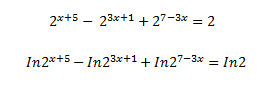
So, recently I have been learning about logarithms and how to solve exponential equations with the help of logarithms, but I am curious if I can take the log of both sides of an equation like this in order to solve it?
newlogarithmquestion.png

If not, then could someone explain why? Thanks.
 
Mathematics news on Phys.org
You cannot, the logarithm of a sum is not equal to the sum of the logarithms of the individual terms.
 
  • Like
Likes   Reactions: Kevin Licer
So, taking the log of both sides of this equation would be more like this?
logs.png
And would it be useful in this case?
 
Yes.
 
  • Like
Likes   Reactions: Kevin Licer
Kevin Licer said:
So, taking the log of both sides of this equation would be more like this?
View attachment 89007And would it be useful in this case?

Yes, that would be the correct way to take the log of both sides, but since you can't do anything with that log on the left because of all the summed terms in its argument, you similarly are stuck at solving this problem. It's a very difficult one to solve that's outside of the scope of what you're doing. You can get lucky and find an easy interger solution though (although this isn't the only solution and you won't be finding the others).
 
  • Like
Likes   Reactions: Kevin Licer
Kevin Licer said:
So, taking the log of both sides of this equation would be more like this?
View attachment 89007And would it be useful in this case?

Orodruin said:
Yes.
Orodruin's answer is a response to the first question, I'm pretty sure. As for the second question, would it be useful?
No, for the reason already given, that the log of a sum can't be simplified further.
 
  • Like
Likes   Reactions: Kevin Licer
Yes, I see now, I thought I could solve the equation by taking the log of both sides, but seeing as that is a mistake I'll try and work it out another way. Thanks!
 
The most common way of solving a problem like this in an elementary fashion is to try to get it into the form of a polynomial equation that can be easily solved. Of course, the question has to be set specifically so that it's "easy" to solve that way, and in this case, it is.

You need to be familiar with the rules of exponentiation. These are what you need: ##a^{b+c} = a^b \cdot a^c## and ##a^{bc} = (a^b)^c##

Using those rules, you can convert your equation into a sextic (power-6) equation in terms of a new variable ##y##, where ##y = 2^x##. This equation (thankfully) has at least one nice integer solution, which you can quickly find by trial and error (aided by the Rational Root Theorem, http://www.purplemath.com/modules/rtnlroot.htm).

At this point you need to find the full solution set, or at least show there are no other real, positive solutions (since an exponential is strictly positive). You can do this by either polynomial long division or the much simpler synthetic division (http://www.purplemath.com/modules/synthdiv.htm) by the linear factor you uncovered in the last step to get a quintic (power-5) polynomial. It's "tough" to solve or even sketch this curve, but fortunately, there is a little trick called the Decartes' Rule of Signs (http://www.purplemath.com/modules/drofsign.htm) that allows you to very quickly conclude that the quintic has no positive real roots. Hence the single value for ##y## you've already found is the only one that is valid.

Finally, you find ##x## by solving ##2^x = y## for ##x##, which I assume you know to do. In the general case you can do so by taking logs of both sides, but here all that's required is simple inspection (this should give you a big hint about how "nice" the solution is).

(Edited for more details, since I was rushing to work in the morning and was unable to complete the post).
 
Last edited:

Similar threads

  • · Replies 2 ·
Replies
2
Views
1K
Replies
3
Views
2K
  • · Replies 1 ·
Replies
1
Views
1K
  • · Replies 2 ·
Replies
2
Views
14K
  • · Replies 8 ·
Replies
8
Views
2K
  • · Replies 3 ·
Replies
3
Views
2K
  • · Replies 8 ·
Replies
8
Views
2K
  • · Replies 1 ·
Replies
1
Views
3K
  • · Replies 10 ·
Replies
10
Views
3K
  • · Replies 6 ·
Replies
6
Views
2K