Can Momentum Exist Without Net Velocity in Special Relativity?

Click For Summary

Discussion Overview

The discussion centers on the concept of momentum in special relativity, particularly whether momentum can exist in a system with zero net velocity. Participants explore the implications of the Lorentz factor and the behavior of particles in a relativistic context, considering both theoretical and practical aspects.

Discussion Character

  • Exploratory
  • Technical explanation
  • Debate/contested
  • Mathematical reasoning

Main Points Raised

  • One participant questions if the nonlinearity of the Lorentz factor allows for a system with zero average velocity to have non-zero momentum, presenting a scenario with multiple particles moving in opposite directions.
  • Another participant challenges the definition of "average velocity," stating that velocity is an intensive property and suggesting that "net movement" would be a more appropriate term.
  • Concerns are raised about the momentum transfer involved in stopping and reversing the direction of particles, with some arguing that this transfer must be accounted for in the overall momentum of the system.
  • A participant provides an analogy involving a train and a passenger to illustrate that even with zero average velocity, total momentum can be non-zero.
  • There is a discussion about the relationship between momentum and velocity in special relativity, noting that momentum is not linearly proportional to velocity as it is in classical physics.
  • One participant introduces the concept of "hidden momentum," suggesting it is a known but controversial topic in classical electrodynamics.

Areas of Agreement / Disagreement

Participants express differing views on the definitions of average velocity and net movement, with some agreeing on the need to consider energy transfer in momentum calculations while others maintain that the definitions used are problematic. The discussion remains unresolved regarding the implications of these definitions on the existence of momentum without net velocity.

Contextual Notes

Limitations include the ambiguity in defining "average velocity" versus "net movement," and the assumptions made about energy transfer and momentum in the context of special relativity. The discussion does not reach a consensus on these definitions or their implications.

Andy Bloch
Messages
4
Reaction score
0
(I hope this post doesn't cross the border into the forbidden realm of quackery and speculation.) I have what seems like a simple question about Special Relativity but I haven’t seen it discussed anywhere, nor has anyone I've asked.

Does the nonlinearity of the Lorentz factor provide a way for an asymmetric system to have momentum with zero average velocity, and vice-versa?

Consider this example:
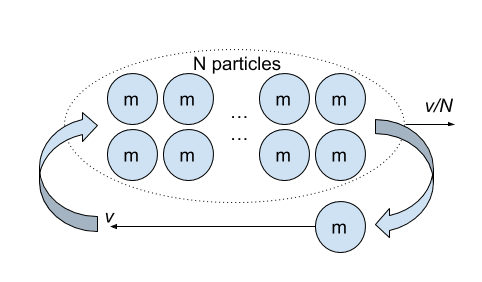
nparticles.png

There are N + 1 identical particles in this system. At any time, there is one particle (an electron, perhaps) moving to the left with relativistic velocity v (relative to the laboratory frame), and N particles moving to the right with velocity v/N. The process can be repeated continuously. There is no net movement of the system. But, it seems that the total (relativistic) momentum is non-zero. The total momentum to the left is (assuming v/N << c):

ptotal = γ m v - N m v / N = (γ-1) m v

where γ is the Lorentz factor.

Is there something I am missing?

Yes, I've ignored the periods of acceleration. But (1) if the clock hypothesis is true, making those periods very short should make any effect negligible, and (2) if the acceleration periods did affect the total momentum and exactly canceled it out, then changing the acceleration curve would have to have no effect on the total momentum. That doesn't seem likely to me.

(No, this would not seem to be a good way to power a spacecraft . It does not provide a constant thrust, just an initial velocity boost. I've done some calculations, with very generous assumptions, that suggest that even a velocity on the order of 1 m/s would not currently be feasible.)

I'm hoping someone here can quickly show me what is wrong with my math or reasoning, or provide a reference where this has been discussed.

Thanks in advance for any feedback.
 

Attachments

  • nparticles.png
    nparticles.png
    5.7 KB · Views: 601
Physics news on Phys.org
What do you mean by ”average velocity”? Velocity is an intensive property, not an extensive one.
 
How are you stopping the particles and turning them round? Have you accounted for the momentum transfer inherent in that?
 
Ibix said:
How are you stopping the particles and turning them round? Have you accounted for the momentum transfer inherent in that?
The amount of momentum transfer when accelerating a particle is the same as decelerating it back to zero velocity, but in opposite directions, so there should be no net momentum transfer.
 
Orodruin said:
What do you mean by ”average velocity”? Velocity is an intensive property, not an extensive one.
I probably should have written "net movement" instead of "average velocity."
 
Andy Bloch said:
The amount of momentum transfer when accelerating a particle is the same as decelerating it back to zero velocity, but in opposite directions, so there should be no net momentum transfer.
The key word there is "net". You need to get the energy absorbed in slowing the particle at one end up to the other end to accelerate the next one. And the mechanism that does that will carry momentum - presumably exactly enough to correct for your imbalance.
 
  • Like
Likes   Reactions: Andy Bloch and Dale
Say Train whose mass is M kg, goes 1m/s and a passenger whose mass is m kg, is running -1m/s in the system of station. Average velocity of the two is zero but total momentum is (M-m)*1 kg m/s. I am sorry for this word trick.
 
Last edited:
Andy Bloch said:
I probably should have written "net movement" instead of "average velocity."

In classical physics, momentum is linearly proportional to velocity. So, in a system of particles of equal mass, the net momentum is zero iff the net velocity is zero. By this, I mean simply adding the velocity vectors for each particle.

In SR, momentum is no longer linearly proportional to velocity. In a system of particles of equal mass with zero net momentum, typically the net velocity is not zero.

You've essentially found this yourself through your calculations. There's no mystery as far as I can see.
 
There is no reasonable way of defining ”net movement” other than movement of the center of energy. This is given by the net momentum divided by the total energy. If the net momentum is zero so is the movement of the center of energy (for a closed system). It makes no sense whatsoever to define net movement by summing particle velocities. Again, velocity is intensive, not extensive. The extrnsive properties are energy and momentum.
 
  • Like
Likes   Reactions: Andy Bloch
  • #10
Ibix said:
The key word there is "net". You need to get the energy absorbed in slowing the particle at one end up to the other end to accelerate the next one. And the mechanism that does that will carry momentum - presumably exactly enough to correct for your imbalance.
This was the most helpful answer. Yes, transferring the energy back to the other end will offset the momentum difference.
 
  • #11
Google "hidden momentum". This concept is well-known in classical electrodynamics, though rather controversial.

Eugene.
 

Similar threads

  • · Replies 67 ·
3
Replies
67
Views
7K
  • · Replies 17 ·
Replies
17
Views
2K
  • · Replies 6 ·
Replies
6
Views
2K
  • · Replies 1 ·
Replies
1
Views
1K
  • · Replies 49 ·
2
Replies
49
Views
5K
  • · Replies 10 ·
Replies
10
Views
1K
  • · Replies 24 ·
Replies
24
Views
3K
  • · Replies 21 ·
Replies
21
Views
3K
  • · Replies 1 ·
Replies
1
Views
1K
  • · Replies 3 ·
Replies
3
Views
3K