Discussion Overview
The discussion centers around whether a single interaction term in a Lagrangian can represent multiple vertices in Feynman diagrams, exploring the implications for perturbation theory and diagram construction.
Discussion Character
- Technical explanation, Conceptual clarification, Debate/contested
Main Points Raised
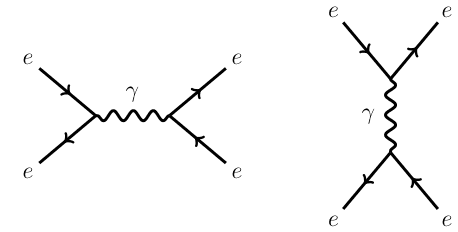
- One participant questions if a single interaction term can represent two vertices in Feynman diagrams, specifically referencing the term L = eψγμψAμ.
- Another participant asserts that the interaction term provides the vertices, indicating that the vertices in the diagrams are the same.
- A subsequent reply suggests that it is possible to draw the same vertices multiple times in a diagram with the interaction term appearing only once in the Lagrangian.
- Another participant confirms that this situation corresponds to higher orders in perturbation theory.
- One participant emphasizes that the Lagrangian establishes the rules for drawing diagrams, noting that vertices correspond to a coupling constant and conservation laws.
Areas of Agreement / Disagreement
The discussion reflects a general agreement that a single interaction term can lead to multiple vertices in diagrams, particularly in the context of higher-order perturbation theory. However, the nuances of this relationship and its implications remain somewhat contested.
Contextual Notes
Participants do not fully explore the assumptions underlying the relationship between interaction terms and vertices, nor do they clarify the mathematical steps involved in higher-order perturbation theory.