Can Single Photons Bend When They Hit a Material?

  • Context: Graduate 
  • Thread starter Thread starter Choisai
  • Start date Start date
  • Tags Tags
    Photons Refraction
Click For Summary
SUMMARY

Refraction occurs when light transitions between materials with different refractive indices, causing bending. However, waves striking a surface perpendicularly do not bend, as confirmed by symmetry principles. When considering single photons, they do not bend either; instead, they travel straight through the material. This behavior is due to refraction being a collective effect involving multiple photons and atomic interactions within the medium.

PREREQUISITES
  • Understanding of refraction and refractive index
  • Basic knowledge of wave-particle duality in quantum physics
  • Familiarity with solid state physics concepts
  • Experience with classical wave behavior
NEXT STEPS
  • Research the principles of wave-particle duality in quantum mechanics
  • Study the effects of refractive index on light propagation
  • Explore solid state physics and its implications on light behavior
  • Learn about transient states in wave propagation through different media
USEFUL FOR

Physics students, educators, and researchers interested in the behavior of light and photons in various materials.

Choisai
Messages
25
Reaction score
1
As a physics student, I was taught that refraction happens because when light approaches a material with a refraction index that is different than the index of the medium it is traveling through at that moment, the light that hits it first, as shown here:
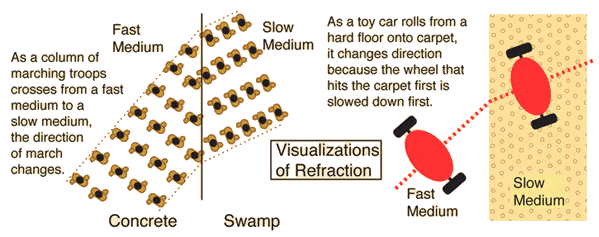
refr.gif


This raises to me two questions:

1) From this explanation it follows that waves that come perpendicular to the surface should not 'bend'. That is however not what I have seen personally. How can that be explained?
(I gather from that that such drawings are merely analogies and should not be taken literally, but that doesn't give me a full explanation)


2) What happens when single photons hit the material? Will they 'bend' as well?
 
Physics news on Phys.org
Choisai said:
From this explanation it follows that waves that come perpendicular to the surface should not 'bend'.That is however not what I have seen personally. How can that be explained?

I hate to tell you, but the explanation is your personal experience is wrong - it doesn't bend. Don't feel too bad though - personal experience is notoriously 'imprecise'

Choisai said:
What happens when single photons hit the material? Will they 'bend' as well?

Best to have that explained by a master:
https://www.amazon.com/dp/0691125759/?tag=pfamazon01-20

But, and this is maddening, even that is a simplification, requiring some hairy solid state physics to fully explain.

Thanks
Bill
 
Choisai said:
From this explanation it follows that waves that come perpendicular to the surface should not 'bend'. That is however not what I have seen personally. How can that be explained?
What direction could it bend? If the waves come in perpendicular to the surface, there is no preferred direction, and so the wave must continue to go straight, by symmetry.

Choisai said:
What happens when single photons hit the material? Will they 'bend' as well?
Refraction is a collective effect involving many photons and the motion of many atoms in the medium. A single photon will go straight.

Even for a classical wave, refraction only takes place in the steady state after the wave has fully penetrated the medium. When the wave first arrives it will go straight, and this will be followed by a transient period during which the atomic motions come up to speed.
 

Similar threads

  • · Replies 33 ·
2
Replies
33
Views
2K
  • · Replies 2 ·
Replies
2
Views
2K
  • · Replies 16 ·
Replies
16
Views
3K
Replies
12
Views
1K
Replies
14
Views
2K
  • · Replies 8 ·
Replies
8
Views
3K
  • · Replies 25 ·
Replies
25
Views
13K
  • · Replies 13 ·
Replies
13
Views
3K
  • · Replies 52 ·
2
Replies
52
Views
6K
  • · Replies 8 ·
Replies
8
Views
8K