Can someone check my answers to these four wave questions

  • Thread starter Thread starter question dude
  • Start date Start date
  • Tags Tags
    Wave
Click For Summary

Homework Help Overview

The discussion revolves around wave phenomena, specifically focusing on questions related to wavefronts, refraction, and diffraction. The original poster presents answers to four questions from their textbook, seeking feedback on their reasoning and diagrams.

Discussion Character

  • Exploratory, Conceptual clarification, Assumption checking

Approaches and Questions Raised

  • The original poster attempts to clarify their understanding of wavefront curvature and the implications of wave direction on wavefront gaps. They question whether their diagram accurately represents the concepts discussed.
  • Participants engage in a back-and-forth about the relationship between incident and refracted wave directions, specifically regarding the size of wavefront gaps and the curvature of wavefronts.
  • There is inquiry into the conditions under which wavefront gaps may change, particularly when considering different angles of refraction.

Discussion Status

Participants provide feedback on the original poster's answers, confirming some of their reasoning while also prompting further clarification on specific points. The discussion is active, with multiple interpretations being explored, particularly regarding the effects of wave direction on wavefront characteristics.

Contextual Notes

The original poster notes that their textbook does not provide answers, which may influence the level of confidence in their responses. There is also mention of the instructor's expectations regarding the accuracy of sketches and diagrams.

question dude
Messages
80
Reaction score
0
My textbook didn't include answers to these questions at the back.

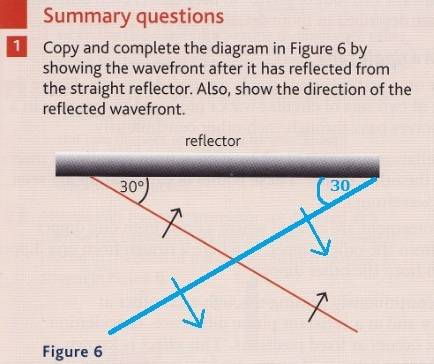
Question 1:
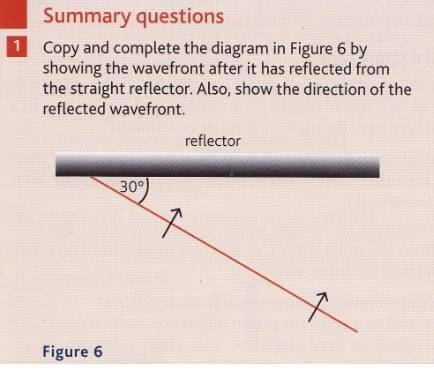
attachment.php?attachmentid=199004.jpg


my answer:

attachment.php?attachmentid=199005&d=1361388367.jpg


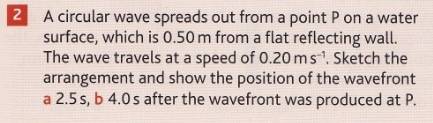
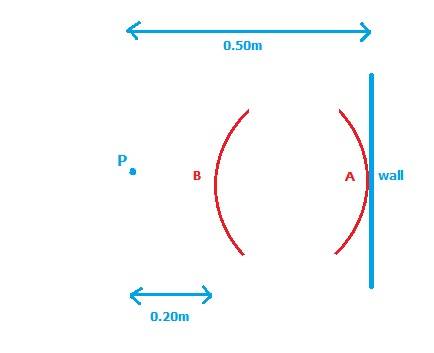
Question 2:

attachment.php?attachmentid=199007&d=1361390989.jpg


my answer:

part A and B of the question are shown by wavefronts A and B in the picture below,
attachment.php?attachmentid=199008&d=1361391008.jpg


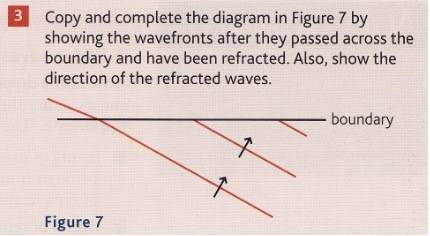
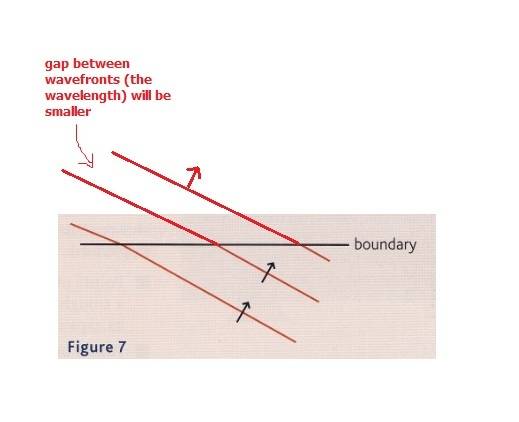
Question 3:

attachment.php?attachmentid=199009&d=1361391020.jpg


my answer:

attachment.php?attachmentid=199010&d=1361391061.jpg


and just out of curiousity, if the direction of the refracted wave were closer to the direction of the incident waves than the boundary normal, would the gap between the wavefronts be bigger?


Question 4:
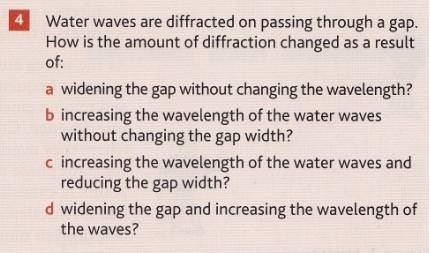
attachment.php?attachmentid=199011&d=1361391082.jpg


my answers:

a) reduced diffraction
b) increased diffraction
c) increased diffraction
d) I'm not sure here. Doesn't this depend on exactly how much the gap is widened by and how long the wavelengths have been increased to?
 
Physics news on Phys.org
Looks good over all. Some specific comments:

2. I would say you are correct for a rough sketch. A more accurate drawing would show different amounts of curvature for the two waves -- probably not required for full credit/marks here, but that is ultimately up to your instructor.

3. No, the gaps would not be bigger than they are in the incident wave. Think about it: if the refracted wave were in the exact same direction as the incident wave, how would the wavefront gaps compare to those in the incident wave? (I.e., would they be larger, smaller, or the same?)

4-d. You are correct. There is a slight chance that your instructor or the question writer meant the answer to be "no change", but as you said you really can't determine this without knowing the amounts by which the two quantities were changed.

Good job.
 
Redbelly98 said:
Looks good over all. Some specific comments:

2. I would say you are correct for a rough sketch. A more accurate drawing would show different amounts of curvature for the two waves -- probably not required for full credit/marks here, but that is ultimately up to your instructor.

can I ask what you mean by that? haven't I done that in the diagram? :confused:

Redbelly98 said:
3. No, the gaps would not be bigger than they are in the incident wave. Think about it: if the refracted wave were in the exact same direction as the incident wave, how would the wavefront gaps compare to those in the incident wave? (I.e., would they be larger, smaller, or the same?)
.

So for question 3, have I drawn it correctly then? (the gaps would be smaller for the refracted waves)

I assume what you've written here is in reply to my query: ''and just out of curiousity, if the direction of the refracted wave were closer to the direction of the incident waves than the boundary normal, would the gap between the wavefronts be bigger?''

anyway to answer you, if refracted waves were in the same direction as the incident wave, then the wavefront gaps would be the same, right?

You know, I think my query was phrased awkwardly, here's what I want to ask with a diagram to help:

attachment.php?attachmentid=199054.jpg


if the refracted direction is the purple arrow (so that wave direction would be further away from the normal than the incident direction), then would the wavefront gaps be bigger?

and also, is it possible for the incident wave to be refracted to the direction of the blue arrow? If it is, how would the gaps between the refracted wavefronts differ from the gaps in the incident waves?
 
Last edited:
question dude said:
can I ask what you mean by that? haven't I done that in the diagram? :confused:
In the diagram, the two waves seem to have the same amount of curvature. Probably okay, since they just ask for a sketch, but in reality wave B would be less curved than wave A, having traveled for a longer time.


So for question 3, have I drawn it correctly then? (the gaps would be smaller for the refracted waves)
Yes, sorry I did not clarify that. You did draw it correctly.

I assume what you've written here is in reply to my query: ''and just out of curiousity, if the direction of the refracted wave were closer to the direction of the incident waves than the boundary normal, would the gap between the wavefronts be bigger?''
Yes.
anyway to answer you, if refracted waves were in the same direction as the incident wave, then the wavefront gaps would be the same, right?
Yes.
You know, I think my query was phrased awkwardly, here's what I want to ask with a diagram to help:

attachment.php?attachmentid=199054.jpg


if the refracted direction is the purple arrow (so that wave direction would be further away from the normal than the incident direction), then would the wavefront gaps be bigger?
Yes.
and also, is it possible for the incident wave to be refracted to the direction of the blue arrow? If it is, how would the gaps between the refracted wavefronts differ from the gaps in the incident waves?
Nope, it's not possible. The angle θ2 in your figure must be between 0 and 90O; it can't become negative and result in the blue ray.
 
Redbelly98 said:
In the diagram, the two waves seem to have the same amount of curvature. Probably okay, since they just ask for a sketch, but in reality wave B would be less curved than wave A, having traveled for a longer time.


Yes, sorry I did not clarify that. You did draw it correctly.


Yes.

Yes.

Yes.

Nope, it's not possible. The angle θ2 in your figure must be between 0 and 90O; it can't become negative and result in the blue ray.

Thank you so much for the help
 

Similar threads

  • · Replies 17 ·
Replies
17
Views
3K
Replies
5
Views
3K
Replies
12
Views
2K
Replies
20
Views
5K
  • · Replies 2 ·
Replies
2
Views
2K
  • · Replies 3 ·
Replies
3
Views
1K
  • · Replies 6 ·
Replies
6
Views
7K
Replies
6
Views
2K
  • · Replies 61 ·
3
Replies
61
Views
6K
  • · Replies 29 ·
Replies
29
Views
3K