Can someone please explain Feynman's index notation?

Click For Summary

Discussion Overview

The discussion centers around Feynman's index notation as presented in Volume II, Chapter 25 of his lectures on physics. Participants express confusion regarding the notation, particularly in relation to metric conventions and the implications of index placement. The scope includes theoretical aspects of relativity and mathematical notation.

Discussion Character

  • Debate/contested
  • Technical explanation
  • Conceptual clarification

Main Points Raised

  • One participant finds parts of Feynman's notation unreadable and questions the use of a (+,-,-,-) metric, suggesting that certain equations should be adjusted for consistency.
  • Another participant argues that Feynman makes the metric implicit in his expressions, allowing for all-lower indices without explicit raising and lowering.
  • A participant raises a question about the interpretation of ##\partial_t## and references the German Wikipedia page on Einstein notation, noting the validity of both index positions.
  • Concerns are expressed about the differences between ##\partial_{\mu}## and ##\partial^{\mu}##, with a belief that repeated indices should be summed over one upstairs and one downstairs.
  • Some participants discuss the coherence of the equations as definitions, while others question the clarity of the notation and its implications for understanding.
  • There is a suggestion that the notation may not significantly impact the understanding of the equations, as Feynman does not distinguish between contravariant and covariant components.
  • Participants express dissatisfaction with how certain expressions behave differently, particularly regarding the treatment of minus signs in operations versus operators.
  • There is a mention of Einstein's summation convention and its prevalence, with some participants suggesting that Feynman's notation may be less versatile.
  • One participant references historical context, noting Einstein's own use of both notations and the importance of index placement in physics.

Areas of Agreement / Disagreement

Participants express a range of opinions regarding the clarity and utility of Feynman's notation. There is no consensus on whether the notation is coherent or effective, and multiple competing views remain regarding its implications and correctness.

Contextual Notes

Participants highlight the potential confusion arising from the lack of explicit distinction between covariant and contravariant components in Feynman's notation, as well as the implications of using a non-standard metric. The discussion reflects varying interpretations of the same mathematical expressions.

etotheipi
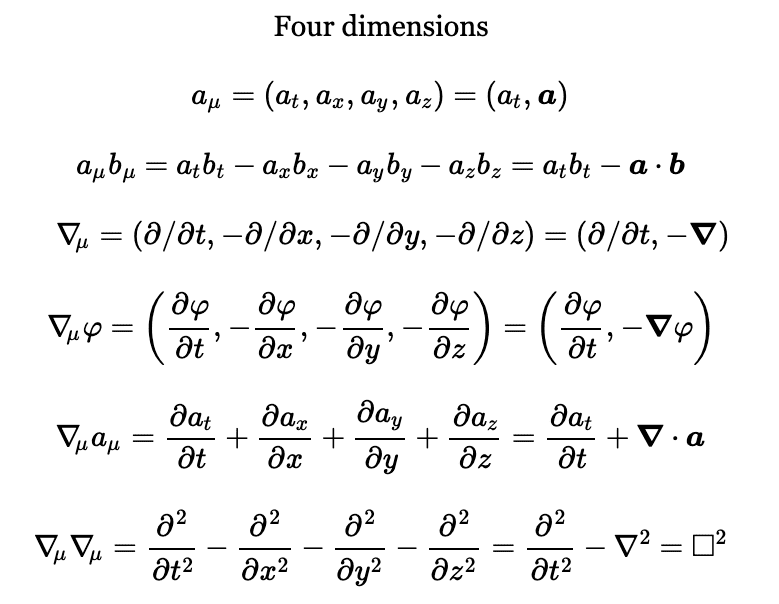
I found some parts of Vol II, Chapter 25 basically unreadable, because I can't figure out his notation. AFAICT he's using a (+,-,-,-) metric, but these equations don't really make any sense:
1605461954420.png


The first one is fine, and so is the second so long as we switch out ##a_{\mu} b_{\mu}## for ##a_{\mu} b^{\mu}##. But I'm pretty certain the second one should be$$\nabla_{\mu} = (\partial_t, \partial_x, \partial_y, \partial_z) = (\partial_t, \nabla)$$whilst the fifth should be$$\nabla_{\mu} a^{\mu} = \partial_t a^t + \partial_x a^x + \partial_y a^y + \partial_z a^z = \partial_t a_t - \partial_x a_x - \partial_y a_y - \partial_z a_z = \partial_t a_t - \nabla \cdot \mathbf{a}$$and finally the sixth is okay, but again only so long as we switch out ##\nabla_{\mu} \nabla_{\mu}## for ##\nabla_{\mu} \nabla^{\mu}##.

One might argue that he's put everything downstairs to avoid confusion (!), but given that index placement is of such importance when we have a metric that is not the identity, I wonder if there's a subtlety to his notation that I missed? Thank you.
 
Physics news on Phys.org
He's not using the metric explicitly, but making it implicit in his expressions. So he can use all-lower indices because he doesn't use raising and lowering explicitly. Note that his expressions for inner products and the gradient operator work out the same as more standard notation in component terms, but only because he's put the signs in by hand.

I don't think I've read Feynman's take on relativity, certainly not in a long time, but if memory serves @vanhees71 always comments that the mathematical presentation is one of the few bits where he think Feynman mis-stepped.
 
  • Like
Likes   Reactions: etotheipi
@fresh_42 but the objects ##\partial_{\mu} = \frac{\partial}{\partial x^{\mu}}## and ##\partial^{\mu} = \frac{\partial}{\partial x_{\mu}}## are different. And also, I believe repeated indices should be summed over one upstairs and one downstairs, so ##a_{\mu} b^{\mu}## is valid, whilst ##a_{\mu} b_{\mu}## isn't.
 
Well, certainly this is not Einstein notation so, how is the notation defined? What it means to have repeated indexes, etc...

If these equations are supposed to be definitions, there's nothing you can do about it, and they seem to perfectly coherent.
 
  • Like
Likes   Reactions: etotheipi
Right, thanks! So, in this context, do all the ##a_{\mu}## refer to contravariant components?
 
I think it doesn't make a difference whether you think of them as contravariant or covariant, and Feynman isn't distinguishing. He'd only need to distinguish if he were making his metric explicit.

What I don't like is how ##a_\mu b_\mu## and ##\nabla_\mu a_\mu## work differently. In one case the minus signs seem to be part of the operator while in the other they seem to be part of the operation.
 
  • Like
Likes   Reactions: stevendaryl and etotheipi
etotheipi said:
@fresh_42 but the objects ##\partial_{\mu} = \frac{\partial}{\partial x^{\mu}}## and ##\partial^{\mu} = \frac{\partial}{\partial x_{\mu}}## are different. And also, I believe repeated indices should be summed over one upstairs and one downstairs, so ##a_{\mu} b^{\mu}## is valid, whilst ##a_{\mu} b_{\mu}## isn't.
As I said, both is possible. It is an abbreviation and convention anyway, nothing written in stone. Look at the link I gave: they mention both notations. As long as there is only one summation, confusion can be excluded. It becomes important with multiple indices, not with one. The more as it is explained in the first line.
 
  • Like
Likes   Reactions: etotheipi
Ibix said:
What I don't like is how ##a_\mu b_\mu## and ##\nabla_\mu a_\mu## work differently. In one case the minus signs seem to be part of the operator while in the other they seem to be part of the operation.

I think what he's going for, is something like$$\begin{align*}\nabla_{\mu} a_{\mu} &= \left(\frac{\partial}{\partial t} a_t \right) - \left(-\frac{\partial}{\partial x} a_x \right) - \left(-\frac{\partial}{\partial y} a_y \right) - \left(-\frac{\partial}{\partial z} a_z \right) \\

&= \frac{\partial a_t}{\partial t} + \frac{\partial a_x}{\partial x} + \frac{\partial a_y}{\partial y} + \frac{\partial a_z}{\partial z}\end{align*}$$I don't like the notation anyway, so I think I'll try to forget about it :-p
 
  • #10
etotheipi said:
I think what he's going for, is something like$$\begin{align*}\nabla_{\mu} a_{\mu} &= \left(\frac{\partial}{\partial t} a_t \right) - \left(-\frac{\partial}{\partial x} a_x \right) - \left(-\frac{\partial}{\partial y} a_y \right) - \left(-\frac{\partial}{\partial z} a_z \right) \\

&= \frac{\partial a_t}{\partial t} + \frac{\partial a_x}{\partial x} + \frac{\partial a_y}{\partial y} + \frac{\partial a_z}{\partial z}\end{align*}$$I don't like the notation anyway, so I think I'll try to forget about it :-p
I wouldn't do that. It might mean that you cannot read a couple of books. Indices are very important in physics, but you cannot determine how different authors use(d) them.
 
  • Like
Likes   Reactions: etotheipi
  • #11
fresh_42 said:
I wouldn't do that. It might mean that you cannot read a couple of books. Indices are very important in physics, but you cannot determine how different authors use(d) them.

Perhaps, but I think the Einstein summation convention with proper index placement and whatnot is so prevalent nowadays that it's not worth stressing about this more obscure (and probably less versatile) notation.
 
  • #12
etotheipi said:
Perhaps, but I think the Einstein summation convention with proper index placement and whatnot is so prevalent nowadays that it's not worth stressing about this more obscure (and probably less versatile) notation.
Well, Einstein was of different opinion than you. He used both.

Here is the original from 1918:

1605467543738.png
"For this we introduce the rule: If an index occurs twice in a term of an expression, it must always be summed up, unless the opposite is expressly noted.
...
Following Ricci and Levi-Civita, the contravariant character is indicated by the upper and the covariant by the lower index."

Since co- and contravariance is only determined by its transformation rules, there is no way to decide whether your equations above refer to either of them. As written, they are simply vectors, neither co- nor contravariant.
 
  • Like
Likes   Reactions: etotheipi
  • #13
Ibix said:
I don't think I've read Feynman's take on relativity, certainly not in a long time, but if memory serves @vanhees71 always comments that the mathematical presentation is one of the few bits where he think Feynman mis-stepped.
Yes, that's a nuissance. I don't understand, why Feynman is doing this. The only other thing which is really wrong in his famous lectures (as far as I'm aware of) is the relativistic treatment of the DC conducting wire, but that's done wrong in almost all textbooks I know of. See

https://www.physicsforums.com/insights/relativistic-treatment-of-the-dc-conducting-straight-wire/

and the AJP paper by Peters quoted therein.
 

Similar threads

  • · Replies 1 ·
Replies
1
Views
30K
Replies
612
Views
142K
  • · Replies 11 ·
Replies
11
Views
2K
  • · Replies 35 ·
2
Replies
35
Views
30K