MATLAB Can Light Rays Cross Near a BH? - Simulated w/ Matlab

Click For Summary
SUMMARY

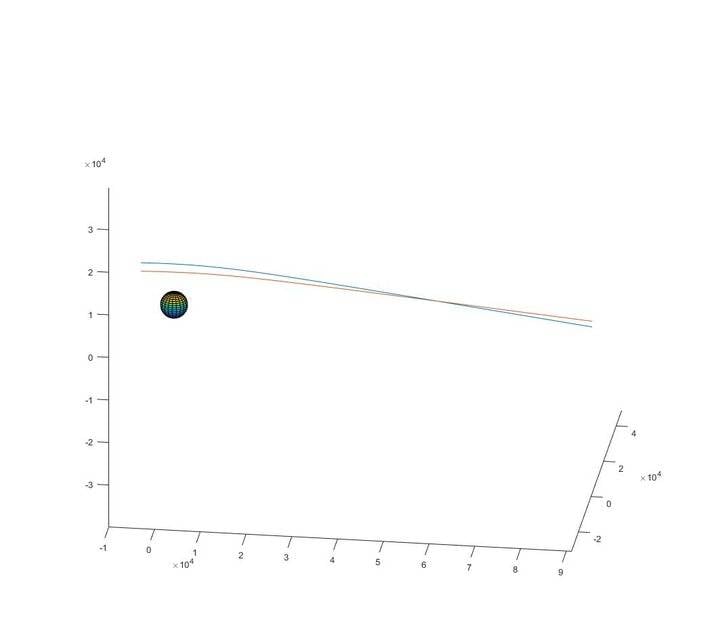
This discussion focuses on simulating the behavior of two parallel light rays passing near a Kerr black hole (BH) using Matlab. The simulation parameters include a BH mass of 1.988×1030 kg, an angular momentum per unit mass of 0.9 along the z-axis, and initial positions of the rays at (-1×10⁴, 2×10⁴, 1×10³) and (-1×10⁴, 2×10⁴, -1×10³). The results indicate that the rays cross each other, with final positions of (-9.12×10⁴, 1.55×10³, -667) and (9.12×10⁴, 1.55×10³, 667). The discussion raises questions about potential errors in the model, particularly regarding the use of the ode45 algorithm for calculations.

PREREQUISITES
  • Understanding of Kerr black hole physics
  • Familiarity with Matlab programming and simulation techniques
  • Knowledge of gravitational lensing concepts
  • Experience with numerical methods, specifically the ode45 algorithm
NEXT STEPS
  • Investigate the properties of Kerr black holes and their effects on light propagation
  • Learn advanced Matlab techniques for simulating physical systems
  • Study gravitational lensing and its mathematical modeling
  • Explore numerical integration methods and their accuracy in simulations
USEFUL FOR

Researchers in astrophysics, physicists studying general relativity, and Matlab users interested in simulating complex physical phenomena, particularly those related to black holes and light behavior.

Haorong Wu
Messages
419
Reaction score
90
TL;DR
When I simulate that two parallel light rays pass near a Kerr BH, the result shows that they cross each other. Is it possible?
Hi. I use Matlab to simulate that two parallel light rays pass near a Kerr BH. The angular momentum of the BH points to the ##z## direction. The ##z## components of the start points of the two rays are ## 1\times 10^3 ~\rm{m}## and ##- 1\times 10^3 ~\rm{m}##, respectively. The result, as shown in the figure, indicates that the rays cross each other. In the end, the ##z## components of the two rays are ##-667~\rm{m}## and ##667~\rm{m}##, respectively.

I am not sure if this is possible or not. Maybe there are some errors in my model. How can I check if my result is correct or not?

Thanks.
untitled.jpg
 
Physics news on Phys.org
You haven't really explained your initial conditions, so it's hard to comment. I think your rays start symmetrically above and below the equatorial plane. What are their initial directions, and what are the mass and angular momentum parameters of the hole?
 
@Ibix

Sorry, I thought that is not important, so I did not mention it. Here are the parameters (all are in Cartesian coordinates):

mass of BH is ##1.988\times10^{30}~\rm{kg}=1.47\times10^3~\rm{m}## ;
angular momentum per unit mass is ##0.9## (along z-axis);
position of BH is ##(0,~0,~0)##;
initial positions of rays are ##(-1\times 10^4,~2\times 10^4,~1\times 10^3)## and ##(-1\times 10^4,~2\times 10^4,~-1\times 10^3)##, respectively;
both initial wave vectors are ##(1.03\times 10^7 ,~1.82\times 10^6 , ~ 0)##;

The results are:
the final positions of rays are ##(9.12\times 10^4,~1.55\times 10^3,~-667)## and ##(9.12\times 10^4,~1.55\times 10^3,~667)##, respectively;
the final wave vectors are ##(1.05\times 10^7,~-2.28\times 10^6,~-1.90\times 10^5)## and ##(1.05\times 10^7,~-2.28\times 10^6,~1.90\times 10^5)##, respectively.

The wave number is increased by ##2.36\times10^5~\rm{m^{-1}}##, but I think that is due to the calculation error of the ode45 algorithm.
 
Last edited:
This is gravitational lensing.
 

Similar threads

  • · Replies 8 ·
Replies
8
Views
2K
  • · Replies 3 ·
Replies
3
Views
2K
  • · Replies 1 ·
Replies
1
Views
3K
  • · Replies 1 ·
Replies
1
Views
2K
  • · Replies 5 ·
Replies
5
Views
5K
  • · Replies 46 ·
2
Replies
46
Views
8K
  • · Replies 2 ·
Replies
2
Views
4K
  • · Replies 25 ·
Replies
25
Views
2K
  • · Replies 25 ·
Replies
25
Views
877
  • · Replies 3 ·
Replies
3
Views
1K