Can we measure absolute motion of Earth and Sun?

  • Context: High School 
  • Thread starter Thread starter zasvitim
  • Start date Start date
  • Tags Tags
    Earth Solar wind
Click For Summary
SUMMARY

This discussion centers on the feasibility of measuring the absolute motion of the Earth and Sun, particularly through the analysis of solar wind particles and light. It establishes that solar wind, traveling at 300-1000 km/s, takes significantly longer to reach Earth than light, which travels at approximately 300,000 km/s. The calculations indicate that if the Sun moves at 100 km/s, it would traverse over 15 million kilometers in the time it takes for solar wind to reach Earth, suggesting measurable differences. However, the consensus is that there is no concept of absolute motion in modern physics, as established by Newton's laws and Einstein's theories.

PREREQUISITES
  • Understanding of Newton's second law (F = ma)
  • Familiarity with Einstein's 1905 paper on electromagnetic phenomena
  • Knowledge of solar wind characteristics and behavior
  • Basic grasp of classical physics concepts regarding motion and reference frames
NEXT STEPS
  • Research the implications of Einstein's theory on electromagnetic phenomena and absolute motion
  • Study the characteristics and measurements of solar wind using NOAA forecasts
  • Explore Maxwell's equations and their relevance to electromagnetic fields
  • Investigate the concept of reference frames in classical and modern physics
USEFUL FOR

Physicists, astronomy enthusiasts, and students studying classical mechanics and modern physics, particularly those interested in the concepts of motion and reference frames.

zasvitim
Messages
44
Reaction score
0
TL;DR
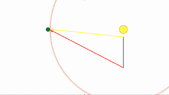
What if we can measure absolute motion of Earth and Sun?
Slow particles (solar wind) should come from a direction that is different than the direction photons come from: it takes slow particles more time to reach the Earth, therefore slow particles should be emitted earlier.

Some calculations:
- Sun diameter is about 1400000 km
- solar wind speed is 300-1000 km per second - at least 300 times slower than light.
- it takes light about 500 seconds to reach Earth. So it should take about 500*300 = 150000 seconds.

If we assume that the absolute speed of the Sun is 100 km per second, the distance it passes within 150000 seconds is at least: 150000 * 100 = 15000000 km - more than 10 Sun diameters.
For particles with speed 300 km per second it's 30 sun diameters

Should be measurable..
 

Attachments

  • My_image.png
    My_image.png
    50.6 KB · Views: 59
Physics news on Phys.org
Animation:
ezgif-6-3a0145e489.gif
 
zasvitim said:
TL;DR Summary: What if we can measure absolute motion of Earth and Sun?
There is no concept of absolute space and time against which an absolute velocity (or absolute motion) could be calculated.
 
  • Like
Likes   Reactions: Lord Jestocost, Dale and SammyS
zasvitim said:
TL;DR Summary: What if we can measure absolute motion of Earth and Sun?

Should be measurable.
And the fact that we don't see any such difference in angle tells you what about the existence of an absolute frame?
 
  • Like
Likes   Reactions: russ_watters
PeroK said:
There is no concept of absolute space and time against which an absolute velocity (or absolute motion) could be calculated.
In classical physics? But can't we just measure where it comes from?
 
Ibix said:
And the fact that we don't see any such difference in angle tells you what about the existence of an absolute frame?
Are there any papers / studies?
 
zasvitim said:
In classical physics?
In all physics since Galileo.
 
  • Like
Likes   Reactions: phinds and russ_watters
zasvitim said:
Are there any papers / studies?
Of what? The solar wind? It's constantly monitored - have a look at the Space Weather thread in the Astronomy and Astrophysics forum where there are regular links to the NOAA forecasts.
 
Ibix said:
In all physics since Galileo.
But it works for light only, no? Slow motion's different? For example sound comes not from where jet is at this exact moment but from where it was?
Otherwise sonic booms would not exist?
 
  • #10
If you throw a stone and make a step, stone will not come from the place you are now, it will come from where you were when you threw it..
 
  • #11
zasvitim said:
If you throw a stone and make a step, stone will not come from the place you are now, it will come from where you were when you threw it..
That is irrelevant.

zasvitim said:
Are there any papers / studies?
The introduction to Einstein's famous paper of 1905 deals with the issue of the lack of an absolute rest frame for electromagnetic phenomena. That was another way of saying there is no concept of absolute motion.

The laws of physics have no cencept of asbolute motion. For example, Newton's second law is
$$F = ma$$If absolute motion were relevant, that equation would have to include a term for the absolute velocity of the particle. In Newtonian physics, it's acceleration that is absolute. You can measure forces and acceleration independent of your inertial reference frame. But, there is no experiment that would determine your absolute velocity. Einstein, in 1905, took this idea a step further and applied it to electromanetic phenomena as well.
 
Last edited:
  • Like
Likes   Reactions: russ_watters
  • #12
PeroK said:
That is irrelevant.


The introduction to Einstein's famous paper of 1905 deals with the issue of the lack of an absolute rest frame for electromagnetic phenomena. That was another way of saying there is no concept of absolute motion.

The laws of physics have no cencept of asbolute motion. For example, Newton's second law is
$$F = ma$$If absolute motion were relevant, that equation would have to include a term for the absolute velocity of the particle. In Newtonian physics, it's acceleration that is absolute. You can measure forces and acceleration independent of your inertial reference frame. But, there is no experiment that would determine your absolute velocity. Einstin, in 1905, took this idea a step further and applied it the electromanetic phenomena as well.
Electromagnetic force comes from current position, but light comes from retarded position
 
  • #13
zasvitim said:
Electromagnetic force comes from current position, but light comes from retarded position
That's not correct. The EM field at a point depends on the retarded position. Maxwell's equations and all the laws of physics are explicitly independent of any absolute velocity.

There is no concept of absolute velocity in modern physics.
 
  • Like
Likes   Reactions: Dale
  • #14
We are attracted to the point where the moon is "now" if it moves straight, not to the point where moon light comes from
 
  • #15
I'm not speaking about absolute velocity now, I'm speaking about absolute direction in space. Direction is absolute, right?
 
  • #16
zasvitim said:
I'm not speaking about absolute velocity now, I'm speaking about absolute direction in space. Direction is absolute, right?
You'd need to define what you mean by "absolute direction". There's no experimental evidence that the universe has an up direction and a down direction, for example.
 
  • #17
Thread closed for Moderation.
 
  • Like
Likes   Reactions: hutchphd
  • #18
Thread is reopened provisionally.
 
  • #19
There is no such thing as an absolute direction or velocity, and direction measurements do not work the way the OP appears to think. I'll draw a diagram to explain later - on my phone at the moment and I don't have appropriate tools here.
 
  • #20
zasvitim said:
We are attracted to the point where the moon is "now" if it moves straight,
No.

For all intents and purposes, "now" is not instant; it moves at the speed of light.
 
  • #21
Here's a diagram that shows what's going on. It's effectively the same as the animation in #2, but with two important additions.
aberration.gif

The first addition is that there are two frames of reference shown here. At the bottom, we see the frame where the Earth (blue circle) and Sun (yellow circle) are at rest, and above it we see a frame where they are moving up the page. The second addition is an angle-measuring device on the Earth - in this case it's an absurdly long telescope pointing at the Sun - that's the narrow black tube extending to the right of the Earth.

At the start of the animation the Sun emits a red particle which flies on a trajectory intercepting Earth at the end of the animation and leaving a red trail. Half way through the animation a faster green particle is emitted, also leaving a trail, and arrives at the Earth at the same time as the red one. In the bottom frame (where Earth and Sun are stationary) it's obvious that the Earth sees the particles coming straight down.

Where the OP has gone wrong is in the analysis of the other frame where the Earth and Sun are moving. Yes, the particles have lateral motion in this frame - but so does the angle detector. This is the key point that you missed, OP. It has exactly the correct motion to catch both particles, so it detects both particle as incoming straight from the Sun - as it must, because that's what happened in the rest frame.

The OP's analysis failed to take into account what the lateral motion does to the function of the angle detector. Angle detectors at rest in the moving frame would see a different impact angle for the two particles, but not angle detectors at rest on the Earth. So they couldn't detect absolute motion even if there were any such thing to detect.
 
  • Like
Likes   Reactions: zasvitim and jbriggs444
  • #22
Ibix said:
Here's a diagram that shows what's going on. It's effectively the same as the animation in #2, but with two important additions.
View attachment 355868
The first addition is that there are two frames of reference shown here. At the bottom, we see the frame where the Earth (blue circle) and Sun (yellow circle) are at rest, and above it we see a frame where they are moving up the page. The second addition is an angle-measuring device on the Earth - in this case it's an absurdly long telescope pointing at the Sun - that's the narrow black tube extending to the right of the Earth.

At the start of the animation the Sun emits a red particle which flies on a trajectory intercepting Earth at the end of the animation and leaving a red trail. Half way through the animation a faster green particle is emitted, also leaving a trail, and arrives at the Earth at the same time as the red one. In the bottom frame (where Earth and Sun are stationary) it's obvious that the Earth sees the particles coming straight down.

Where the OP has gone wrong is in the analysis of the other frame where the Earth and Sun are moving. Yes, the particles have lateral motion in this frame - but so does the angle detector. This is the key point that you missed, OP. It has exactly the correct motion to catch both particles, so it detects both particle as incoming straight from the Sun - as it must, because that's what happened in the rest frame.

The OP's analysis failed to take into account what the lateral motion does to the function of the angle detector. Angle detectors at rest in the moving frame would see a different impact angle for the two particles, but not angle detectors at rest on the Earth. So they couldn't detect absolute motion even if there were any such thing to detect.
There still should be a difference on where particle can get. That should be measurable. I mean particle cannot get to a "shadow" area. Or to "opposite side" of Earth.
"Shadow" areas are different for red and green particles.
 
  • #23
By the way. Very cool animation.
Thanks.
 
  • #24
zasvitim said:
There still should be a difference on where particle can get. That should be measurable. I mean particle cannot get to a "shadow" area. Or to "opposite side" of Earth.
"Shadow" areas are different for red and green particles.
The shadow areas are the same for red and green particles. This is clearly seen in the rest frame shown on the bottom. It will remain true in the moving frame.

It is tempting to think of the target just sitting there in its final location with the green particle sneaking up from underneath. But the target is moving upward. It can block a shot prior to the time when the target reaches its final position. You can't sneak a shot underneath because the target was right there already, blocking the shot with its right hand side.
 
Last edited:
  • #25
Are
jbriggs444 said:
The shadow areas are the same for red and green particles. This is clearly seen in the rest frame shown on the bottom. It will remain true in the moving frame.

It is tempting to think of the target just sitting there in its final location with the green particle sneaking up from underneath. But the target is moving upward. It can block a shot prior to the time when the target reaches its final position. You can't sneak a shot underneath because the target was right there already, blocking the shot with its right hand side.
Are you saying that the "southern hemisphere" of the planet is as reachable as the "northern hemisphere" for red particles? Because it seems like red particles have more possibilities in southern hemisphere.
 
  • #26
I mean.. Reachable areas are definitely different.. And that would show the direction of absolute motion..
Screenshot 2025-01-15 at 04.24.21.png
 
  • Skeptical
Likes   Reactions: PeroK
  • #27
zasvitim said:
Electromagnetic force comes from current position, but light comes from retarded position
This is not true. The electromagnetic force also depends only on the retarded position of any source charges. See Jefimenko’s equations the fields are exclusively from the retarded time.

However, the direction of the field is not the same as the direction from the point to the source charge at the retarded time. That direction is the direction that the source charge would be if it continued to move inertially after the retarded time. However, since the charge may move non-inertially, it is clear that this is not the position that it is now, but rather an extrapolation from the retarded time and retarded velocity.
 
  • Like
Likes   Reactions: A.T. and PeroK
  • #28
zasvitim said:
I mean.. Reachable areas are definitely different.. And that would show the direction of absolute motion..
View attachment 355879
You forgot the motion of the planet again. Add my telescope to the diagram in the post I quoted and your reasoning will show that no particles can enter the telescope because it's all in the "shadow" of the lower edge - yet the animation shows that they can enter. What has happened is that you drew the Earth where it is at the end of the particles' motion, and assumed that this is the only time and place where it blocks the particle trajectories. You treated it as transparent at all other times.

@jbriggs444 has already noted the simplest way to see that the shadow area is the same - do the analysis in the test frame. Then you note that the moving frame animation would be identical whether the Earth and Sun are moving, or the "camera" is moving in the opposite direction. Obviously the camera can make no difference to the result, and hence neither can the Earth and Sun moving. In fact, there is literally no difference between the two cases, an observation known as the principle of relativity. No experiment has ever detected a violation of this principle, and there have been some very sensitive efforts.
 
  • Like
Likes   Reactions: jbriggs444
  • #29
zasvitim said:
I mean.. Reachable areas are definitely different.. And that would show the direction of absolute motion..
View attachment 355879
What is your diagram supposed to show? You have to consider multiple timepoints from two frames, like Ibix' animation does. Can you modify the animation to add the two points you are worried about? Free Software like GIMP should be able to edit the GIF file.
 
  • #30
A.T. said:
Free Software like GIMP should be able to edit the GIF file.
It created it, so definitely!
 

Similar threads

  • · Replies 20 ·
Replies
20
Views
2K
  • · Replies 28 ·
Replies
28
Views
2K
  • · Replies 1 ·
Replies
1
Views
1K
  • · Replies 1 ·
Replies
1
Views
2K
  • · Replies 12 ·
Replies
12
Views
2K
  • · Replies 25 ·
Replies
25
Views
1K
  • · Replies 21 ·
Replies
21
Views
2K
Replies
17
Views
4K
  • · Replies 2 ·
Replies
2
Views
1K
  • · Replies 4 ·
Replies
4
Views
3K