Can You Make a Frictionless Loop Turn?

  • Thread starter Thread starter Keasy
  • Start date Start date
  • Tags Tags
    Frictionless Loop
Click For Summary
SUMMARY

The discussion centers on the feasibility of causing a homogenous hollow cylinder to rotate about its vertical axis without friction. The consensus is that while traditional methods may not work, using an electrically conductive tube can allow it to spin like the rotor of an induction motor, similar to the rotating anodes in glass X-ray tubes. Additionally, a rotating magnetic field can be generated using fixed stator coils, which induces currents in the rotor, facilitating rotation. The conversation also touches on the potential for airflow to drive the cylinder through tangential jets, leveraging the Coandă effect.

PREREQUISITES
  • Understanding of induction motor principles
  • Knowledge of rotating magnetic fields
  • Familiarity with the Coandă effect
  • Basic concepts of torque and force configurations
NEXT STEPS
  • Research the principles of induction motors and their applications
  • Explore the Coandă effect and its implications in fluid dynamics
  • Investigate methods for generating rotating magnetic fields
  • Study the design and operation of rotating anodes in X-ray tubes
USEFUL FOR

Engineers, physicists, and designers interested in rotational dynamics, particularly those exploring innovative methods for generating torque and rotation in frictionless environments.

Keasy
Messages
21
Reaction score
6
TL;DR
If you have a hollow cylinder which is frictionless , non-magnetic and motionless, Is there any way to cause it to rotate about its longitudinal axis?
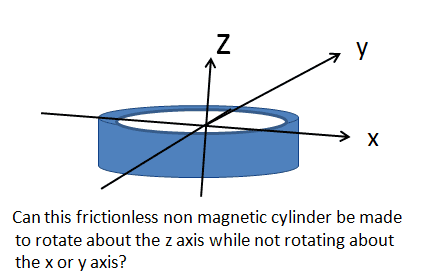
Suppose we are give a homogenous hollow cylinder or "normal" dimensions (for example 3" inside dia., 4" outside dia., 5" high". The composition is any non-exotic, non-magnetic, solid material. Is there any way to cause it to rotate about its vertical axis? Whatever the material is, any non-linear effects or surface deformation is avoided.

By frictionless we mean, as usual I think, any force we attempt to apply to the cylinder will only result in a force on the cylinder perpendicular to the vertical axis (z).
1626108249795.png

To simplify the question a bit while still retaining the key issue, the center of the cylinder is at the origin ox a x-y-z coordinate system with the z axis also the longitudinal axis of the cylinder. There can be no rotation of the cylinder about the x or y axis. Linear motion along the x, y, or z axis is fine.

To me it looks like the answer to this question is "no", but if I am wrong (not unheard of), there are some very interesting , very useful designs which are possible.
 
Engineering news on Phys.org
I wonder if a rotating electric field (possibly non-uniform) could generate a torque...
 
How will you know the object is rotating? Use that measurement mode to make it rotate.
 
  • Like
Likes   Reactions: Dullard
Keasy said:
To me it looks like the answer to this question is "no", but if I am wrong (not unheard of), there are some very interesting , very useful designs which are possible.
Yes. If the tube was electrically conductive it could be spun like the rotor of an induction motor. That is how the rotating anodes inside glass X-ray tubes are driven.

Even if it was friction free, airflow past the cylinder would have a boundary layer, so it could be driven by tangential jets of air.
https://en.wikipedia.org/wiki/Coandă_effect#Mechanism

Are you planning on making a gas centrifuge, maybe to separate isotopes of uranium ?
 
hutchphd said:
How will you know the object is rotating? Use that measurement mode to make it rotate.
I was thinking of sensitive optics to see if it is rotating. And of course in principle this could make it rotate, essentially using the momentum of photons. But this effect is so small its not really a useful solution.
 
Baluncore said:
Yes. If the tube was electrically conductive it could be spun like the rotor of an induction motor. That is how the rotating anodes inside glass X-ray tubes are driven.

Even if it was friction free, airflow past the cylinder would have a boundary layer, so it could be driven by tangential jets of air.
https://en.wikipedia.org/wiki/Coandă_effect#Mechanism

Are you planning on making a gas centrifuge, maybe to separate isotopes of uranium ?
Thanks for those valid suggestions. I'm not looking at anything related to gas centrifuges; it is more related to understanding some force/torque configurations with some possibly useful configurations.
 
Baluncore said:
Yes. If the tube was electrically conductive it could be spun like the rotor of an induction motor. That is how the rotating anodes inside glass X-ray tubes are driven.

Interesting. Is there any way to tell it which way to turn?
 
hutchphd said:
Interesting. Is there any way to tell it which way to turn?
Yes.
A two or three phase rotating magnetic field outside the cylinder is created by using fixed stator coils. The rotating external field induces currents in the rotor, which then reacts by rotating with the field. You can also make an induction motor inside-out, with the fixed field inside a tubular rotor.

With a three phase supply there is a 120° phase shift between the phases. To reverse the sense of field rotation, swap any two of the three phase inputs.

Since you have very low friction in the rotor, there will be very low slip, so rotation will be close to synchronous with the supply frequency. What range of RPM do you require ?

https://en.wikipedia.org/wiki/Induction_motor#Principle_of_operation
 
Just finding a way to cause the cylinder to rotate was my basic issue. I was thinking primarily of a set o torques or forces but this certainly is a more direct method.
 

Similar threads

  • · Replies 1 ·
Replies
1
Views
1K
  • · Replies 8 ·
Replies
8
Views
3K
  • · Replies 16 ·
Replies
16
Views
3K
  • · Replies 3 ·
Replies
3
Views
3K
Replies
14
Views
2K
  • · Replies 22 ·
Replies
22
Views
5K
  • · Replies 7 ·
Replies
7
Views
3K
  • · Replies 7 ·
Replies
7
Views
2K
  • · Replies 97 ·
4
Replies
97
Views
6K
  • · Replies 1 ·
Replies
1
Views
3K