Capacitive soil moisture sensor using TLC555

Click For Summary
SUMMARY

The forum discussion centers on the design and functionality of a capacitive soil moisture sensor utilizing the TLC555 timer IC. The sensor operates by measuring capacitance changes in response to soil moisture levels, with reported capacitance values of 120pF in air and 4.5nF when submerged in water. Users noted that the sensor's voltage output remains constant when enclosed in a plastic bag, suggesting that conductivity may mask capacitance changes. Recommendations include using an insulating coating on conductive surfaces and considering an oscillator bridge design to improve sensitivity to capacitance variations.

PREREQUISITES
  • Understanding of capacitive sensing principles
  • Familiarity with TLC555 timer IC functionality
  • Basic knowledge of circuit design and measurement techniques
  • Experience with multimeters for capacitance and voltage measurement
NEXT STEPS
  • Research oscillator bridge circuits for improved capacitance measurement
  • Learn about insulating coatings suitable for moisture sensors
  • Explore the effects of conductivity on capacitive sensing
  • Investigate alternative sensor designs for soil moisture detection
USEFUL FOR

This discussion is beneficial for electronics hobbyists, circuit designers, and agricultural engineers interested in developing or improving capacitive soil moisture sensors.

akaliuseheal
Messages
53
Reaction score
8
Hello everybody,

I have made soil moisture sensor and it kinda works. It is a capacative sensor not resistive sensor based upon TLC555 which has a role to create square wave. Square wave is brought to a homemade capacitor. Capacitance changes with change of moisture. Output is measured voltage on impedance (I have included the schematics).
Since it is capacative sensor, it should work when it is not directly exposed to water (in a plastic bag for expample) but it does not. Voltage remains constant when I submerge it in water while it is in a plastic bag but works when submerged without the bag. Homemade capacitor is made of copper plate like in the video. This should work, right? Have I made a mistake soldering it together?
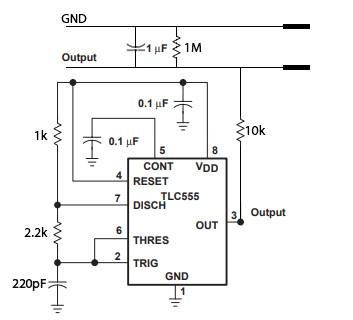
schematics.jpg

TLC555: http://pdf1.alldatasheet.com/datasheet-pdf/view/28905/TI/TLC555.html
Youtube link: (06:52 for capacative type sensor)


Edit: Voltage is 5V
 
Engineering news on Phys.org
Why aren't the sensor GND and the IC GND connected?
 
  • Like
Likes   Reactions: davenn
They are, every ground including that "GND" is connected.
 
Do you have any idea what the capacitance is dry? and moist?
 
anorlunda said:
Do you have any idea what the capacitance is dry? and moist?
Vaule of C when submerged and when it is in the air? If that is what you asked, what I measured is 120pF when in air and 4.5nF when fully submerged. I measured it with cheep multimeter and wires used for connecting were around 70pF. Voltage measured when in air is 4.66V (when touching it with hand, voltage drops to around 3V and drops again when the slightest amount of water gets on it) , when fully submerged it gets down to 90mV and starts rising slowly.

220pF in schematics is changed to 330pF.
Vcc is 5V
 
Try it with no (or very little) air in the bag. The closer the water is to the sensor the more responsive the circuit will be.

Do you get the same results with and without bag when using distilled water?

Also what is the measured capacitance of the sensor when in the bag, both when in air and submersed in water?
 
It had no air, I used a tape like one in image provided
tn_1970.jpg


I see no reason to test it with distilled water since it won't be used with distilled water and I do not have it.

Capacitance does change even when it is covered with tape or a bag. I don't have the numbers right now but that part of a sensor works just fine.
 
However, measured voltage does not, only when copper plate is directly exposed to water.
 
akaliuseheal said:
However, measured voltage does not, only when copper plate is directly exposed to water.
That's why the distilled water test. I suspect the reason it works only when in contact with the water is because conductivity is being sensed, masking any capacitance change. Clean distilled water has very low conductivity and would confirm/eliminate that possibility. If you are in the USA, distilled water is available for about USD $1 in larger grocery stores. Or you can boil some water on the stove and collect the steam as condensate.

Cheers,
Tom
 
  • Like
  • Informative
Likes   Reactions: DaveE, dlgoff and anorlunda
  • #10
Tom.G said:
conductivity is being sensed, masking any capacitance change

Sorry for the late reply, I haven't had a chance to test it since I was busy. If that is true, does that mean that I will need a larger capacitance. I have not used the same size copper plate as shown in the video, it is more like the size of that arduino sensor.
 
Last edited:
  • #11
You need a circuit where small changes in capacitance cause a measurable effect, and changes in resistance can be separated or ignored. Perhaps an oscillator bridge which changes frequency when capacitance changes. To design it you need estimates of the minimum and maximum capacitance.

Caveat: I am not a circuit designer. I know the principles, but other PF members can help with more specifics.
 
  • Like
Likes   Reactions: sophiecentaur
  • #12
Measure the resistance of the sensor itself both in and out of water. Use your Ohmmeter on its highest range.

You need an insulating coating on all sensor/conductive surfaces that get damp/wet, the thinner the coating the better. Just painting it with some oil based paint may last long enough for testing. Or glue a layer of a thin plastic bag over the sensor. Spread on a thin layer of glue, then rub the plastic to squeeze out excess glue and air bubbles.

For longer term use, a coat of epoxy would be better.

Cheers,
Tom
 
  • #13
you forgot the diode
 
  • #14
In the circuit shown in post #1 there are two things I cannot quite understand:
  • You have drawn GND and Output as attached to a connector. What about VDD?
  • The Output is connected to GND through a capacitor and a resistance, which means that
    • Essentially no pulses will appear on Output
    • A highly capacitive load is connected to OUT. Is that allowed according to the specs?
 
  • #15
akaliuseheal said:
I measured is 120pF when in air and 4.5nF when fully submerged.

You have a 1uf capacitor in parallel with your probe. the dry capacitance is therefore 1.000120uF and the wet capacitance is 1.0045uF. This is less than half a percent difference.

Also the probe is connected to the output.

marcuspoulton said:
you forgot the diode

I found the circuit akaliuseheal is trying to build. The diode and a 1nF capacitor makes much more sense.

BoB
 

Similar threads

  • · Replies 39 ·
2
Replies
39
Views
4K
  • · Replies 5 ·
Replies
5
Views
2K
  • · Replies 5 ·
Replies
5
Views
6K
  • · Replies 2 ·
Replies
2
Views
3K
  • · Replies 3 ·
Replies
3
Views
3K
Replies
5
Views
3K
  • · Replies 6 ·
Replies
6
Views
11K
Replies
2
Views
6K
  • · Replies 19 ·
Replies
19
Views
5K
  • · Replies 24 ·
Replies
24
Views
9K