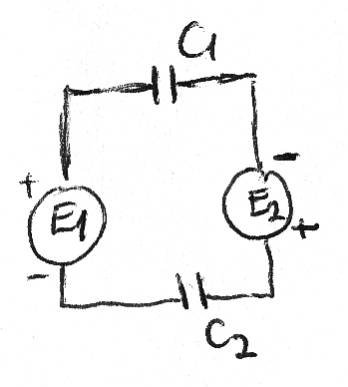
symth,
can you please explain me what happens in the circuit I've attached?
Yes.
It looks easy but still puzzles me.
It
is easy. Why does it puzzle you?
I mean if one voltage supplier was missing i know that the two capacitors are connected in series, and they will charge.
The capacitors are in series no matter how many voltage sources there are, or what the value of each source is. Since the voltages are connected in series, the total voltage is the sum of each voltage source value.
Capacitors do not charge. The net charge of a capacitor is zero whether there is zero volts across the plate or X number of volts across the plates. That is because for every electron pushed on one plate, another electron is pulled from the other plate for a net charge change of zero. The imbalance of electrons between the plates causes a voltage to form, which stores electrical energy in an electrostatic field. Therefore, a capacitor becomes energized, not charged.
Please consider:
case 1: E1=E2
case 2 E1>E2
The total voltage available to energize the caps is the sum of the voltage sources, no matter what the values are in relation to each other.
i just want to understand how it woks/eliminate bugs i have in understanding electricity.
A noble goal. Another goal would be to to work on your capitalization.
The capacitors are initially uncharged.
OK, no initial charge imbalance? At the end of the transient time, each capacitor in series will have the same charge imbalance.
Like i said, if the circuit would have had only one voltage supplier, I'm pretty sure the answer is that there will be a current until the capacitors charge completely , and then the flow stops . The same happens here? the + of a voltage source and the - of another one can charge a capacitor? if i were to measure the voltage across one capacitor how much it will be?
Yes, the two voltages sources in series act as one voltage source, just like a connecting batteries in series. Both voltage sources are in the same current loop.
The total voltage is Et, and the total capacitance in series is Ct. The voltage across each cap after the transient period will be Et*Ct/C1 and Et*Ct/C2 .
Ratch