Capacitor Network - Series or Parallel?

Join the discussion
Ask a follow-up here, or get your own question answered by working scientists, mathematicians and engineers — people, not an autocomplete.
Real named experts · corrections over time · the nuance an AI answer skips
6 replies · 2K views
Shreya
Messages
187
Reaction score
64
Homework Statement
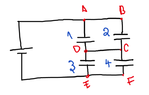
Find the equivalent capacitance.
Relevant Equations
Series & Parallel Capacitor formulae
My textbook solution states that 1 & 2 are in parallel and so is 3 & 4 and those 2 are in series. That is, (1 P 2) S (3 P 4). My thinking is such: points A & B are of same potential, say V, C & D are of same potential, say x and E & F are are of same potential, say 0. So I can say that 1 and 3 are in series and so is 2 &4. Therefore, I can say (1 S 3) P (2 S 4). I'm sure there is a flaw in my method. Please be kind to point it out.
 

Attachments
  • Screenshot from 2022-10-12 19-54-51.png
    Screenshot from 2022-10-12 19-54-51.png
    9.7 KB · Views: 177
Physics news on Phys.org
Shreya said:
Homework Statement:: Find the equivalent capacitance.
Relevant Equations:: Series & Parallel Capacitor formulae

My textbook solution states that 1 & 2 are in parallel and so is 3 & 4 and those 2 are in series. That is, (1 P 2) S (3 P 4). My thinking is such: points A & B are of same potential, say V, C & D are of same potential, say x and E & F are are of same potential, say 0. So I can say that 1 and 3 are in series and so is 2 &4. Therefore, I can say (1 S 3) P (2 S 4). I'm sure there is a flaw in my method. Please be kind to point it out.
C and D are only guaranteed to be at the same potential because there is a wire connecting them.

If you had (1 S 3) P (2 S 4) then there would be no wire connecting the middle nodes in the two series chains and there would be no guarantee that the two middle nodes would be at the same potential.

If you had such a guarantee (say because the two series chains had capacitors with identical ratios of capacitance) then the two middle nodes would be at the same potential and the circuit would behave identically to the series chain of two parallel pieces (1 P 2) S (3 P 4).

It might be helpful to re-draw the circuit to eliminate the redundant nodes B, D and F (if two nodes are connected by a wire, there is only one node). Then the true nature of the circuit becomes more obvious.
 
  • Like
Likes   Reactions: Shreya
That makes sense @jbriggs444 . But I don't see why 1 P 2 would be in series with 3 P 4 though
 
Shreya said:
That makes sense @jbriggs444 . But I don't see why 1 P 2 would be in series with 3 P 4 though
There is no resistance between A and B, C and D, or E and F. You can combine each pair into a single node. The nature of the circuit will become clear when you do this.
 
  • Like
Likes   Reactions: Shreya and jbriggs444
Shreya said:
Homework Statement:: Find the equivalent capacitance.
Relevant Equations:: Series & Parallel Capacitor formulae

So I can say that 1 and 3 are in series and so is 2 &4. Therefore, I can say (1 S 3) P (2 S 4). I'm sure there is a flaw in my method. Please be kind to point it out
Two components are in series only if they carry the same current at any time.
That is not the case with 1 and 3 (or 2 and 4).
 
  • Like
Likes   Reactions: Shreya