Capacitors in Series and finding voltage

Click For Summary
In a physics discussion about capacitors in series, participants focused on finding the voltage across the first capacitor. They established that capacitors in series have the same charge but different voltages unless they have the same capacitance. The equivalent capacitance was determined to be 6/11 C, leading to the equation Q = (6/11 C) * V_total. By applying the formula Q = C * V, they derived the voltage across the first capacitor as V1 = (6/11) * V_total. The conversation highlighted the importance of understanding charge relationships and working backwards to solve for voltage.
lylos
Messages
77
Reaction score
0
We've been studying capacitors in series in my physics class. I have a problem tonight and I know the answer, I just don't know how to get to it.

The problems is as follows:
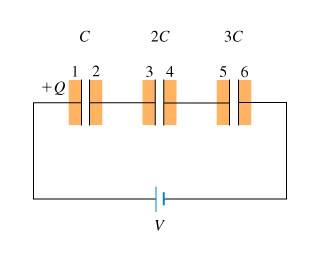
37016.jpg

Find the voltage V1 across the first capacitor.
Express your answer in terms of V.
 
Physics news on Phys.org
capacitors in sereis always have the same charge. They do not the same voltage unless they have the same capacitance.

What would be your first step?
 
ranger said:
capacitors in sereis always have the same charge. They do not the same voltage unless they have the same capacitance.

What would be your first step?

The first step is finding that they all have the same charge. Then, I think, I would find the equivalent capacitance which is equal to 11/6 C. From there I don't know where I would get the voltage for each one.
 
Do you know also know of a formula that relates capacitance, voltage, and charge?
 
ranger said:
Do you know also know of a formula that relates capacitance, voltage, and charge?

ofcourse, c=q/v... So Ceq=Q/Veq...
 
lylos said:
ofcourse, c=q/v... So Ceq=Q/Veq...

Good. But instead of Ceq=Q/Veq (not sure what you mean by Veq). It should be Ceq=Q/V, where V is the total source voltage.

We know what Ceq and V is simply V, what's left to be determined? Remember that this quantity would be the same for all caps.
 
ranger said:
Good. But instead of Ceq=Q/Veq (not sure what you mean by Veq). It should be Ceq=Q/V, where V is the total source voltage.

We know what Ceq and V is simply V, what's left to be determined? Remember that this quantity would be the same for all caps.

Ok by the Veq I meant the total voltage... So what we have is that the total voltage is equal to V. The C equivalence is equal to 11/6 C. And that the charge on each capacitor is Q. Now from that information, I am still at a loss as to how to determine the voltage across the first capacitor.

The answer is 6/11 V according to the system my homework is in...
 
Are you sure the Ceq = (11C)/6? Recheck it. If the charge on each cap is Q, then what is Q? Knowing Q, you will be able to find V for any cap.
 
ranger said:
Are you sure the Ceq = (11C)/6? Recheck it. If the charge on each cap is Q, then what is Q? Knowing Q, you will be able to find V for any cap.

Ok, I see that I made the mistake there... It is 6/11 C. So we would then set that 6/11 C = Q(for each capacitor) / (Vtot).

So Q = 6 (Vtot) (C) / 11 for each capacitor.

Now that we have that, we could then find the voltage by knowing the q=v/c equation.

C = (6/11 C Vtot / 11)/V1
C V1 = 6/11 C Vtot
V1 = 6/11 Vtot

And that's the answer! Thank you for your help!
The problem that I had was knowing to get the charge for each capacitor and then work backwards...
 
  • #10
You're very much welcome. And well done on your part :approve:
 

Similar threads

Replies
2
Views
894
Replies
20
Views
2K
Replies
4
Views
2K
Replies
5
Views
617
Replies
4
Views
2K
Replies
2
Views
2K
  • · Replies 4 ·
Replies
4
Views
3K
  • · Replies 11 ·
Replies
11
Views
4K
  • · Replies 4 ·
Replies
4
Views
2K