Carbon dioxide in water, analysis of dissolved species HPLC?

Click For Summary

Discussion Overview

The discussion revolves around the analysis of dissolved carbon dioxide (CO2) in water, focusing on the speciation of carbonic acid and its related species. Participants explore methods for measuring the concentrations of these species using techniques such as HPLC and discuss the challenges associated with detecting carbonic acid and its derivatives in a stable manner.

Discussion Character

  • Exploratory
  • Technical explanation
  • Debate/contested
  • Mathematical reasoning

Main Points Raised

  • One participant seeks guidance on how to analyze dissolved CO2 and its species in water, expressing uncertainty about the detection of carbonic acid and the differentiation between bicarbonate and hydrogen carbonate.
  • Another participant questions the timescale of speciation and suggests that immediate measurement after CO2 bubbling may complicate the analysis.
  • Concerns are raised about the stability of dissolved species and the potential for reactions to occur during the transfer of the solution for analysis.
  • Some participants propose measuring pH as a means to calculate the relative concentrations of carbonic acid forms, noting the challenge of distinguishing between H2CO3 and CO2(aq).
  • There is mention of using acid dissociation constants to derive ratios of carbonate species, though the reliability of methods for speciation is questioned.
  • One participant shares a document that may assist others facing similar issues with CO2 in water equilibrium.
  • Discussions include the total concentration of all forms of carbonic acid and the implications of measuring only certain parameters to calculate others.

Areas of Agreement / Disagreement

Participants express varying levels of agreement on the methods for analyzing dissolved CO2 and its species, with some suggesting that measuring pH can simplify calculations, while others remain uncertain about the feasibility of accurate speciation. The discussion reflects multiple competing views on the best approach to take.

Contextual Notes

Participants acknowledge the complexity of measuring dissolved species due to potential reactions and the need for assumptions regarding dissociation constants. There is also uncertainty regarding the definitions and measurements of certain species, which may affect the analysis.

rwooduk
Messages
757
Reaction score
59
Does anyone here have any analytical experience with dissolved gas, particularly CO2?

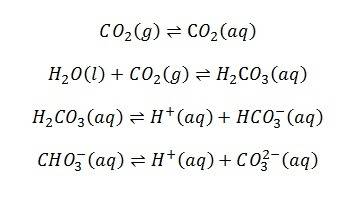
When CO2 is dissolved in water there can be several reactions:
EsgCVyk.jpg


What I would ideally like to do is dissolve CO2 into water and then by some means of analysis, see how much of each species there is in the water. However, carbonic acid seems very difficult to detect, see:

http://www.chemistryviews.org/details/ezine/973843/Tracking_Carbonic_Acid.html

I could use a bicarbonate indicator for the bicarbonate but this is just a colour change and won't give an amount. Hydrogen carbonate seems to be the same as bicarbonate so I've no idea how I would differentiate between the two. And also I have no idea on the carbonate.

Would these things even exist in stable amounts of would they keep reacting and reversibly reacting?

If someone could point me in the right direction, or just give me a place to start it would really be appreciated as this really isn't my field (not a chemist).

I have access to HPLC, GC etc etc
 
Chemistry news on Phys.org
"Speciation" on what timescale?
 
  • Like
Likes   Reactions: rwooduk
Bystander said:
"Speciation" on what timescale?

Thanks, I have not heard of this before. Literally as soon as I stop bubbling the CO2 into the water I want to measure the amounts present. However, I will then be transferring the liquid (with a beaker) and pouring it into a reaction vessel. Also for analysis I'm going to have to walk over to the chemistry building with the solution in hand. I'm getting the feeling this is not going to be easy. Any idea of how I determine the "speciation" over time? Or what methods of analysis I could use? Thanks again for any help.
 
rwooduk said:
I'm getting the feeling this is not going to be easy.
It's not going to be holding any more still than carbonated water (that is, not at all). Supposedly, "Mentos" will accelerate the degassing of "some" colas (see Mythbusters). Agitation/mixing/stirring will accelerate any process, be it solution/dissolution or exsolution. Total amount in solution is easy, total assay. Speciation? I've never seen anything to be regarded as believable; every method depends on "knowing/assuming" pKa1,2 and pKhyd. There might be spectroscopic methods, but, again, they will depend upon assumptions about absorption cross-sections.
 
  • Like
Likes   Reactions: rwooduk
Do you have to measure them all? Once you measure pH you can rather easily calculate relative concentrations of all other carbonic acid forms present (the only tricky thing being H2CO3 vs CO2(aq), as they are typically treated as a single entity).
 
  • Like
Likes   Reactions: rwooduk
Bystander said:
It's not going to be holding any more still than carbonated water (that is, not at all). Supposedly, "Mentos" will accelerate the degassing of "some" colas (see Mythbusters). Agitation/mixing/stirring will accelerate any process, be it solution/dissolution or exsolution. Total amount in solution is easy, total assay. Speciation? I've never seen anything to be regarded as believable; every method depends on "knowing/assuming" pKa1,2 and pKhyd. There might be spectroscopic methods, but, again, they will depend upon assumptions about absorption cross-sections.

Sorry could you tell me what you mean by "total assay"?

Borek said:
Do you have to measure them all? Once you measure pH you can rather easily calculate relative concentrations of all other carbonic acid forms present (the only tricky thing being H2CO3 vs CO2(aq), as they are typically treated as a single entity).

Really we are looking for changes in amounts during reactions (once ultrasound is applied to the CO2 / water mixture). I understand calculations based on pH can be done but I'm unsure of how you would get an amount of one species in the mixture. If you have a free minute could you perhaps give an example?

Many thanks for the advice!
 
Start with the acid dissociation

HCO3- ↔ H+ + CO32-

and the acid dissociation constant (know, given in tables):

K_a = \frac {[H^+][CO_3^{2-}]}{[HCO_3^-]}

Solve for the CO32-/HCO3- ratio and you have pH and Ka on the right (both known).

This is just a starting point, but I am running out of time.
 
  • Like
Likes   Reactions: rwooduk
Borek said:
Start with the acid dissociation

HCO3- ↔ H+ + CO32-

and the acid dissociation constant (know, given in tables):

K_a = \frac {[H^+][CO_3^{2-}]}{[HCO_3^-]}

Solve for the CO32-/HCO3- ratio and you have pH and Ka on the right (both known).

This is just a starting point, but I am running out of time.

That's great I'll take it from there, thanks again!
 
  • #10
Ok, think I'm nearly there with this. I can assume an ideal solution and use the following:

tbbB6bi.jpg


Therefore I can get K0,K1,K2 AND Kw by inserting the above into:

lzu6Kez.jpg


The next part is where I'm a little confused, I want to use these:

PTLhFtN.jpg


To calculate these:

BqKErbL.jpg


This is good, I can measure the pH and get [H+] and I know the K values by calculating from the above BUT 1. how did they get 9.36 from 9.33-9.35? 2. What is CT? 3. I still see 2 unknowns in 9.36 namely CT and [HCO3].

Finally, Borek kindly gave me a starter here:

mTt4PZI.jpg


What is the difference in method between what I have posted above and this? And again I'm still left with two unknowns.

Thanks for any advice, I'm a little lost.

p.s. would it be better to just use the ratios:

fXKCxav.jpg


But again 2 unknowns :-/
 
Last edited:
  • #11
CT is total concentration of all forms (also known as the analytical concentration):

C_T = [H_2CO_3] + [HCO_3^-] + [CO_3^{2-}]

Unfortunately that's something you need to know/measure (but in most applications total concentrations of the acid involved is much easier to control/determine than every ion separately). What I was trying to tell you was that you don't need to measure everything, there is a set of equations describing the equilibrium, so it is enough to know some parameters to be able to calculate everything else as well.
 
  • Like
Likes   Reactions: rwooduk
  • #12
I see, that makes sense, okay I will try to use the equilibrium conditions and see how I get on.

Thanks again for your help!
 

Similar threads

  • · Replies 8 ·
Replies
8
Views
4K
  • · Replies 6 ·
Replies
6
Views
5K
  • · Replies 2 ·
Replies
2
Views
5K
Replies
2
Views
3K
Replies
2
Views
4K
  • · Replies 15 ·
Replies
15
Views
126K
  • · Replies 4 ·
Replies
4
Views
2K
Replies
33
Views
41K
  • · Replies 5 ·
Replies
5
Views
7K
Replies
5
Views
16K