Center of gravity of an irregular object of mass

Click For Summary
The discussion revolves around calculating the center of gravity for an irregular object with a mass of 4.50 g, requiring the addition of a 1.60-g mass to shift the center of gravity 2.00 cm to the left. The original poster struggled with the problem due to a lack of instruction on the relevant concepts. After seeking assistance and taking a break, they revisited the material and successfully derived the equation for the center of mass. By applying the formula and substituting the values, they determined the correct position for the additional mass to be approximately 7.63 cm to the left of the original center of gravity. The discussion highlights the importance of understanding the center of mass equations in solving such problems.
Superfluous
Messages
11
Reaction score
1
The center of gravity of an irregular object of mass 4.50 g is shown in the figure. You need to move the center of gravity 2.00 cm to the left by gluing on a tiny 1.60-g mass, which will then be considered as part of the object. Where should you attach this additional mass? Express your answer in cm to the left of the original center of gravity.
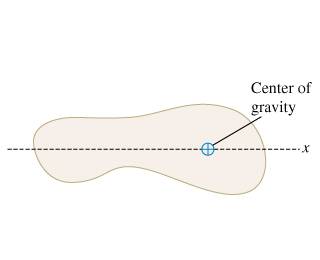
YF-11-20.jpg


Well, to tell the truth, I don't know how to go about solving this at all. My physics instructor skipped over the section that included this, but still assigned the homework. The chapter that this problem is in includes a bunch of rigid-body equilibrium problems, which I have been solving by using Newton's laws and summing up torques, but this problem has really thrown me for a loop. Would someone please describe the process I use to solve this type of problem, or the relevant equations even?

Thanks.
 
  • Like
Likes archoy2001
Physics news on Phys.org
Superfluous said:
The center of gravity of an irregular object of mass 4.50 g is shown in the figure. You need to move the center of gravity 2.00 cm to the left by gluing on a tiny 1.60-g mass, which will then be considered as part of the object. Where should you attach this additional mass? Express your answer in cm to the left of the original center of gravity.

YF-11-20.jpg


Well, to tell the truth, I don't know how to go about solving this at all. My physics instructor skipped over the section that included this, but still assigned the homework. The chapter that this problem is in includes a bunch of rigid-body equilibrium problems, which I have been solving by using Newton's laws and summing up torques, but this problem has really thrown me for a loop. Would someone please describe the process I use to solve this type of problem, or the relevant equations even?

Thanks.

Can you think of anything unique or special about the CG?
 
No, unforunately I do not understand what you're trying to point me towards.
 
What is the relevant equation here -- the equation for the center of mass of a set of objects?
 
I am happy to report that I figured it out. I guess taking a break for awhile and coming back to it can do wonders. I re-read the section and took a stab at it:

\frac{m_{1}(0)+m_{2}(x)}{m_{1}+m_{2}}=2

Solved for x:

x=\frac{2(m_{1}+m_{2})}{m_{2}}

Plugged in values... got a result of about 7.63 cm. Seemed reasonable, so I tried it. Turned out to be correct. Thanks to everyone who tried to help.
 
The book claims the answer is that all the magnitudes are the same because "the gravitational force on the penguin is the same". I'm having trouble understanding this. I thought the buoyant force was equal to the weight of the fluid displaced. Weight depends on mass which depends on density. Therefore, due to the differing densities the buoyant force will be different in each case? Is this incorrect?

Similar threads

  • · Replies 25 ·
Replies
25
Views
1K
Replies
5
Views
2K
Replies
2
Views
1K
  • · Replies 4 ·
Replies
4
Views
6K
Replies
15
Views
2K
  • · Replies 3 ·
Replies
3
Views
4K
  • · Replies 5 ·
Replies
5
Views
8K
  • · Replies 8 ·
Replies
8
Views
2K
Replies
10
Views
5K
  • · Replies 2 ·
Replies
2
Views
3K