Center of gravity of an irregular object of mass

Click For Summary

Homework Help Overview

The problem involves determining where to attach an additional mass to move the center of gravity of an irregular object. The object has a mass of 4.50 g, and the goal is to shift the center of gravity 2.00 cm to the left by adding a 1.60-g mass.

Discussion Character

  • Exploratory, Assumption checking, Problem interpretation

Approaches and Questions Raised

  • Participants express uncertainty about the process for solving the problem and seek clarification on relevant equations and concepts related to the center of gravity.

Discussion Status

Some participants are exploring the problem's requirements and questioning the assumptions involved. One participant reports having figured out the solution after revisiting the relevant material, indicating a productive direction in the discussion.

Contextual Notes

Participants note that the problem is part of a chapter on rigid-body equilibrium, which may influence their understanding and approach to the question. There is mention of a lack of coverage on the specific topic by the instructor, contributing to the confusion.

Superfluous
Messages
11
Reaction score
1
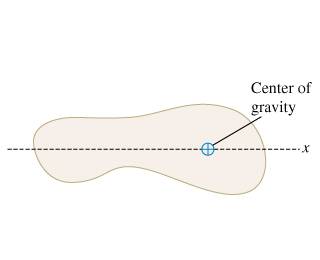
The center of gravity of an irregular object of mass 4.50 g is shown in the figure. You need to move the center of gravity 2.00 cm to the left by gluing on a tiny 1.60-g mass, which will then be considered as part of the object. Where should you attach this additional mass? Express your answer in cm to the left of the original center of gravity.
YF-11-20.jpg


Well, to tell the truth, I don't know how to go about solving this at all. My physics instructor skipped over the section that included this, but still assigned the homework. The chapter that this problem is in includes a bunch of rigid-body equilibrium problems, which I have been solving by using Newton's laws and summing up torques, but this problem has really thrown me for a loop. Would someone please describe the process I use to solve this type of problem, or the relevant equations even?

Thanks.
 
  • Like
Likes   Reactions: archoy2001
Physics news on Phys.org
Superfluous said:
The center of gravity of an irregular object of mass 4.50 g is shown in the figure. You need to move the center of gravity 2.00 cm to the left by gluing on a tiny 1.60-g mass, which will then be considered as part of the object. Where should you attach this additional mass? Express your answer in cm to the left of the original center of gravity.

YF-11-20.jpg


Well, to tell the truth, I don't know how to go about solving this at all. My physics instructor skipped over the section that included this, but still assigned the homework. The chapter that this problem is in includes a bunch of rigid-body equilibrium problems, which I have been solving by using Newton's laws and summing up torques, but this problem has really thrown me for a loop. Would someone please describe the process I use to solve this type of problem, or the relevant equations even?

Thanks.

Can you think of anything unique or special about the CG?
 
No, unforunately I do not understand what you're trying to point me towards.
 
What is the relevant equation here -- the equation for the center of mass of a set of objects?
 
I am happy to report that I figured it out. I guess taking a break for awhile and coming back to it can do wonders. I re-read the section and took a stab at it:

\frac{m_{1}(0)+m_{2}(x)}{m_{1}+m_{2}}=2

Solved for x:

x=\frac{2(m_{1}+m_{2})}{m_{2}}

Plugged in values... got a result of about 7.63 cm. Seemed reasonable, so I tried it. Turned out to be correct. Thanks to everyone who tried to help.
 

Similar threads

  • · Replies 25 ·
Replies
25
Views
2K
Replies
5
Views
2K
Replies
2
Views
1K
  • · Replies 4 ·
Replies
4
Views
6K
Replies
15
Views
2K
  • · Replies 3 ·
Replies
3
Views
4K
  • · Replies 5 ·
Replies
5
Views
8K
  • · Replies 8 ·
Replies
8
Views
2K
Replies
10
Views
5K
  • · Replies 2 ·
Replies
2
Views
3K