minidee
- 20
- 0
Let vectors vec{A}=(0,0,-3), vec{B}=(2,0,0), and vec{C}=(0,1,1).
Calculate the following, expressing your answers as ordered triples (three comma-separated numbers).
Calculate A x C. For this part, remember that only perpendicular components contribute to the cross-product. The vector C has two components--one perpendicular to vector A, and one parallel to vector A The one that is parallel is not included in the cross product.
Vector A x Vector C =
i don't even know where to start with this problem. I already did A X B but I'm not sure how to do this perpendicular parallel thing. Please elaborate and solve out the problem! Thanks!
And this center of mass problem confuses me.
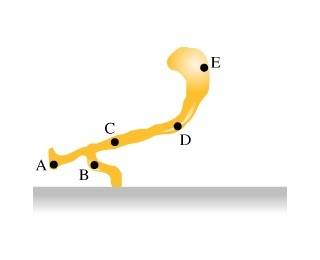
Would the base of the irregular object be B, so the center of mass should be C since it is directly over it?
The abstract sculpture shown in the figure can be placed on a horizontal surface without tipping over. Different parts of the sculpture may be hollow or solid, or made of different materials, but the artist isn't revealing any such information.
Five locations labeled A through E are indicated on the diagram. Which of these, if any, is a possible location of the object's center of mass?
A
B
C
D
E
cannot be determined
And lastly, this problem, I've used a valid equation, got 23 degrees but the machine still churns out that my answer is wrong? What might you guys get?
A 35-cm-diameter phonograph record is dropped onto a turntable being driven at 33 and 1/3rpm. If the coefficient of friction between the record and turntable is 0.20, how far will the turntable rotate between the time when the record first contacts it and when the record is rotating at the full 33 and 1/3 rpm? Assume that the record is a homogeneous disk. Hint: You'll need to do an integral to calculate the torque.
Express your answer using two significant figures.
answer: theta= ? degrees
I think the answer is 23 degrees, I don't know why the machine says I'm wrong.
Calculate the following, expressing your answers as ordered triples (three comma-separated numbers).
Calculate A x C. For this part, remember that only perpendicular components contribute to the cross-product. The vector C has two components--one perpendicular to vector A, and one parallel to vector A The one that is parallel is not included in the cross product.
Vector A x Vector C =
i don't even know where to start with this problem. I already did A X B but I'm not sure how to do this perpendicular parallel thing. Please elaborate and solve out the problem! Thanks!
And this center of mass problem confuses me.
Would the base of the irregular object be B, so the center of mass should be C since it is directly over it?
The abstract sculpture shown in the figure can be placed on a horizontal surface without tipping over. Different parts of the sculpture may be hollow or solid, or made of different materials, but the artist isn't revealing any such information.
Five locations labeled A through E are indicated on the diagram. Which of these, if any, is a possible location of the object's center of mass?
A
B
C
D
E
cannot be determined
And lastly, this problem, I've used a valid equation, got 23 degrees but the machine still churns out that my answer is wrong? What might you guys get?
A 35-cm-diameter phonograph record is dropped onto a turntable being driven at 33 and 1/3rpm. If the coefficient of friction between the record and turntable is 0.20, how far will the turntable rotate between the time when the record first contacts it and when the record is rotating at the full 33 and 1/3 rpm? Assume that the record is a homogeneous disk. Hint: You'll need to do an integral to calculate the torque.
Express your answer using two significant figures.
answer: theta= ? degrees
I think the answer is 23 degrees, I don't know why the machine says I'm wrong.