Centripetal Acceleration while Swinging a Stone on a String

Click For Summary
SUMMARY

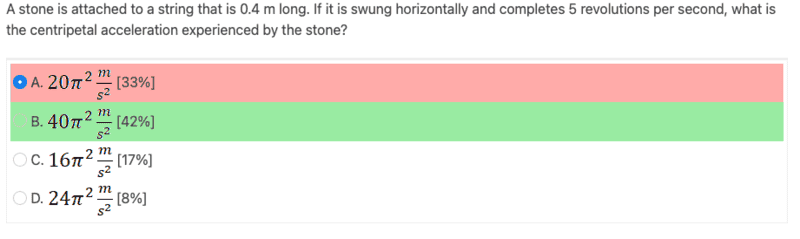
The discussion centers on calculating centripetal acceleration for a stone swung on a string at a frequency of 5 revolutions per second. The angular velocity is determined to be 10π rad/s, derived from the conversion of frequency to angular frequency. The correct formula for centripetal acceleration can be applied using either the tangential velocity or directly with angular frequency. The final calculation confirms that the centripetal acceleration is 40 m/s² when using the radius of 0.4 meters.

PREREQUISITES
  • Understanding of angular velocity and frequency
  • Familiarity with centripetal acceleration formulas
  • Knowledge of converting revolutions per second to radians per second
  • Basic grasp of circular motion concepts
NEXT STEPS
  • Study the relationship between frequency and period in circular motion
  • Learn how to derive angular velocity from linear velocity
  • Explore the derivation and application of centripetal acceleration formulas
  • Investigate the implications of radius on centripetal acceleration
USEFUL FOR

Physics students, educators, and anyone interested in understanding the dynamics of circular motion and centripetal acceleration calculations.

singh101
Messages
14
Reaction score
4
Homework Statement
I can't seem to figure out the answer for this question with formulas given.
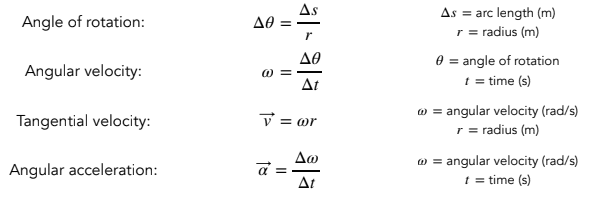
Relevant Equations
Angle of rot= arc length/ radius
Angular velocity= angle of rotation/ time
v=rw (v=tangential veloctity) (w=angular velocity) r= radius
centripe acceleration= v^2/r
So my initial understanding is that it completes 5 revolutions per second. I converted the 5 rev to radians, so each revolution is 2pi. Now since I got angle of rotation I can plug it into the angular velocity formula which is Angular velocity= angle of rotation/ time. However since I don't have time I can change the formula to angle of rot x frequency. Frequency in this case would be 5. So ang Velocity is 10pi rad/s. From their on I get the tang velocity and plug it into the centrip acceleration formula, however I keep getting the wrong answer. Is there anyway to solve this with the equation given below or am I missing any equations.
Screen Shot 2024-01-16 at 6.27.41 PM.png


Screen Shot 2024-01-16 at 6.18.55 PM.png
 
Last edited by a moderator:
Physics news on Phys.org
singh101 said:
So ang Velocity is 10pi rad/s.
Right so far.
singh101 said:
From their on I get the tang velocity and plug it into the centrip acceleration formula, however I keep getting the wrong answer.
I cannot tell where you went wrong if you do not show your detailed working.
 
  • Like
Likes   Reactions: MatinSAR
my question is that is 2pi the angle of rotation or is that the angular velocity.
 
Oh wait I think I figured out my mistake. The 5 revolutions per second is the frequency am I correct? How would that be stated as a period
 
singh101 said:
my question is that is 2pi the angle of rotation or is that the angular velocity.
There is no specific angle of rotation in the question, only a rate: 5 revs/s ##=10\pi^c/s##, where the c denotes radians.
 
  • Like
Likes   Reactions: MatinSAR
singh101 said:
Oh wait I think I figured out my mistake. The 5 revolutions per second is the frequency am I correct? How would that be stated as a period
The rotation period is the time to complete one revolution.
 
  • Like
Likes   Reactions: MatinSAR
singh101 said:
so is the 5 revolution per second the frequency or period. I am assuming that is the frequency. If it is the frequency then what would the period be stated as if it were given in the question.
5 revs/s is the rotation rate. "Frequency" needs to be distinguished from "angular frequency ". The frequency is the number of revolutions per unit time, 5 per second, whereas angular frequency is the number of radians per unit time.
In equations like ##v=\omega r## and ##a=\omega^2r## use the angular frequency.
 
  • Like
Likes   Reactions: MatinSAR
oh ok so 5rev/s can be converted into rad by multiplying it by 2pi which gives is 10pi rad/s. This then in added to the formula v=rw. so w is 10pi x 0.4. which gives us 4pi. This is then put into the formula v^2/r (4pi)^2/0.4= 40m/s^2. Am I correct?
 
  • Like
Likes   Reactions: PhDeezNutz
singh101 said:
oh ok so 5rev/s can be converted into rad by multiplying it by 2pi which gives is 10pi rad/s. This then in added to the formula v=rw. so w is 10pi x 0.4. which gives us 4pi. This is then put into the formula v^2/r (4pi)^2/0.4= 40m/s^2. Am I correct?
Yes. Or you can use ##\omega^2r## for the centripetal acceleration instead, skipping finding v.
 
  • Like
Likes   Reactions: MatinSAR and singh101
  • #10
Oh ok thank you so much I understand where I made the mistake.
 
  • Like
Likes   Reactions: PhDeezNutz

Similar threads

Replies
5
Views
3K
Replies
335
Views
16K
  • · Replies 9 ·
Replies
9
Views
2K
  • · Replies 2 ·
Replies
2
Views
2K
  • · Replies 2 ·
Replies
2
Views
2K
  • · Replies 4 ·
Replies
4
Views
2K
Replies
2
Views
2K
Replies
1
Views
1K
  • · Replies 20 ·
Replies
20
Views
5K
  • · Replies 24 ·
Replies
24
Views
2K