kaiiliana
- 2
- 0
[Mentor Note -- thread moved to the schoolwork forums]
Hi. So I'm a Physics HL student in IB and I'm designing a circuit for my Physics IA. (think of it as a lab/project if you're not familiar with IB)
I'm required to have an independent variable of 7 dif. values and a dependent variable. For my IA, I'm trying to build a diode bridge full rectification circuit. What I will do is I will connect different capacitors of different capacitance values, and connect the circuit to an oscilloscope to read the ripple values generated. According to formulas I've seen online, my hypothesis is that when I increase the capacitance, the ripple will decrease. By showing the relationship between capacitance and ripple, I plan to conclude that since different mobile phone chargers have different capacitors within with capacitances, the ones with higher capacitance values will be more qualified.
I have a few questions regarding this circuit I'm planning to build. I have the oscilloscope and cables at school so that's fine. I know I need an AC power generator, a transformer, 4 diodes, 7 capacitors and one resistor for the circuit. Though, I'm not sure for what values I should buy these. I'm going to an electronics store tomorrow, but how many ohms should my resistor be, or what interval of capacitances should I buy my capacitors in, how many volts should the ac generator have etc. ? Also I know the basic set up of a diode bridge rectifier circuit, sth like this:
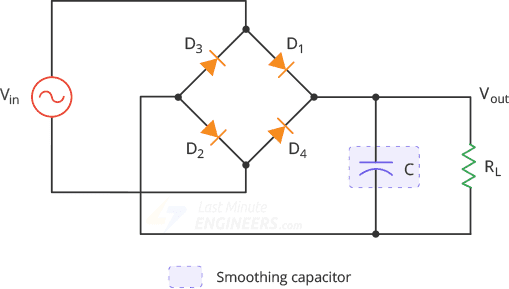
Though I'm not sure where I would connect the oscillator. Also, the value that I'll read from the oscillator, is it the ripple voltage or the ripple current, and in that case how do they differ? Like, I know the diff. between voltage and current obv but doesn't the ripple current/voltage give the same thing technically? I had a hard time trying to grasp that. So yeah, I would appreciate if you could answer the questions I had, or any advice regarding this circuit or IA is appreciated. If you advice me on changing something, or are confident about your knowledge in this topic, feel free to dm please. Thanks a lot.
Hi. So I'm a Physics HL student in IB and I'm designing a circuit for my Physics IA. (think of it as a lab/project if you're not familiar with IB)
I'm required to have an independent variable of 7 dif. values and a dependent variable. For my IA, I'm trying to build a diode bridge full rectification circuit. What I will do is I will connect different capacitors of different capacitance values, and connect the circuit to an oscilloscope to read the ripple values generated. According to formulas I've seen online, my hypothesis is that when I increase the capacitance, the ripple will decrease. By showing the relationship between capacitance and ripple, I plan to conclude that since different mobile phone chargers have different capacitors within with capacitances, the ones with higher capacitance values will be more qualified.
I have a few questions regarding this circuit I'm planning to build. I have the oscilloscope and cables at school so that's fine. I know I need an AC power generator, a transformer, 4 diodes, 7 capacitors and one resistor for the circuit. Though, I'm not sure for what values I should buy these. I'm going to an electronics store tomorrow, but how many ohms should my resistor be, or what interval of capacitances should I buy my capacitors in, how many volts should the ac generator have etc. ? Also I know the basic set up of a diode bridge rectifier circuit, sth like this:
Though I'm not sure where I would connect the oscillator. Also, the value that I'll read from the oscillator, is it the ripple voltage or the ripple current, and in that case how do they differ? Like, I know the diff. between voltage and current obv but doesn't the ripple current/voltage give the same thing technically? I had a hard time trying to grasp that. So yeah, I would appreciate if you could answer the questions I had, or any advice regarding this circuit or IA is appreciated. If you advice me on changing something, or are confident about your knowledge in this topic, feel free to dm please. Thanks a lot.
Last edited by a moderator:
