Characteristic Polynomials and Minimal polynomials

Click For Summary
SUMMARY

This discussion focuses on the concepts of characteristic polynomials and minimal polynomials, particularly in the context of linear transformations and eigenvalues. Participants engage in proving statements related to eigenvectors and their linear independence using induction. Key techniques mentioned include the rational canonical form and the Cayley-Hamilton theorem, which are essential for solving the posed questions effectively.

PREREQUISITES
  • Understanding of linear transformations and eigenvalues
  • Familiarity with the rational canonical form of matrices
  • Knowledge of the Cayley-Hamilton theorem
  • Concepts of linear independence in vector spaces
NEXT STEPS
  • Study the proof techniques for eigenvector linear independence
  • Explore the rational canonical form in detail
  • Review the Cayley-Hamilton theorem and its applications
  • Learn about induction proofs in linear algebra contexts
USEFUL FOR

Students and educators in linear algebra, mathematicians focusing on eigenvalues and eigenvectors, and anyone seeking to deepen their understanding of characteristic and minimal polynomials.

xfunctionx
Messages
9
Reaction score
0
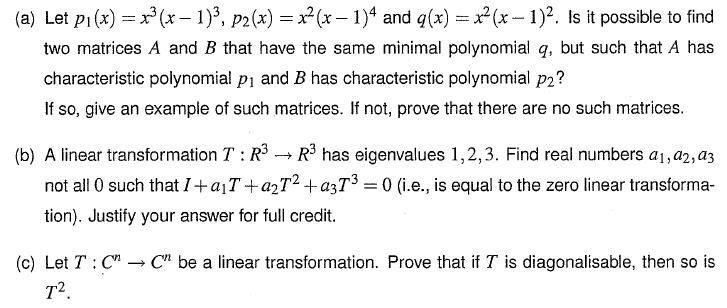
Hi, there are a few questions and concepts I am struggling with. The first question comes in 3 parts. The second question is a proof.

Question 1: Please Click on the link below :smile:
1.jpg


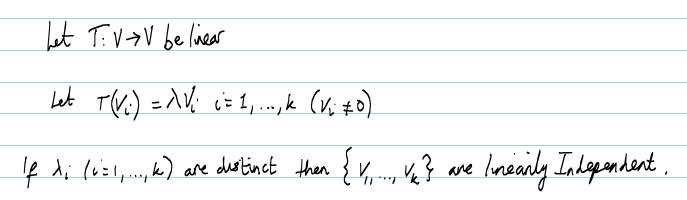
Question 2: Please Click on the link below :smile:
2.jpg


For Q2, could you please show me how to prove this. If possible, could you also link me to a web page where the full proof has already been provided?

I would appreciate the help.
 
Physics news on Phys.org
Hi xfunctionx,

Show us what you've done so far.
 
sure ... let me just write it up
 
Question 1 attempt: I got stuck early.

3.jpg


Question 2 attempt/proof from lecture notes:

I don't understand what my lecturer did right at the end. Or how his conclusion proved anything. Please could you help me understand, or show me a better proof?

4.jpg


5.jpg


6.jpg
 
For question two:

You can prove this by induction. Clearly, it's true for k = 0 since eigenvectors are always non-zero. Now, to prove it for k = n, we assume it's true for k = n - 1.

Suppose that,

(a_1)(v_1) + (a_2)(v_2) + ... + (a_n)(v_n) = 0

Apply T to the LHS, and you get

(λ_1)(a_1)(v_1) + (λ_2)(a_2)(v_2) + ... + (λ_n)(a_n)(v_n) = 0

Now, multiply the first equation by λ_n, and subtract it from the second. The last term will cancel out. You will be left with

(λ_1 - λ_n)(a_1)(v_1) + (λ_2 - λ_n)(a_2)(v_2) + ... + (λ_(n-1) - λ_n)(a_(n-1))(v_(n-1)) = 0.

By the inductive hypothesis, each of the coefficients here must be zero. Can you show that this implies the the a_i from i=1 to (n-1) must be 0? (Hint: Use the fact that the eigenvalues are distinct). Then the original first equation becomes (a_n)(v_n) = 0, so a_n too must be zero.
 
Last edited:
dx said:
Clearly, it's true for k = 0 ...

Sorry, I meant k = 1.
 
dx said:
Sorry, I meant k = 1.

Thank you for your help dx, I will attempt the proof and try to understand it using induction.
 
Can anyone help me with question 1?
 
Have you gone over the rational canonical form of a matrix? Or the Cayley-Hamilton theorem? If you have, question 1 should be straightforward. The answer to part (a) is yes (use the rational canonical form). For (b), use the Cayley-Hamilton theorem. For (c), write D = S-1 T S, where S is an invertible matrix and D is diagonal. What's D2?
 
  • #10
Hello xf...nx

Your proof of 2nd question which according to you is from Lecture notes is quite straight forward using definition of Linear independence and eigen vectors and the defined LT and given hypothesis of the theorem. It is the best and simplest proof you have. Just read a bit about Linear independence, eigen vectors and linear transformation and you will find that the proof is quite straight forward and simple.
 

Similar threads

  • · Replies 11 ·
Replies
11
Views
5K
  • · Replies 7 ·
Replies
7
Views
2K
  • · Replies 3 ·
Replies
3
Views
7K
  • · Replies 2 ·
Replies
2
Views
4K
  • · Replies 4 ·
Replies
4
Views
3K
Replies
7
Views
2K
  • · Replies 2 ·
Replies
2
Views
2K
  • · Replies 4 ·
Replies
4
Views
3K
  • · Replies 5 ·
Replies
5
Views
2K
  • · Replies 1 ·
Replies
1
Views
2K