Math Amateur
Gold Member
MHB
- 3,920
- 48
I am reading Bruce N. Coopersteins book: Advanced Linear Algebra (Second Edition) ... ...
In Section 10.2 Cooperstein writes the following, essentially about external direct sums ... ...
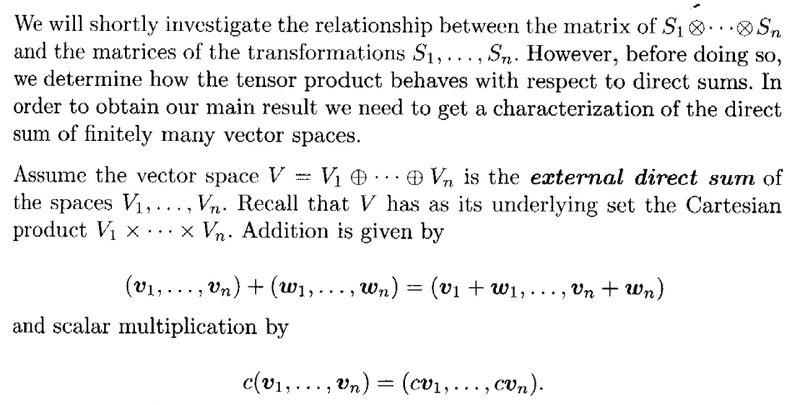

Cooperstein asserts that properties (a) and (b) above "characterize the space ##V## as the direct sum of the spaces ##V_1, \ ... \ ... \ , V_n##"
Can someone please explain how/why properties (a) and (b) above characterize the space ##V## as the direct sum of the spaces ##V_1, \ ... \ ... \ , V_n##?Help will be appreciated ...
Peter
In Section 10.2 Cooperstein writes the following, essentially about external direct sums ... ...
Cooperstein asserts that properties (a) and (b) above "characterize the space ##V## as the direct sum of the spaces ##V_1, \ ... \ ... \ , V_n##"
Can someone please explain how/why properties (a) and (b) above characterize the space ##V## as the direct sum of the spaces ##V_1, \ ... \ ... \ , V_n##?Help will be appreciated ...
Peter
Attachments

