Properties of Tensor Products - Cooperstein, Theorem 10.3

Math Amateur
Gold Member
MHB
Messages
3,920
Reaction score
48
I am reading Bruce N. Coopersteins book: Advanced Linear Algebra (Second Edition) ... ...

I am focused on Section 10.2 Properties of Tensor Products ... ...

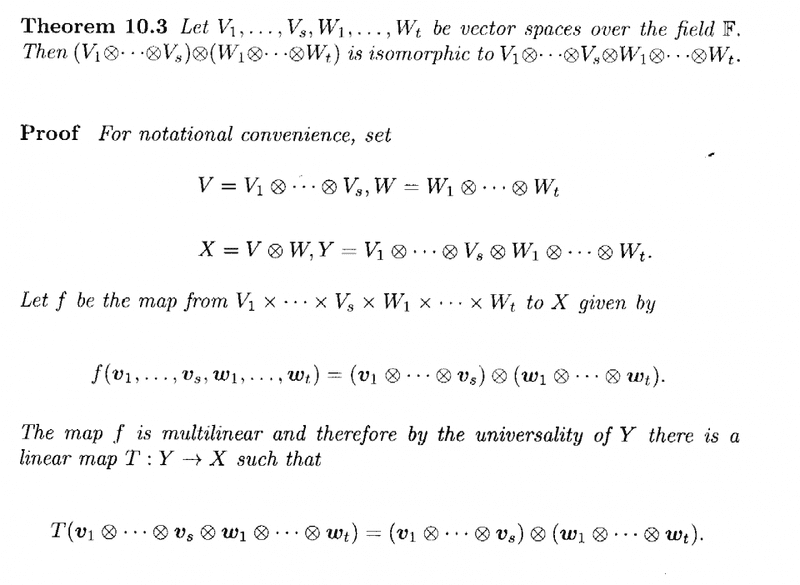
I need help with an aspect of the proof of Theorem 10.3 regarding a property of tensor products ... ...The relevant part of Theorem 10.3 reads as follows:
?temp_hash=33b5ae1cfdc2f7ac325b528ac71daf3b.png

In the above text from Cooperstein (Second Edition, page 355) we read the following:" ... ... The map [itex]f[/itex] is multilinear and therefore by the universality of [itex]Y[/itex] there is a linear map [itex]T \ : \ Y \longrightarrow X[/itex] such that[itex]T(v_1 \otimes \ ... \ v_s \otimes w_1 \otimes \ ... \ w_t )[/itex]

[itex]= (v_1 \otimes \ ... \ v_s ) \otimes (w_1 \otimes \ ... \ w_t )[/itex]

... ... ... "
My question is as follows:

What does Cooperstein mean by "the universality of [itex]Y[/itex]" and how does the universality of [itex]Y[/itex] justify the existence of the linear map [itex]T \ : \ Y \longrightarrow X[/itex] ... and further, if [itex]T[/itex] does exist, then how do we know it has the form shown ...

Hope someone can help ...

Peter
*** Note ***

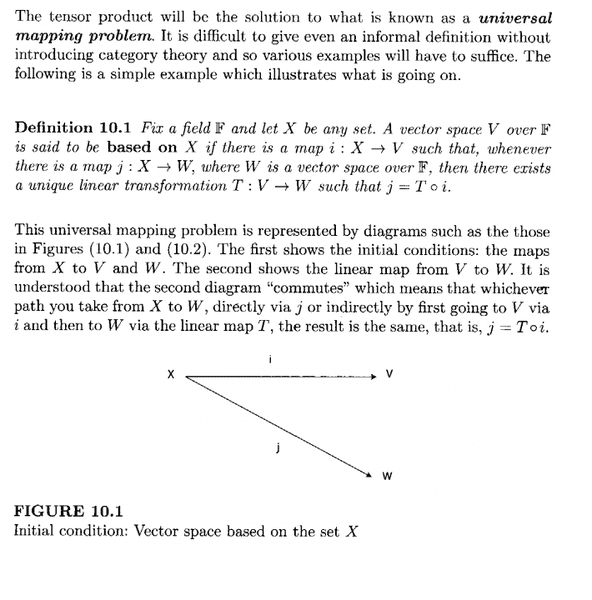
Presumably, Cooperstein is referring to some "universal mapping property" or "universal mapping problem" such as he describes in his Section 10.1 Introduction to Tensor Products as follows:
?temp_hash=33b5ae1cfdc2f7ac325b528ac71daf3b.png

?temp_hash=33b5ae1cfdc2f7ac325b528ac71daf3b.png
... ... BUT ... ... there is no equivalent of the logic surrounding the mapping [itex]j[/itex] ... unless we are supposed to assume the existence of [itex]j[/itex] and its relation to the existence of [itex]T[/itex] ... ?Indeed reading Cooperstein's definition of a tensor product ... it reads like the tensor product is the solution to the UMP ... but I am having some trouble fitting the definition and the UMP to the situation in Theorem 10.3 ...

Again, hope someone can help ...

Peter
 

Attachments

  • Cooperstein - 1 - Theorem 10.3 - PART 1       ....png
    Cooperstein - 1 - Theorem 10.3 - PART 1 ....png
    45.1 KB · Views: 1,326
  • Cooperstein - 1 - Universal Mapping Problem  - PART 1     ....png
    Cooperstein - 1 - Universal Mapping Problem - PART 1 ....png
    51.5 KB · Views: 686
  • Cooperstein - 2 - Universal Mapping Problem  - PART 2     ....png
    Cooperstein - 2 - Universal Mapping Problem - PART 2 ....png
    29.4 KB · Views: 632
I will state it with 2 vector spaces for simplicity.

The tensor product ##V \otimes W##, where ##V,W## are vector spaces, has the following universal property:
If ##f: V \times W \to U## is a bilinear map to a vector space ##U##, then there is a unique linear map ##T : V \otimes W \to U## such that ##f(v,w)=T(v \otimes w)##.

(Prop 5.1 in https://people.maths.ox.ac.uk/hitchin/hitchinnotes/Differentiable_manifolds/Chapter_2.pdf)
(See also https://en.wikipedia.org/wiki/Tensor_product#Universal_property )
 
  • Like
Likes   Reactions: Math Amateur
Thanks Samy ... that looks pretty directly applicable to Theorem 10.3 ...

Appreciate your help ...

Peter
 
Math Amateur said:
I am reading Bruce N. Coopersteins book: Advanced Linear Algebra (Second Edition) ... ...

I am focused on Section 10.2 Properties of Tensor Products ... ...

I need help with an aspect of the proof of Theorem 10.3 regarding a property of tensor products ... ...The relevant part of Theorem 10.3 reads as follows:
?temp_hash=33b5ae1cfdc2f7ac325b528ac71daf3b.png

In the above text from Cooperstein (Second Edition, page 355) we read the following:" ... ... The map [itex]f[/itex] is multilinear and therefore by the universality of [itex]Y[/itex] there is a linear map [itex]T \ : \ Y \longrightarrow X[/itex] such that[itex]T(v_1 \otimes \ ... \ v_s \otimes w_1 \otimes \ ... \ w_t )[/itex]

[itex]= (v_1 \otimes \ ... \ v_s ) \otimes (w_1 \otimes \ ... \ w_t )[/itex]

... ... ... "
My question is as follows:

What does Cooperstein mean by "the universality of [itex]Y[/itex]" and how does the universality of [itex]Y[/itex] justify the existence of the linear map [itex]T \ : \ Y \longrightarrow X[/itex] ... and further, if [itex]T[/itex] does exist, then how do we know it has the form shown ...

Hope someone can help ...

Peter
*** Note ***

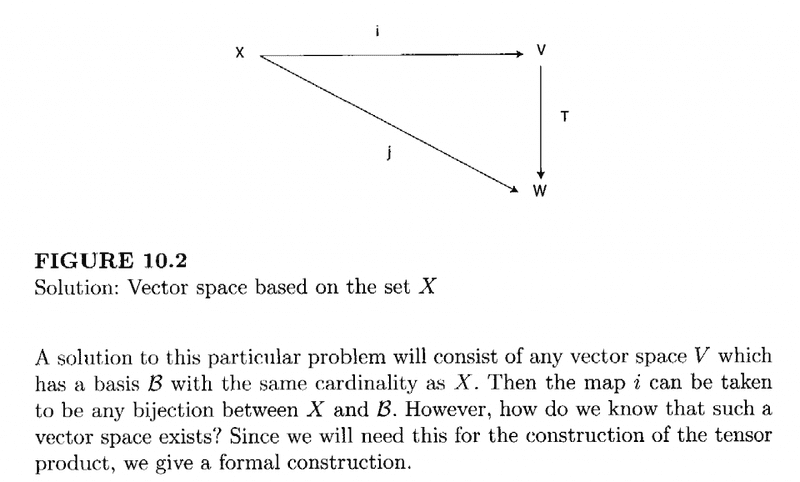
Presumably, Cooperstein is referring to some "universal mapping property" or "universal mapping problem" such as he describes in his Section 10.1 Introduction to Tensor Products as follows:
?temp_hash=33b5ae1cfdc2f7ac325b528ac71daf3b.png

?temp_hash=33b5ae1cfdc2f7ac325b528ac71daf3b.png
... ... BUT ... ... there is no equivalent of the logic surrounding the mapping [itex]j[/itex] ... unless we are supposed to assume the existence of [itex]j[/itex] and its relation to the existence of [itex]T[/itex] ... ?Indeed reading Cooperstein's definition of a tensor product ... it reads like the tensor product is the solution to the UMP ... but I am having some trouble fitting the definition and the UMP to the situation in Theorem 10.3 ...

Again, hope someone can help ...

Peter
Samy_A said:
I will state it with 2 vector spaces for simplicity.

The tensor product ##V \otimes W##, where ##V,W## are vector spaces, has the following universal property:
If ##f: V \times W \to U## is a bilinear map to a vector space ##U##, then there is a unique linear map ##T : V \otimes W \to U## such that ##f(v,w)=T(v \otimes w)##.

(Prop 5.1 in https://people.maths.ox.ac.uk/hitchin/hitchinnotes/Differentiable_manifolds/Chapter_2.pdf)
(See also https://en.wikipedia.org/wiki/Tensor_product#Universal_property )

Hi Samy,

I was too quick to indicate that I understood what you said and the implications of what you said ... ...

... indeed ... I need some further help ...

I cannot see how what you have said leads to T having the property that

[itex]T(v_1 \otimes \ ... \ v_s \otimes w_1 \otimes \ ... \ w_t )[/itex]

[itex]= (v_1 \otimes \ ... \ v_s ) \otimes (w_1 \otimes \ ... \ w_t )[/itex]Can you explain why T has the above property?Hope you can help ...

Peter
 
It is a direct application of the universality of the tensor product. In sloppy language, that principle means that a multilinear map on a cartesian product of vector spaces defines ("can be extended to") a linear map on the tensor product of these vector spaces.

In the proof, they define ##f: V_1 \times \dots \times V_s \times W_1 \times \dots \times W_t \to X=V \otimes W## by ##f(v_1,\dots ,v_s,w_1,\dots ,w_t)=(v_1 \otimes \dots \otimes v_s ) \otimes (w_1 \otimes \dots \otimes w_t)##.

This ##f## is clearly multilinear. Therefore, there exists a linear ##T: V_1 \otimes \dots \otimes V_s \otimes W_1 \otimes \dots \otimes W_t \to X## such that ##T(v_1 \otimes \dots \otimes v_s \otimes w_1 \otimes \dots \otimes w_t) =f(v_1,\dots ,v_s,w_1,\dots ,w_t)=(v_1 \otimes \dots \otimes v_s ) \otimes (w_1 \otimes \dots \otimes w_t) ##
 
Last edited:
  • Like
Likes   Reactions: Math Amateur
Oh! , OK Samy, Thanks ...

Most important principle ... seems to be used again and again in proofs of properties of tensor products ...

Peter
 

Similar threads

  • · Replies 2 ·
Replies
2
Views
2K
  • · Replies 1 ·
Replies
1
Views
1K
  • · Replies 1 ·
Replies
1
Views
2K
  • · Replies 7 ·
Replies
7
Views
4K
  • · Replies 4 ·
Replies
4
Views
2K
  • · Replies 1 ·
Replies
1
Views
1K
Replies
2
Views
2K
  • · Replies 2 ·
Replies
2
Views
2K
  • · Replies 5 ·
Replies
5
Views
2K
  • · Replies 13 ·
Replies
13
Views
4K