Charge distribution among connected metal spheres -- Simple question

Click For Summary
SUMMARY

The discussion centers on the charge distribution among connected metal spheres, specifically addressing the scenario where three identical spheres are connected. The consensus is that when the spheres are connected, they share the total charge equally, resulting in each sphere carrying a charge of Q/3. This conclusion is supported by the principle of symmetry, which dictates that identical conductors will have equal charge distribution when connected. The participants also emphasize the importance of assuming equal radii for accurate calculations.

PREREQUISITES
  • Understanding of electrostatics and charge distribution principles
  • Familiarity with the concept of electric potential in conductors
  • Knowledge of basic circuit theory involving connected conductors
  • Ability to interpret and analyze physics problems involving multiple conductors
NEXT STEPS
  • Study the principles of electrostatic equilibrium in conductors
  • Learn about the implications of charge conservation in connected systems
  • Explore the concept of electric potential and its role in charge distribution
  • Review similar problems in electrostatics, such as those found in physics textbooks like Wiley's
USEFUL FOR

This discussion is beneficial for physics students, educators, and anyone interested in understanding electrostatic principles and charge distribution in conductive materials.

lightlightsup
Messages
100
Reaction score
11
Homework Statement
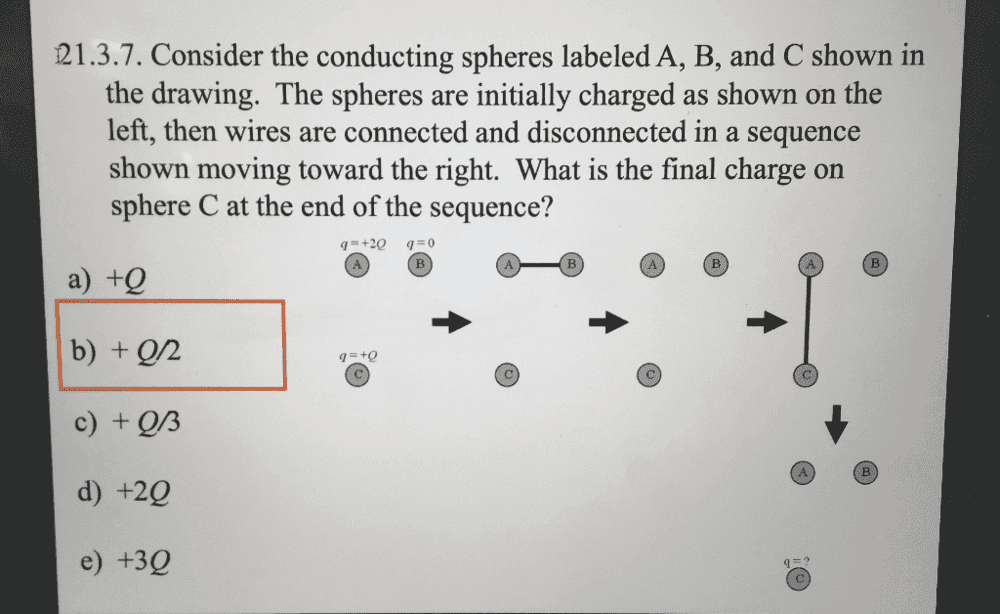
See image.
Relevant Equations
See image.
My answer was +Q/3.
I was assuming that the charges would distributed themselves completely.
But, apparently, I'm wrong?
For example, if there were 12##e^-##s on Sphere C, then, in the first step in the system: the ##e^-##s would balance out until each sphere has 4 ##e^-##s each?
What am I getting wrong here?
media_760_7609866f-4102-4290-a64f-291ef225ffbc_phpcFiZpf.png


Similar problem here?:
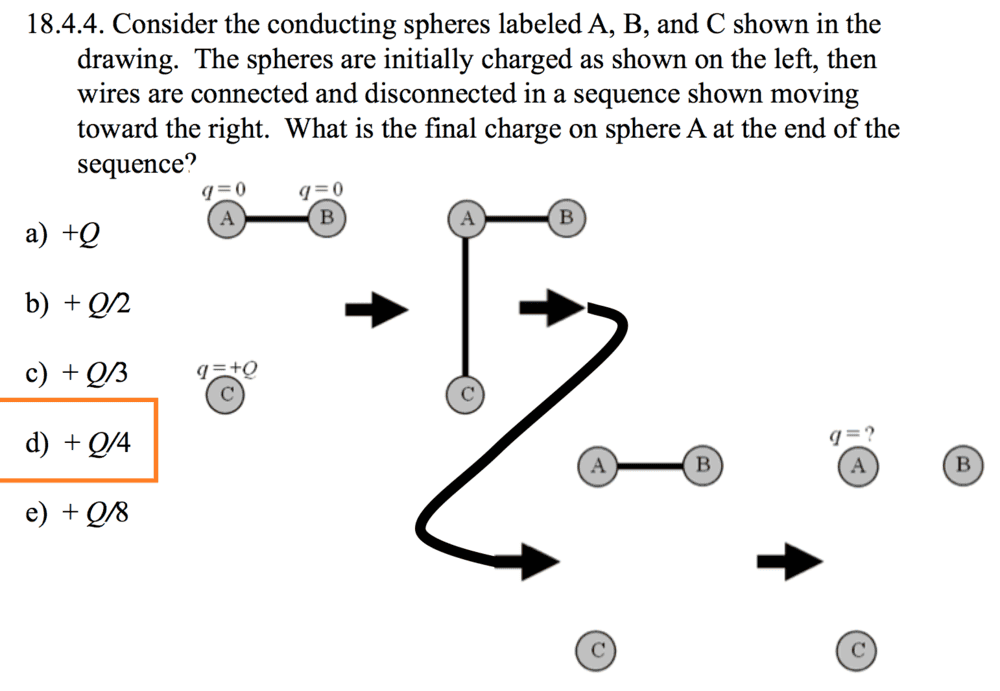
phpA4taEQ.png
 
Physics news on Phys.org
If there are only A and C, the both have charge Q/2 by connection and subsequent separation. Then pull A left and right as to form original A and B and separate them finally. Each side shares charge in half.
 
lightlightsup said:
Homework Statement:: See image.
Relevant Equations:: See image.

My answer was +Q/3.
I was assuming that the charges would distributed themselves completely.
But, apparently, I'm wrong?
For example, if there were 12##e^-##s on Sphere C, then, in the first step in the system: the ##e^-##s would balance out until each sphere has 4 ##e^-##s each?
What am I getting wrong here?
I agree with you that the answer should be Q/3. Look at the second step in 18.4.4 where all three conductors are connected. They all are at the same potential. If the spheres are identical (no reason to assume otherwise), they must all carry the same fraction of the total charge, Q/3. Disconnecting the wire between A and C just traps the charge on C and the AB combination that is still connected. No charge will flow from A to B or B to A because they already have equal amounts of charge. The answer in 21.3.7 is not (b) because of similar considerations. (On edit) The answer given for the second situation is (b).

Your assumption that the charges are distributed equally is correct. By symmetry if two identical conductors are connected, there is no reason for one conductor to have more charge than the other (we neglect any charge on the connecting wire). You may wish to ask your teacher about this.
 
Last edited:
  • Like
Likes   Reactions: lightlightsup
kuruman said:
I agree with you that the answer should be Q/3. Look at the second step in 18.4.4 where all three conductors are connected. They all are at the same potential. If the spheres are identical (no reason to assume otherwise), they must all carry the same fraction of the total charge, Q/3. Disconnecting the wire between A and C just traps the charge on C and the AB combination that is still connected. No charge will flow from A to B or B to A because they already have equal amounts of charge. The answer in 21.3.7 is not (b) because of similar considerations.

Your assumption that the charges are distributed equally is correct. By symmetry if two identical conductors are connected, there is no reason for one conductor to have more charge than the other (we neglect any charge on the connecting wire). You may wish to ask your teacher about this.

LOL. Here I was, hoping someone would tell me I was wrong about my understanding of something.
Those are official answers from Wiley.
 
Wiley has been known to be in error, mostly typos from poorly proofed copy by poorly paid editors. Your teacher is the ultimate authority.
 
  • Like
Likes   Reactions: lightlightsup
As kuruma n pointed out you have to assume the radii of all spheres is the same or you can't do the problem.
Under this assumption , looks like the answer should be Q/3 all right.
 
rude man said:
As kuruma n pointed out you have to assume the radii of all spheres is the same or you can't do the problem.
Under this assumption , looks like the answer should be Q/3 all right.
Also, you need to assume that that radius is much smaller than the distances between the spheres.
@lightlightsup , what are you getting for the second problem? I get the book answer. Note that A starts with a charge of 2Q here.
 
The answer to the second problem is the book's answer. I cannot reconstruct from memory what I was thinking when I posted the original version of #3 about it.
 
I'm probably wrong, but I still tend to believe that the answer to 18.44 is Q/4.
 
  • #10
haruspex said:
Also, you need to assume that that radius is much smaller than the distances between the spheres.
@lightlightsup , what are you getting for the second problem? I get the book answer. Note that A starts with a charge of 2Q here.
I was referring to problem 18.4.4 for which the answer I got was Q/3. Prob. 21.3.7 was labeled "similar problem" by the OP. Anyway I did not look at 21.3.7.
 
  • #11
kuruman said:
The answer to the second problem is the book's answer. I cannot reconstruct from memory what I was thinking when I posted the original version of #3 about it.
Like others among us I believe you confused prob. 18.4.4 with 21.7.3.
 
  • #12
rude man said:
Like others among us I believe you confused prob. 18.4.4 with 21.7.3.
I was right in the first place to say that the book's answer is incorrect for 21.3.7. I restored post #3 and crossed out my comments in #8.
haruspex said:
@lightlightsup , what are you getting for the second problem? I get the book answer. Note that A starts with a charge of 2Q here.
And C starts with charge +Q, not 0. The label for C could be mistaken for 0 although +0 doesn't make much sense.

Question 21.3.7:
Initial distribution
QA = +2Q; QB = 0; QC = +Q
Connect A and B
QA = +Q; QB = +Q; QC = +Q
##\dots##
 
  • #13
kuruman said:
And C starts with charge +Q, not 0.
Ah yes, I should have expanded the image.
 

Similar threads

  • · Replies 18 ·
Replies
18
Views
3K
Replies
23
Views
4K
Replies
6
Views
2K
  • · Replies 1 ·
Replies
1
Views
2K
  • · Replies 21 ·
Replies
21
Views
5K
Replies
28
Views
5K
  • · Replies 1 ·
Replies
1
Views
2K
  • · Replies 10 ·
Replies
10
Views
2K
Replies
24
Views
4K
Replies
8
Views
6K