Charged Conducting Sheet v. Charged Non-Conducting Sheet

  • Thread starter Thread starter Taulant Sholla
  • Start date Start date
  • Tags Tags
    Charged Conducting
Click For Summary
SUMMARY

The electric field for a charged conducting sheet is defined as E=σ/ε0, while for a charged non-conducting sheet, it is E=σ/2ε0. This distinction arises from the behavior of charges in electrostatic equilibrium; in a conducting plate, charges redistribute to maintain zero electric field inside the conductor. The derivation for the conducting plate omits the factor of 2 present in the non-conducting case due to this redistribution. The discussion emphasizes the negligible effect of an approaching electron's electric field on the overall charge distribution of the plate, especially when the electron is far from the plate.

PREREQUISITES
  • Understanding of Gauss' Law
  • Familiarity with electrostatic equilibrium concepts
  • Knowledge of electric field equations for charged plates
  • Basic principles of charge redistribution in conductors
NEXT STEPS
  • Study the derivation of electric fields using Gauss' Law for different geometries
  • Explore the concept of electrostatic shielding in conductors
  • Learn about charge distribution dynamics in conductive materials
  • Investigate the effects of moving charges on electric fields in electrostatics
USEFUL FOR

Physics students, electrical engineers, and anyone studying electrostatics or electric field theory will benefit from this discussion.

Taulant Sholla
Messages
96
Reaction score
5
Homework Statement
An electron is shot directly toward the center of a large metal plate that has surface charge density sigma. If the initial kinetic energy of the electron is known and if the electron is to stop (due to electrostatic repulsion from the plate) just as it reaches the plate, how far from the plate must the launch point be?
Relevant Equations
E=sigma/a/epsilon_0
The solution to this problem states the electric field is E=σ/ε0. Is that because it's a conducting plate? I know for a non-conducting plate it's E=σ/2ε0. This is a Gauss' Law problem. I know how to derive for non-conducting plate. What's different with conducting plate derivation? Thank you!
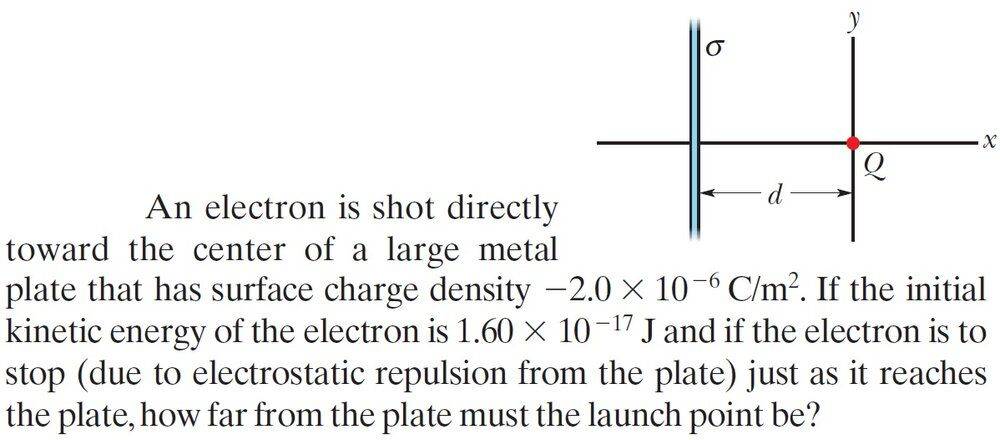
problem.jpg
 
Physics news on Phys.org
Taulant Sholla said:
What's different with conducting plate derivation?
For a non-conducting plate, there need not be any other charge on it, but for a conducting plate there is necessarily an equal charge on the further surface.

One thing bothers me about this question, though: as the electron approaches the plate, the charges on the plate will redistribute.
 
  • Like
Likes   Reactions: Adesh
haruspex said:
One thing bothers me about this question, though: as the electron approaches the plate, the charges on the plate will redistribute.
Strictly speaking you are right but for the level of this problem (i suspect high school or college level) we can safely consider as negligible the EM field produced by the moving electron (or just neglect the E-field in the quasi static approximation).
Does it have analytical solution if we don't neglect the EM field produced by the electron? I don't think so.
 
  • Like
Likes   Reactions: Adesh
For a conducting plate in electrostatic equilibrium such as the metal one in your problem, the electric field indeed is ##\sigma /\epsilon_0##. To derive this, one crucial thing has to be considered-- the electric field inside of a conductor in electrostatic equilibrium is zero (hopefully you know the qualitative argument as to why this is!) Set up a Gaussian cylinder with surface area of the faces each being A, and have one end of the cylinder be inside the conductor and the other outside (this is the same Gaussian surface used in the non-conducting plate derivation). Using the crucial fact mentioned above, do you see where you lose that factor of 2 in the denominator of ##\sigma /2\epsilon_0##?
 
  • Like
Likes   Reactions: Delta2
Delta2 said:
Strictly speaking you are right but for the level of this problem (i suspect high school or college level) we can safely consider as negligible the EM field produced by the moving electron (or just neglect the E-field in the quasi static approximation).
Does it have analytical solution if we don't neglect the EM field produced by the electron? I don't think so.
Yes, I'm sure it's fine as long as the initial distance from the plate is large compared with the average spacing of electrons on the plate.
 
haruspex said:
Yes, I'm sure it's fine as long as the initial distance from the plate is large compared with the average spacing of electrons on the plate.
i am not so sure i understand you here, can you expand?
 
Delta2 said:
i am not so sure i understand you here, can you expand?
Under that condition, for most of the journey of the electron towards the plate there will be very little redistribution.
 
  • Like
Likes   Reactions: Delta2
haruspex said:
Under that condition, for most of the journey of the electron towards the plate there will be very little redistribution.
Yes, but since the stopping point of the electron is just above the plate, there will be some fraction of the journey (when the electron gets very close to the plate) where the redistribution is not negligible, but yes this is a tiny fraction of the total journey of electron.
 
Delta2 said:
Yes, but since the stopping point of the electron is just above the plate, there will be some fraction of the journey (when the electron gets very close to the plate) where the redistribution is not negligible, but yes this is a tiny fraction of the total journey of electron.
Right, but what matters is how that compares with the initial spacing of the electrons. E.g. start with just five electrons in a square sheet. They will be one at each corner and one central. When the fired electron reaches the sheet, the fired electron will have deviated one way and the central electron another.
 
  • #10
haruspex said:
Right, but what matters is how that compares with the initial spacing of the electrons. E.g. start with just five electrons in a square sheet. They will be one at each corner and one central. When the fired electron reaches the sheet, the fired electron will have deviated one way and the central electron another.
Yes , the way i understand it is that when the distance of the electron is big, in comparison with the inter-electron spacing in the plate, then the force from the electron will be small in comparison with the interelectron forces in the plate, hence it won't affect much the positioning of electrons in the plate.
 

Similar threads

  • · Replies 26 ·
Replies
26
Views
3K
  • · Replies 5 ·
Replies
5
Views
2K
Replies
9
Views
4K
Replies
12
Views
1K
  • · Replies 2 ·
Replies
2
Views
1K
  • · Replies 5 ·
Replies
5
Views
679
Replies
1
Views
1K
Replies
12
Views
2K
Replies
23
Views
4K