Check Vector Work: Physics Problem Help

  • Thread starter Thread starter phunphysics2
  • Start date Start date
  • Tags Tags
    Vector Work
Click For Summary
The discussion centers on a physics problem involving vector calculations, with the user seeking feedback on their work in preparation for an upcoming exam. An error in determining one of the angles was identified, correcting it from 320 degrees to 310 degrees. The user’s calculations for the first three vectors were confirmed to be accurate, and they successfully summed the components to find the resultant vector's magnitude and angle. Overall, the feedback indicates that the user was on the right track, with only minor adjustments needed. This exchange highlights the importance of accuracy in vector analysis for physics problems.
phunphysics2
Messages
29
Reaction score
0
Greetings fellow Physics adorers,

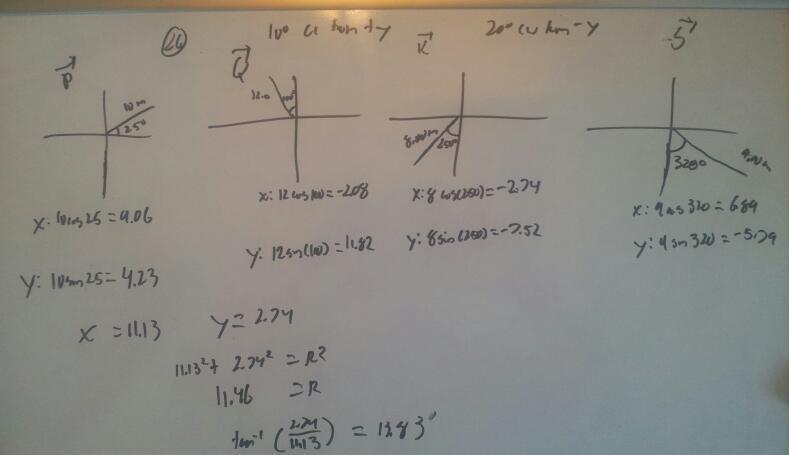
I was wondering if someone could please check my work for this problem. I attached pictures of my work and the problem. It involves vectors.


My instructor said we will be having a problem like this on our exam, and it is an even problem so I'd definitely like to know if I am okay for this problem or not. Thanks for all the help!
2012-09-19 18.13.55-1.jpg


2012-09-19 18.14.32-1.jpg
 
Physics news on Phys.org
If I decipher your handwriting correctly, you have determined the absolute angles to be 25, 100, 250 and 320 degrees. The last one is wrong. Observe that "-y" corresponds to 3 x 90 = 270 degrees, 40 degrees counterclockwise from -y would be 270 + 40 = 310 degrees.
 
Greetings Voko,

Thank you VERY much for your response. And yes I do certainly see why that should be 310 degrees and NOT 320 degrees. Other than that, do you think my work looked reasonably well? Was I on the right track to solvong it other than that angle error? I apologize for the handwiriting. I will try to write bigger and cleaner next time.
 
The components of the first three vectors are calculated correctly. As far as I can tell, you then sum them component-wise, thus getting the components of the resultant vector, then you determine its magnitude and angle. All that seems correct.
 
The book claims the answer is that all the magnitudes are the same because "the gravitational force on the penguin is the same". I'm having trouble understanding this. I thought the buoyant force was equal to the weight of the fluid displaced. Weight depends on mass which depends on density. Therefore, due to the differing densities the buoyant force will be different in each case? Is this incorrect?

Similar threads

  • · Replies 3 ·
Replies
3
Views
777
Replies
13
Views
2K
  • · Replies 3 ·
Replies
3
Views
1K
  • · Replies 1 ·
Replies
1
Views
851
  • · Replies 4 ·
Replies
4
Views
767
  • · Replies 44 ·
2
Replies
44
Views
4K
  • · Replies 10 ·
Replies
10
Views
921
Replies
14
Views
789
Replies
11
Views
3K
  • · Replies 7 ·
Replies
7
Views
3K