Checking my solution to a differentiability problem

1 reply · 2K views · last reply
rasi
Messages
18
Reaction score
0
as you know i have been asked a question which no no way i couldn't tackle it. and its is about differentiabilty. at long last i found a solution. i want to share with you. could you check out please. thanks for now.this is the question.

Printed exercise 5.6.25: Prove that if f is a C^2 function on the real numbers with f^2(x) <= 1 and [f'(x)]^2 + [f''(x)]^2 <= 1 for all x, then f^2(x) + [f'(x)]^2 <= 1 for all x.

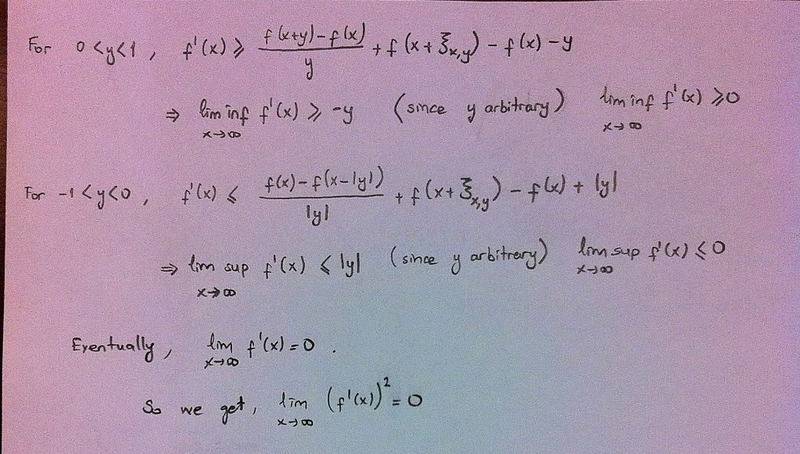
and this is my solution.(i assume that when x goes infinity, the limit value of functions equals zero.)
part1
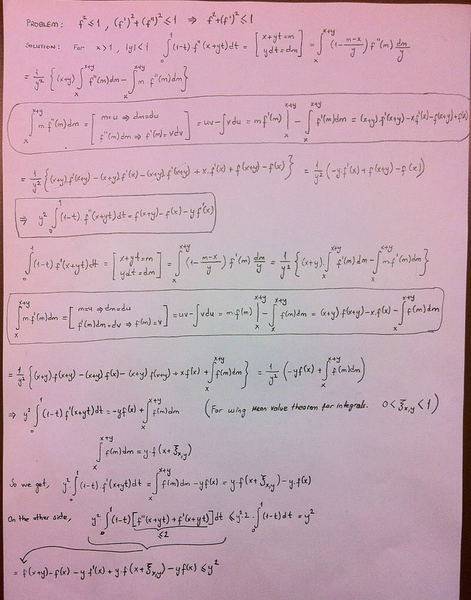
Handwritten derivation on lined paper: problem stating f'' bounded by 1, f and f' bounded by 1, implies f^2 + f'^2 is at most 1; followed by a step-by-step solution using integration by parts and the mean value theorem for integrals.

part2
Handwritten derivation: for 0<y<1, f'(x) >= [f(x+y)-f(x)]/y + f(x+ξ) - f(x) - y, giving liminf f'(x) >= -y; for -1<y<0, f'(x) <= [f(x)-f(x-|y|)]/|y| + f(x+ξ) - f(x) + |y|, giving limsup f'(x) <= |y|; hence lim f'(x) = 0 and lim (f'(x))^2 = 0.
 
I cannot decode the first picture. However, there are functions which locally violate the assertion. So the problem comes down to: If ##f(x_0)^2 \leq 1## and ##f'(x_0)^2 +f''(x_0)\leq 1 ## and ##f(x_0)^2 +f'(x_0)^2> 1##, then there is no twice differentiable continuation of ##f## on ##\mathbb{R}##. This means on the other hand, that the continuity of ##f''(x)## is crucial for the proof!