Chemistry of thyroid hormones doesn't make sense?

  • Thread starter Thread starter sameeralord
  • Start date Start date
  • Tags Tags
    Chemistry hormones
Click For Summary

Discussion Overview

The discussion revolves around the chemistry of thyroid hormones, specifically the coupling reaction involving DIT molecules to form T4 (thyroxine). Participants explore the nature of coupling reactions versus addition reactions and the mechanisms involved in this biochemical process.

Discussion Character

  • Technical explanation
  • Conceptual clarification
  • Debate/contested

Main Points Raised

  • One participant expresses confusion about how DIT molecules can couple to form T4, questioning the terminology used in the context of addition reactions.
  • Another participant clarifies that coupling reactions are distinct from addition reactions, providing a link for further reading.
  • A later reply acknowledges the initial misunderstanding and emphasizes the importance of correctly interpreting the term "coupling reaction."
  • Another participant suggests that the reaction is likely enzyme-catalyzed and speculates on the involvement of a metalloenzyme, noting the complexity of substitution reactions on a phenyl ring.

Areas of Agreement / Disagreement

Participants do not reach a consensus on the specifics of the coupling reaction and its mechanisms, indicating that multiple interpretations and understandings remain in the discussion.

Contextual Notes

There are limitations regarding the assumptions made about the reaction mechanisms and the specific enzymes involved, which are not fully explored in the discussion.

sameeralord
Messages
659
Reaction score
3
Hello everyone,

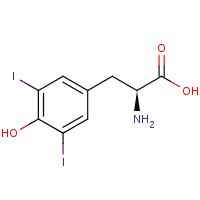
This is a DIT molecule.
displayImage.do?defaultImage=true&imageIndex=0&chebiId=15768.png


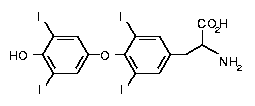
Now the book says there is a coupling reaction DIT + DIT ----> gives T4 molecule or tyroxine hormone

Now this is how T4 looks like
thyroxine.gif


I don't understand how you can get this when there is a addition reaction between these two. Does coupling mean something else. Thank you :smile:
 
Chemistry news on Phys.org
pzona said:
Coupling reactions are something entirely different from addition. Here's the basics:

http://en.wikipedia.org/wiki/Coupling_reaction

Thanks :smile: Somehow I totally forgot to check what coupling reaction mean, I just took it literally thinking it was an addition reaction.
 
This is almost certainly an enzyme-catalyzed reaction. I'm guessing that by 'coupling reaction' they just mean that it's occurring in a metalloenzyme.

Even without knowing the enzyme in question I'd expect as much, given the nature of the reaction. Substitution on a phenyl ring is not easy, and might even require forming a radical intermediate.
 

Similar threads

Replies
2
Views
3K
  • · Replies 8 ·
Replies
8
Views
2K
  • · Replies 8 ·
Replies
8
Views
4K
  • · Replies 2 ·
Replies
2
Views
1K
Replies
1
Views
2K
  • · Replies 1 ·
Replies
1
Views
3K
Replies
2
Views
2K
  • · Replies 2 ·
Replies
2
Views
4K
Replies
1
Views
3K
  • · Replies 5 ·
Replies
5
Views
2K