Smollett
- 2
- 0
Hi there,
I'm trying to simulate a vibrating plate with free edges.
If i consider a consider a plate with fixed edges, the eigenvectors of the matrix bellow (which repesents the Laplacien operator) with S as a nxn tridiagonal matrix with -4 on the diagonal and 1s on either side (making the following a n2 by n2 matrix representing a plate with n2 points).
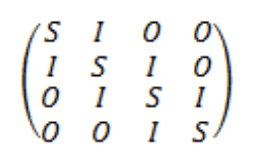
correspond to the state of the plate (the following example is for a plate simulated by a 4 by 4 grid), so i can generate the following images.
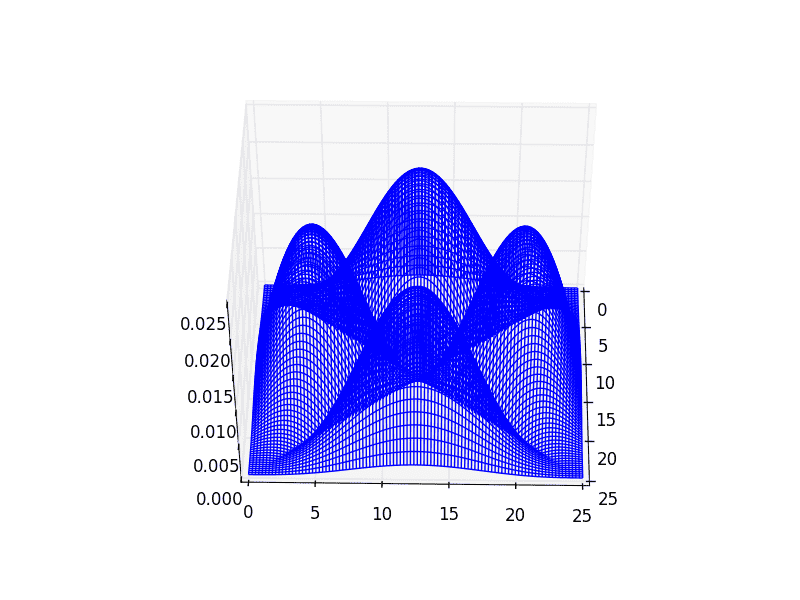
I found an article online (in french) which indicates that it is possible, using the same method but a different matrix to find the resonant states of a plate with free edges (Neumann conditions).
My only question is how to build a matrix with such conditions?
Has anyone encountered this problem before?
I'm trying to simulate a vibrating plate with free edges.
If i consider a consider a plate with fixed edges, the eigenvectors of the matrix bellow (which repesents the Laplacien operator) with S as a nxn tridiagonal matrix with -4 on the diagonal and 1s on either side (making the following a n2 by n2 matrix representing a plate with n2 points).
correspond to the state of the plate (the following example is for a plate simulated by a 4 by 4 grid), so i can generate the following images.
I found an article online (in french) which indicates that it is possible, using the same method but a different matrix to find the resonant states of a plate with free edges (Neumann conditions).
My only question is how to build a matrix with such conditions?
Has anyone encountered this problem before?