Choose from Unknown - A Chiral Compound

  • Thread starter Thread starter AGNuke
  • Start date Start date
  • Tags Tags
    Chiral
Click For Summary
SUMMARY

The discussion centers on identifying a chiral hydrocarbon, X (C8H12), which upon catalytic hydrogenation transforms into an achiral compound (C8H14). Participants analyze the chirality of various alternatives, concluding that the second option is symmetric and thus not chiral. The first alternative is determined to be achiral after hydrogenation, while the third and fourth options retain chirality post-reaction. The conversation highlights the complexities of recognizing chirality in organic compounds.

PREREQUISITES
  • Understanding of chirality in organic chemistry
  • Knowledge of catalytic hydrogenation processes
  • Familiarity with ozonolysis and its products
  • Basic grasp of hydrocarbon structures and nomenclature
NEXT STEPS
  • Research the mechanisms of catalytic hydrogenation in organic compounds
  • Study the principles of ozonolysis and its applications in synthesizing dicarboxylic acids
  • Explore the concept of chirality and its significance in stereochemistry
  • Investigate methods for determining the chirality of organic molecules
USEFUL FOR

Chemistry students, organic chemists, and anyone studying stereochemistry and reaction mechanisms in organic compounds.

AGNuke
Gold Member
Messages
455
Reaction score
9
A C8H12 chiral hydrocarbon, X, is reduced by catalytic Hydrogenation to an achiral C8H14. Ozonolysis (Oxidative) of X gave a chiral C8H12O4 dicarboxylic acid. Choose X from the given.
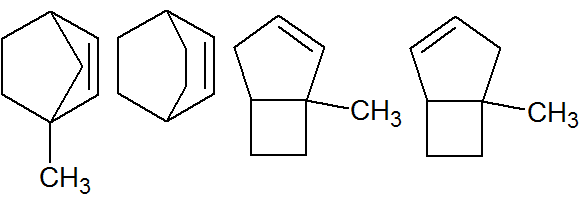
C8H12.png


Attempt
I first determined the chirality of the given alternatives. That rules out the 2nd option, as it is clearly symmetric. Then I just removed the double bonds, as asked in the question to see if any achiral hydrocarbon is formed. First one, I think is achiral. But I am not sure about the 3rd and 4th.

How about my attempt and is it something that I am overlooking?
 
Physics news on Phys.org
I think you are on the right track, but I have been wrong about chiral compounds so many times in the past I no longer trust myself.
 
Yeah me too. It was in the test paper earlier, but I had to leave this simple looking question. What a shame.

I couldn't formulate it back then, that 1st one would be achiral after catalytic hydrogenation.
 
The 3rd and 4th remain chiral after hydrogenation but I'm sure you already knew that.
 
I was unable to think about them in exam.
 

Similar threads

  • · Replies 2 ·
Replies
2
Views
3K
  • · Replies 4 ·
Replies
4
Views
2K
  • · Replies 4 ·
Replies
4
Views
3K
  • · Replies 2 ·
Replies
2
Views
2K
  • · Replies 7 ·
Replies
7
Views
3K
Replies
7
Views
5K
  • · Replies 4 ·
Replies
4
Views
5K
  • · Replies 10 ·
Replies
10
Views
3K
  • · Replies 4 ·
Replies
4
Views
2K
  • · Replies 4 ·
Replies
4
Views
2K