Choosing an Axis of Rotation for Equilibrium Analysis

Click For Summary

Homework Help Overview

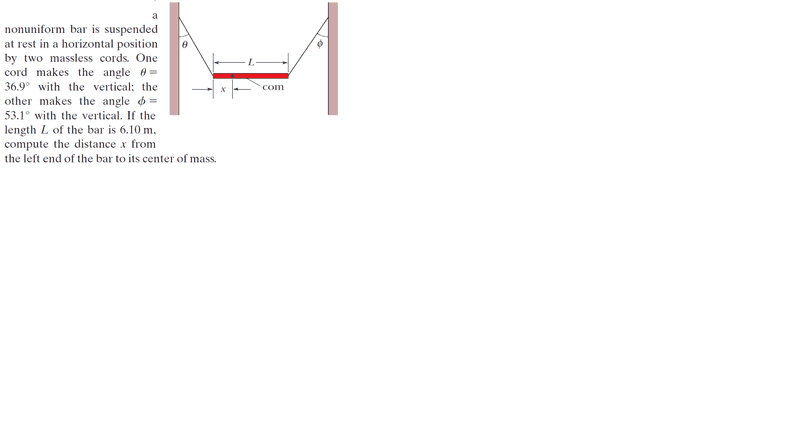
The discussion revolves around the analysis of torque in equilibrium problems, specifically focusing on the choice of the axis of rotation for a plank. Participants explore the implications of selecting different points for this axis, particularly the left end versus the center of mass (COM).

Discussion Character

  • Exploratory, Assumption checking, Problem interpretation

Approaches and Questions Raised

  • Participants discuss the outcomes of choosing different axes of rotation and question the effectiveness of using the COM. There are inquiries about the number of unknowns in the equations and the relationships between them.

Discussion Status

The conversation is ongoing, with participants sharing their attempts and questioning the assumptions behind their approaches. Some guidance has been offered regarding the number of unknowns and the implications of their choices, but no consensus has been reached.

Contextual Notes

There seems to be confusion regarding the number of unknowns in the problem, with participants noting that additional variables may complicate their ability to solve for specific quantities. The discussion also hints at the need for certain values, such as mass, to progress further.
Taulant Sholla
Messages
96
Reaction score
5
Homework Statement
I can get the answer to this problem, but...
Relevant Equations
torque and force equilibrium
If I choose my axis of rotation for torque analysis to be the left-end of the plank, I can get the correct results.

If I instead choose the com point -- I run into a dead end. Is there a way of a priori knowing this would happen? Thank you.
Untitled.png
 
Physics news on Phys.org
Taulant Sholla said:
I run into a dead end
Can you show ?
 
Here's my work based on using the COM as my axis of rotation. It seems I can't solve for x this way?
sol.JPG
 
You introduce angles ##a## and ##b## and now have too many unknowns ? Is that what you mean ?

##\ ##
 
I can find angle a and angle b. Despite this it seems I still can't find x from equations 2, 3 and 4.
 
Ok, so you have three equations with three unknowns, so what is going wrong ?

##\ ##
 
I think there are 4 unknowns: Tr, Tl, m and x.
 
cj said:
I think there are 4 unknowns: Tr, Tl, m and x.
Do you need to know m to find x?

(Tr/m), (Tl/m), and x are the unknowns.
 
Ah, yes - I see. Thank you so much for your help!
 
  • Like
Likes   Reactions: BvU

Similar threads

Replies
1
Views
1K
  • · Replies 8 ·
Replies
8
Views
2K
  • · Replies 95 ·
4
Replies
95
Views
6K
  • · Replies 28 ·
Replies
28
Views
2K
Replies
2
Views
2K
  • · Replies 5 ·
Replies
5
Views
3K
  • · Replies 6 ·
Replies
6
Views
2K
  • · Replies 4 ·
Replies
4
Views
1K
  • · Replies 5 ·
Replies
5
Views
2K
  • · Replies 2 ·
Replies
2
Views
2K