Simple Statics Problem--what am I missing?

  • Thread starter Thread starter Taulant Sholla
  • Start date Start date
  • Tags Tags
    Statics
Click For Summary

Homework Help Overview

The discussion revolves around a statics problem involving torque calculations in the context of a car experiencing linear acceleration. Participants explore the implications of using different points as axes of rotation for torque, particularly the center of mass (COM) versus other fixed points.

Discussion Character

  • Mixed

Approaches and Questions Raised

  • Some participants discuss the validity of using the COM for torque calculations and question whether any point can serve as the axis of rotation. Others introduce the concept of pseudo forces to address the non-statics nature of the problem.

Discussion Status

Participants are actively engaging with the concepts of torque and pseudo forces, with some expressing clarity after receiving explanations. There is a recognition of the role of the COM in simplifying calculations, though questions about the underlying principles remain open for exploration.

Contextual Notes

There is an acknowledgment that the problem involves acceleration, which complicates the application of static principles. Participants are considering the implications of this acceleration on torque calculations and the necessity of including pseudo forces.

Taulant Sholla
Messages
96
Reaction score
5
Homework Statement
Calculate forces and torques
Relevant Equations
Force and torque equilibrium.
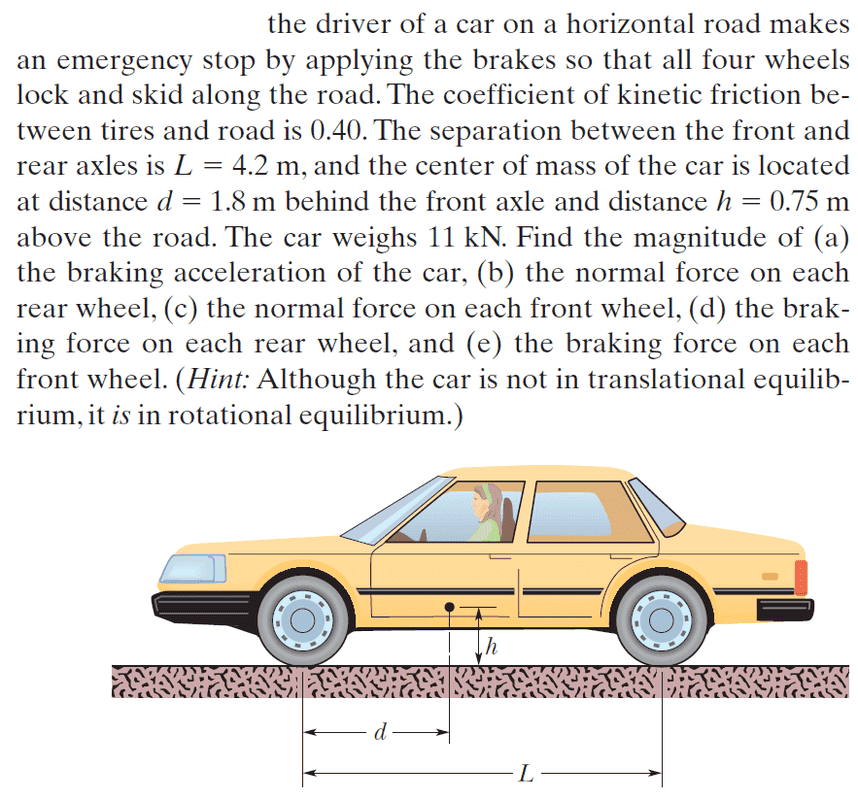
I get the correct answer if I use the COM as the axis of rotation for torque calculations. Shouldn't I be able to use any point as the axis of rotation for torque calculations, e.g. where the front wheels make contact with the ground?
car.png
car.png
 
  • Like
Likes   Reactions: Delta2
Physics news on Phys.org
Newton’s 2nd law applies to acceleration of the center of mass of the system. Even though there is no rotational acceleration, you must sum torques about the COM.
There is a way around this by using the concept of inertial forces, called pseudo forces. Since F=ma, rewrite it as F - ma = 0, where the quantity ma is the pseudo force. So apply the pseudo force ma at the COM , in the direction opposite the acceleration. Now you have an equilibrium situation since all forces and pseudo forces sum to zero, and you can thus sum torques about any point equal to 0 to get the answer.
I don’t often recommend the use of pseudo forces, although it works well here.
 
  • Like
Likes   Reactions: Lnewqban
Taulant Sholla said:
Shouldn't I be able to use any point as the axis of rotation for torque calculations,
It is not a statics problem: the car is accelerating. You can use the COM or any fixed point in an inertial frame; otherwise you must include pseudo forces as @PhanthomJay describes.
 
PhanthomJay said:
Newton’s 2nd law applies to acceleration of the center of mass of the system. Even though there is no rotational acceleration, you must sum torques about the COM.
There is a way around this by using the concept of inertial forces, called pseudo forces. Since F=ma, rewrite it as F - ma = 0, where the quantity ma is the pseudo force. So apply the pseudo force ma at the COM , in the direction opposite the acceleration. Now you have an equilibrium situation since all forces and pseudo forces sum to zero, and you can thus sum torques about any point equal to 0 to get the answer.
I don’t often recommend the use of pseudo forces, although it works well here.
This is very helpful, thank you so much!
 
haruspex said:
It is not a statics problem: the car is accelerating. You can use the COM or any fixed point in an inertial frame; otherwise you must include pseudo forces as @PhanthomJay describes.
Yes, that does clear things up--thank you!
 
haruspex said:
You can use the COM or any fixed point in an inertial frame;
why is that so? What makes valid the choice of COM for torque calculations in this problem?

I know that if two points positions vectors differ by ##\vec{d}## then the torques around those points differ by ##\vec{d}\times \sum \vec{F}## so if the sum of forces is not zero, then the total torque depends on the point chosen. I just don't understand why choosing COM (or any fixed point in an inertial frame) works for problems like this.
 
Delta2 said:
What makes valid the choice of COM for torque calculations in this problem?
Because the problem is the linear acceleration of the body, and the pseudoforce representing that has no moment about the CoM.
 

Similar threads

  • · Replies 7 ·
Replies
7
Views
2K
  • · Replies 33 ·
2
Replies
33
Views
3K
Replies
1
Views
2K
  • · Replies 25 ·
Replies
25
Views
2K
Replies
4
Views
2K
  • · Replies 5 ·
Replies
5
Views
3K
Replies
54
Views
4K
  • · Replies 17 ·
Replies
17
Views
2K
  • · Replies 2 ·
Replies
2
Views
2K
  • · Replies 4 ·
Replies
4
Views
1K