Choosing the right ESC for a Brushless motor

Click For Summary
SUMMARY

The discussion centers on troubleshooting power loss in a WLtoys V912 RC helicopter following a crash. The original ESC rated at 20A may be faulty, and a nearby shop offers a 30A ESC as a replacement, which is deemed acceptable since higher ratings do not harm the motor. Users emphasize the importance of checking for mechanical issues, such as a bent shaft or binding components, and suggest recalibrating the ESC throttle range as a potential solution. The consensus is that while the ESC may be the issue, other factors related to the crash could also contribute to the reduced power.

PREREQUISITES
  • Understanding of brushless motor specifications (e.g., 4500KV rating)
  • Knowledge of Electronic Speed Controllers (ESC) and their ratings (e.g., 20A vs. 30A)
  • Familiarity with RC helicopter mechanics and potential failure points
  • Experience with ESC throttle range calibration procedures
NEXT STEPS
  • Research how to calibrate ESC throttle range for various models
  • Learn about the impact of motor KV ratings on performance
  • Investigate common mechanical issues in RC helicopters post-crash
  • Explore the specifications and compatibility of different ESCs for brushless motors
USEFUL FOR

RC hobbyists, drone enthusiasts, and anyone involved in troubleshooting or upgrading brushless motor systems in remote-controlled vehicles.

karabiner98k
Messages
90
Reaction score
12
Hello everyone.

I have a RC helicopter (WLtoys V912) that recently had a crash. The main board was damaged and replaced and I got it working again but there is a problem. The main brushless motor is not as powerful as before and I have to apply 75% throttle to keep hovering above the ground. It used to hover with 55% throttle at the same altitude. I don't know whether it is the motor or the ESC that causes the problem but since the ESC is located between battery and the main board, it was probably pressed between the two during the crash.

I think the ESC is faulty but I don't have access to the original ESC for my model. It is rated @ 20A. There is a shop nearby and the owner says that he has 30A ESC and I can use it without any problem because he claims higher A rating won't do any harm but lower than stated rating would lead to overheating.

This is a 20A ESC:
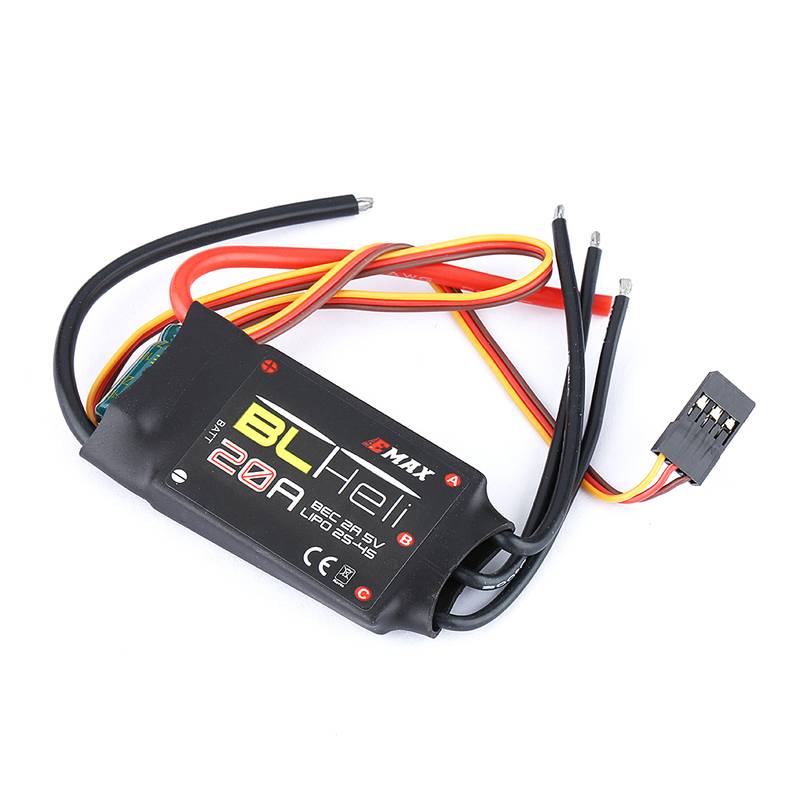
blheli-20-A-ESC.jpg


Is he right? How can I choose the right ESC for my brushless motor (7.4V 4500KV)?
 

Attachments

  • blheli-20-A-ESC.jpg
    blheli-20-A-ESC.jpg
    45.6 KB · Views: 1,051
Last edited:
Engineering news on Phys.org
In my experience seller is right - higher rating is not a problem (other than higher cost and higher mass). On some general level current is limited by the motor construction, so the higher rating of ESC is not going to destroy the motor.

But I wonder if it is really ESC that is a problem. As long as it doesn't bear any signs of overheating chances that it was destroyed in the crash are rather low. On the other hand motor elements can very easily get displaced when hit and even small change in geometry can lower the power.
 
motor elements can very easily get displaced when hit and even small change in geometry can lower the power

Could you please explain more? How can I check the motor to make sure it is not faulty?
 
The only way I can think of is to compare it with another, identical motor. Either in flight, or using a test stand.

Truth is, if it was a crash, everything can be a reason of a different behavior. You said the main board was replaced - no guarantee the new one is exactly identical, it can be a different batch, different firmware and so on.
 
Has the flight time been affected? If it's shorter now than it was before check nothing is bent/binding.
 
karabiner98k said:
I think the ESC is faulty but I don't have access to the original ESC for my model. It is rated @ 20A. There is a shop nearby and the owner says that he has 30A ESC and I can use it without any problem because he claims higher A rating won't do any harm but lower than stated rating would lead to overheating.

He is correct. You can use a 30A controller. The current draw depends on the motor. The controller rating of 30A means you can use a motor that draws upto 30A. The only issue is that a 30A controller might be slightly bigger or heavier.

However it's hard to see how a damaged ESC would work at all. My money is on a bent shaft or something binding. Perhaps the pitch of the blades has changed (eg reduced)?
 
  • Like
Likes   Reactions: NTL2009
Thanks a lot for your help.

My money is on a bent shaft or something binding. Perhaps the pitch of the blades has changed (eg reduced)?

You are right. After crash I replaced the main shaft, blades, flybar and the main gear with brand new ones. So, the problem is not related to them. It now flies perfectly but lacks power when I increase the throttle. It has lost about 20 - 25% of its power.
The motor is surrounded by two layers of heavy metal and it never hit anything during the crash.

Someone told me about ESC throttle range calibration. He told me that maybe my ESC needs recalibration after crash.

What do you think?
 
karabiner98k said:
The motor is surrounded by two layers of heavy metal and it never hit anything during the crash.

You don't have to hit the motor or its elements directly, it is enough to hit the shaft.

Someone told me about ESC throttle range calibration. He told me that maybe my ESC needs recalibration after crash.

Definitely one of many possibilities.
 
How can I calibrate my ESC throttle range?
 
  • #10
You need to google the ESC manual. Or the main board manual. Or you may need to check the details of how to configure your transmitter. Often each of these elements has its own configuration which makes it quite difficult to pinpoint the real reason of your problems.

That's not to discourage you from trying, it is just that my experience with crashed models tells me it can be really everything. I had to revive three planes, each one several times. Each time I have learned something new.
 

Similar threads

Replies
7
Views
5K
  • · Replies 1 ·
Replies
1
Views
3K
  • · Replies 4 ·
Replies
4
Views
3K
Replies
2
Views
4K
  • · Replies 1 ·
Replies
1
Views
4K
  • · Replies 1 ·
Replies
1
Views
13K
Replies
3
Views
3K
  • · Replies 3 ·
Replies
3
Views
3K
  • · Replies 4 ·
Replies
4
Views
2K
  • · Replies 1 ·
Replies
1
Views
4K