NotaMathPerson
- 82
- 0
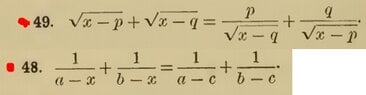
View attachment 5675
Hello! I just want to clarify something about the rules on solving quadratic eqns.
I have already solved both problems but in the process of my solution some questions arise.
For example in the part of my soltution in problem 48 I have this
$(x-c)\left(\frac{a^2+b^2-ac-bc+x(2c-a-b)}{x^2-ax-bx+ab}\right)=0$
Multiplying both sides by $(x^2-ax-bx+ab)$ I get two unqueal roots. I got the correct ansswer for this one
But when I divide both sides by $(x-c)$ I only get one root.
And also for 49
In the part of my solution I have
$x\left(\frac{1}{\sqrt{x-p}}+\frac{1}{\sqrt{x-q}}\right)=(p+q)\left(\frac{1}{\sqrt{x-q}}+\frac{1}{\sqrt{x-p}}\right)$
Dividing both sides by $\left(\frac{1}{\sqrt{x-q}}+\frac{1}{\sqrt{x-p}}\right)$
I get x=p+q which is the correct answer
Now my questions are the following
In prob 48, when I divide both sides of the equation by $x-c$ I end up having one root
In prob 49 when I divide both sides by $\left(\frac{1}{\sqrt{x-q}}+\frac{1}{\sqrt{x-p}}\right)$ I end up with two equal roots
I divided both sides of the equations for both problems by a factor which contain x and I ended up having one root for prob 48 and two equal roots for 49. Can you tell me why is it the case.
I know the reason why I get a single root for prob 48. It is because of the fact that x=c is a solution. But what I am having trouble with is the fact that I used the same process(dividing both sides by a factor containing x) for prob 49 and still end up with two equal roots. Please explain it. Thanks
Hello! I just want to clarify something about the rules on solving quadratic eqns.
I have already solved both problems but in the process of my solution some questions arise.
For example in the part of my soltution in problem 48 I have this
$(x-c)\left(\frac{a^2+b^2-ac-bc+x(2c-a-b)}{x^2-ax-bx+ab}\right)=0$
Multiplying both sides by $(x^2-ax-bx+ab)$ I get two unqueal roots. I got the correct ansswer for this one
But when I divide both sides by $(x-c)$ I only get one root.
And also for 49
In the part of my solution I have
$x\left(\frac{1}{\sqrt{x-p}}+\frac{1}{\sqrt{x-q}}\right)=(p+q)\left(\frac{1}{\sqrt{x-q}}+\frac{1}{\sqrt{x-p}}\right)$
Dividing both sides by $\left(\frac{1}{\sqrt{x-q}}+\frac{1}{\sqrt{x-p}}\right)$
I get x=p+q which is the correct answer
Now my questions are the following
In prob 48, when I divide both sides of the equation by $x-c$ I end up having one root
In prob 49 when I divide both sides by $\left(\frac{1}{\sqrt{x-q}}+\frac{1}{\sqrt{x-p}}\right)$ I end up with two equal roots
I divided both sides of the equations for both problems by a factor which contain x and I ended up having one root for prob 48 and two equal roots for 49. Can you tell me why is it the case.
I know the reason why I get a single root for prob 48. It is because of the fact that x=c is a solution. But what I am having trouble with is the fact that I used the same process(dividing both sides by a factor containing x) for prob 49 and still end up with two equal roots. Please explain it. Thanks
Attachments