etotheipi
I have a bit of a strange puzzle I can't work out. Let's say, we have a thin cylindrical disk of mass ##m## and radius ##r## connected on one side to a light axle of length ##d## through its centre. The axle is itself connected to a light string of length ##l##, the other end of which is connected to a fixed point. The string is taut and makes an angle of ##\theta## to the downward vertical, whilst the axle is horizontal and points in the radial direction, like this:
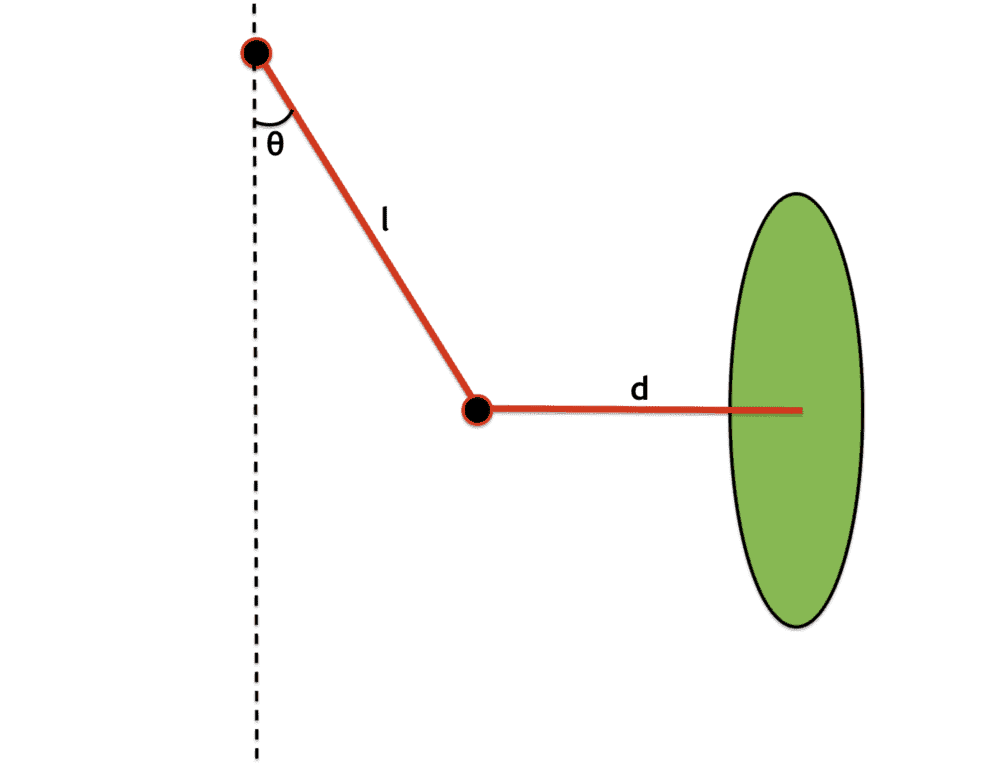
If the disk spins about its own central axis at ##\boldsymbol{\omega} = \omega_S \boldsymbol{e}_r##, and the configuration precesses about the dotted axis at ##\boldsymbol{\Omega} = \Omega_z \boldsymbol{e}_z##, then under the usual gyroscopic approximations ##\omega_S \gg \Omega_z## and ##d\Omega_z/dt = d\omega_S/dt = 0##, we want to determine ##\Omega_z##.
One way to solve it might be to take a coordinate system with origin at the hinge at the very top left hinge, and consider the system to be the string + rod + disk, in which case the angular momentum of the configuration is$$\mathbf{L} = \frac{1}{2}mr^2 \omega_S \boldsymbol{e}_r + [m(l\sin{\theta} + d)^2\ + \frac{1}{4}mr^2] \Omega_z \boldsymbol{e}_z \, \,
\overset{\text{gyro approx}}{\implies} \, \, \boldsymbol{\tau} = (l\sin{\theta} + d)mg \boldsymbol{e}_{\theta} = \frac{1}{2}mr^2 \omega_s \Omega_z \boldsymbol{e}_{\theta}
$$where the equality on the right equation holds under the approximation that ##d\Omega_z / dt = 0##. Another way to solve it, however, would be to take a coordinate system with origin at the centre of the disk (translating with the disk, but not rotating with the disk - i.e. as viewed by this coordinate system, the disk is slowly rotating about its own vertical axis), and consider the system to be the rod + disk. In this analysis, then, the string tension ##T## is an external force. In this coordinate system the angular momentum of the system is$$\boldsymbol{L} = \frac{1}{2}mr^2 \omega_S \boldsymbol{e}_r + \frac{1}{4} mr^2 \Omega_z \boldsymbol{e}_z \quad \overset{\text{gyro approx}}{\implies} \quad \boldsymbol{\tau} = dT\cos{\theta} \boldsymbol{e}_{\theta} = dmg \boldsymbol{e}_{\theta} = \frac{1}{2}mr^2 \omega_s \Omega_z \boldsymbol{e}_{\theta}$$where we used that ##F_z = T\cos{\theta} - mg = 0##. This second approach implies that the precession speed has no dependence on the string length nor the angle.
I presumed that, if I didn't mess up anywhere (I mean, it's pretty likely that I did! ), the discrepancy has to do with the assumptions made. Can anyone see? Thanks!
If the disk spins about its own central axis at ##\boldsymbol{\omega} = \omega_S \boldsymbol{e}_r##, and the configuration precesses about the dotted axis at ##\boldsymbol{\Omega} = \Omega_z \boldsymbol{e}_z##, then under the usual gyroscopic approximations ##\omega_S \gg \Omega_z## and ##d\Omega_z/dt = d\omega_S/dt = 0##, we want to determine ##\Omega_z##.
One way to solve it might be to take a coordinate system with origin at the hinge at the very top left hinge, and consider the system to be the string + rod + disk, in which case the angular momentum of the configuration is$$\mathbf{L} = \frac{1}{2}mr^2 \omega_S \boldsymbol{e}_r + [m(l\sin{\theta} + d)^2\ + \frac{1}{4}mr^2] \Omega_z \boldsymbol{e}_z \, \,
\overset{\text{gyro approx}}{\implies} \, \, \boldsymbol{\tau} = (l\sin{\theta} + d)mg \boldsymbol{e}_{\theta} = \frac{1}{2}mr^2 \omega_s \Omega_z \boldsymbol{e}_{\theta}
$$where the equality on the right equation holds under the approximation that ##d\Omega_z / dt = 0##. Another way to solve it, however, would be to take a coordinate system with origin at the centre of the disk (translating with the disk, but not rotating with the disk - i.e. as viewed by this coordinate system, the disk is slowly rotating about its own vertical axis), and consider the system to be the rod + disk. In this analysis, then, the string tension ##T## is an external force. In this coordinate system the angular momentum of the system is$$\boldsymbol{L} = \frac{1}{2}mr^2 \omega_S \boldsymbol{e}_r + \frac{1}{4} mr^2 \Omega_z \boldsymbol{e}_z \quad \overset{\text{gyro approx}}{\implies} \quad \boldsymbol{\tau} = dT\cos{\theta} \boldsymbol{e}_{\theta} = dmg \boldsymbol{e}_{\theta} = \frac{1}{2}mr^2 \omega_s \Omega_z \boldsymbol{e}_{\theta}$$where we used that ##F_z = T\cos{\theta} - mg = 0##. This second approach implies that the precession speed has no dependence on the string length nor the angle.
I presumed that, if I didn't mess up anywhere (I mean, it's pretty likely that I did!
), the discrepancy has to do with the assumptions made. Can anyone see? Thanks!
Last edited by a moderator:
