Closure in a Topological Space .... Willard, Theorem 3.7 .... ....

Click For Summary
SUMMARY

The forum discussion centers on understanding the proof of Theorem 3.7 from Stephen Willard's "General Topology." The key assertion is that if \( A \subset B \), then \( \overline{B} = \overline{A} \cup \overline{(B - A)} \) leads to the conclusion \( \overline{A} \subset \overline{B} \). Participants clarify that this follows from the set theory principle \( X \subseteq X \cup Y \) for sets \( X \) and \( Y \). The discussion emphasizes the importance of rigorous formalization in topology proofs.

PREREQUISITES
  • Understanding of basic set theory, particularly unions and subsets.
  • Familiarity with topological concepts such as closure and open sets.
  • Knowledge of Stephen Willard's "General Topology" and its notation.
  • Ability to interpret mathematical proofs and formal logic.
NEXT STEPS
  • Study the concept of closure in topological spaces as defined in Willard's "General Topology."
  • Review the properties of unions and intersections in set theory.
  • Explore additional examples of closure properties in various topological spaces.
  • Learn about the implications of K-compactness in topology.
USEFUL FOR

This discussion is beneficial for students of topology, mathematicians focusing on set theory, and anyone seeking a deeper understanding of closure properties in topological spaces.

Math Amateur
Gold Member
MHB
Messages
3,920
Reaction score
48
TL;DR
I need help in order to understand Willard Theorem 3.7 concerning topological closure ...
I am reading Stephen Willard: General Topology ... ... and am currently reading Chapter 2: Topological Spaces and am currently focused on Section 1: Fundamental Concepts ... ...

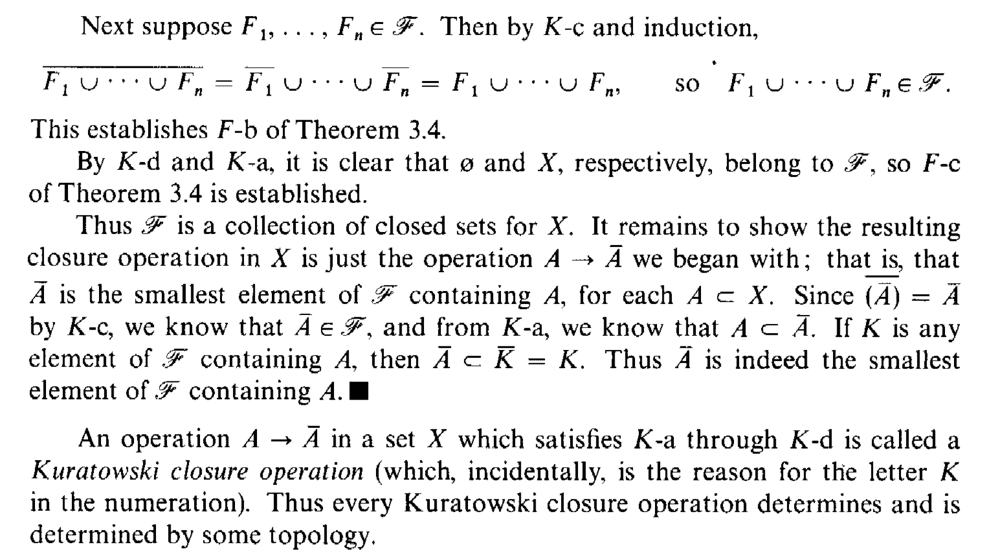
I need help in order to fully understand an aspect of the proof of Theorem 3.7 ... ..Theorem 3.7 and its proof read as follows:
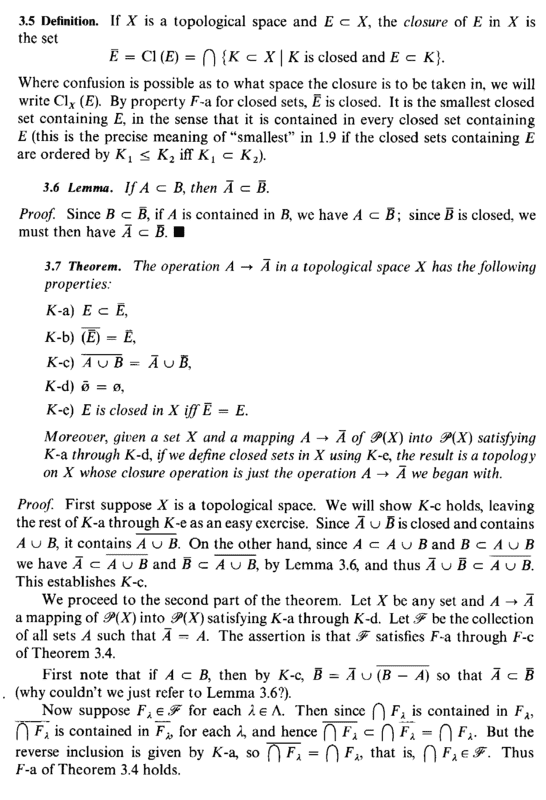
Willard - 1 - Theorem 3.7 ... PART 1 ... .png

Willard - 2 - Theorem 3.7 ... PART 2 ... .png

In the above proof by Willard we read the following:

" ... ... First note that if ##A \subset B##, then by K-c, ##\overline{B} = \overline{A} \cup \overline{ (B -A) }## so that ##\overline{A} \subset \overline{B}## ... ... "Can someone please demonstrate, formally and rigorously, how ##\overline{B} = \overline{A} \cup \overline{ (B -A) }## implies that ##\overline{A} \subset \overline{B}## ...
Help will be much appreciated ...

Peter
 
Last edited:
Physics news on Phys.org
Wow ... that was quick ...

Yes that's right ... hmm is it as simple as that ...

Thanks ...

Peter
 
Hi. Something went wrong with wrong with the formatting. I think it follows from ##X\subseteq X\cup Y## for sets ##X,Y##.

(I deleted previous post, but it was correct).
 
  • Like
Likes   Reactions: Math Amateur
Thanks ...

I think I have corrected the formatting ...

I think you're correct ...

Thanks again ...

Peter
 
  • Like
Likes   Reactions: member 587159
Math_QED said:
Hi. Something went wrong with wrong with the formatting. I think it follows from ##X\subseteq X\cup Y## for sets ##X,Y##.

(I deleted previous post, but it was correct).
I am probably being pedantic ... but it might be more accurate to say that ...

##\overline{B} = \overline{A} \cup \overline{ (B -A) }## implies that ##\overline{A} \subset \overline{B}## ... ... is true because ...

... for sets ##X, Y## and ##Z## we have that ...

##X = Y \cup Z \Longrightarrow Y \subset X##... ...

Peter
 
I would just write it like this:

##\overline{A}\subseteq \overline{A} \cup \overline{B - A} = \overline{B}##
 
  • Like
Likes   Reactions: Math Amateur

Similar threads

  • · Replies 2 ·
Replies
2
Views
2K
  • · Replies 2 ·
Replies
2
Views
2K
  • · Replies 4 ·
Replies
4
Views
2K
  • · Replies 5 ·
Replies
5
Views
3K
  • · Replies 4 ·
Replies
4
Views
3K
  • · Replies 2 ·
Replies
2
Views
2K
  • · Replies 5 ·
Replies
5
Views
3K
  • · Replies 2 ·
Replies
2
Views
3K
  • · Replies 1 ·
Replies
1
Views
2K
  • · Replies 2 ·
Replies
2
Views
2K