Coil resistence/impedance calculations

  • Thread starter Thread starter Nubcakes
  • Start date Start date
  • Tags Tags
    Calculations Coil
Click For Summary
SUMMARY

The discussion centers on the accurate calculation of coil resistance and impedance in RL circuits, specifically addressing the confusion surrounding the use of the reactance formula and the total impedance formula Z = SQ(r^2 + X^2). The participant conducted practical tests using multiple meters, concluding that the measured resistance of a coil at 60Hz is 0.54 Ohms, which contradicts theoretical calculations. Key insights include the importance of measuring at higher frequencies for accurate results and the necessity of proper compensation techniques when using LCR meters.

PREREQUISITES
  • Understanding of RL circuits and their components
  • Familiarity with impedance and reactance concepts
  • Knowledge of LCR meter operation and measurement techniques
  • Basic principles of AC circuit analysis
NEXT STEPS
  • Learn about LCR meter compensation techniques for accurate measurements
  • Study the effects of frequency on inductance and impedance
  • Explore the differences between real and imaginary components in AC circuits
  • Review the Agilent Technologies PDF on impedance measurement for deeper insights
USEFUL FOR

Electrical engineers, interns in electronics, hobbyists building RL circuits, and anyone interested in accurate impedance measurement techniques.

Nubcakes
Messages
7
Reaction score
0
So I've never gotten a straight answer as to how you calculate the resistance of a coil (or cap for that matter). I hesitate to use the term "impedance" because I've been told too many times to count that impedance is the total resistance of a circuit. My professors dance around the topic from time to time but they have never given me a straight answer. I've talked to practicing electrical engineers where I work(as an intern) and they give me the deer in the headlights look. Eventually they all cough up the reactance formula. The only other response I've gotten from an RF-engineer was to use this formula: Z = SQ(r^2 + X^2). X is reactance. I've taken it all for granted until one of my friends today told me neither works in real life.

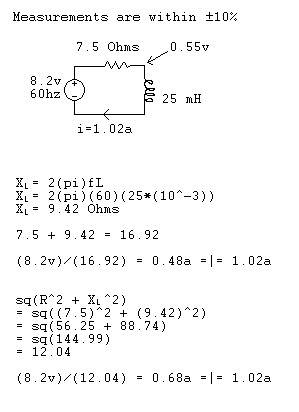
So I decided to get some components and built up an RL circuit to see what actually happens. I used multiple relatively accurate meters to measure the values within the circuit. All meters gave me the same results within 5% so I am pretty sure the measured values are correct. Below is the circuit and calculations I did;
CoilResistenceWTF.jpg


Neither formula gives the correct resistance of the coil. According to my actual test the resistance of the coil at 60Hz should be 0.54 Ohms. Can anyone help me figure this out? Thanks!

EDIT: Just to be clear, this is not for a class in anyway shape or form. This is strictly for my personal understanding.
 
Last edited:
Engineering news on Phys.org
There would be some resistance in the coil as it is just wound with wire.

However, assume there was no resistance,

The coil must have an inductance of about 1.338 mH. ( I calculated this from the voltages you gave.)

To check this:

At 60 Hz this coil has a reactance of (2 * pi * 60 * L) or 0.5044 ohms

Put this into the second formula:

Z2 = (7.5)2 + (0.5044)2

so Z = 7.5169 ohms

Current = 8.2 Volts / 7.5169 ohms or 1.09 amps. Near enough to what you got.

So, the voltage across the resistor would be I * R = 1.09 amps * 7.5 ohms = 8.175 Volts

Voltage across the inductor would be I * XL or 1.09 amps * 0.5044 ohms or 0.5497 Volts

Total voltage = I * Z = 1.09 amps * 7.5169 ohms = 8.19 volts.

So, the second formula (with the squares and square roots) is the one to use.
 
Ugh, the crazy thing is I have 4 separate RLC meters (different brands) that all say the inductor is 24~27mH and the resistor is 7.2~7.9 Ohm. I used 2 meter and oscilloscope to measure the voltages and they were within 0.03 volts of each other. I used the same 2 meters for the AC current and both were within 0.01 amps. Something doesn't add up.Edit; I'd test other resistors if I had any that can handle this kind of power. As it stands I only have 7.5, 50, and 100 ohm resistors that can handle 5 watts or more continuously. Everything else I have is rated at less than 1 watt. I also don't have any other coils which can handle this kind of power to test. All my coils are 10~80 mH.
 
Last edited:
If your coils are wound on an iron core, I wonder if they are rated for 1 amp?
They might be saturating.
 
They are wound around a material that looks similar to a magnet. the material is kind of brittle and a very dark gray. It reminds me of the material you see near the end of cables which is encased in plastic. It looks like a magnet and breaks like a magnet, but it is not one.
 
Nubcakes said:
So I've never gotten a straight answer as to how you calculate the resistance of a coil (or cap for that matter). I hesitate to use the term "impedance" because I've been told too many times to count that impedance is the total resistance of a circuit. My professors dance around the topic from time to time but they have never given me a straight answer. I've talked to practicing electrical engineers where I work(as an intern) and they give me the deer in the headlights look. Eventually they all cough up the reactance formula. The only other response I've gotten from an RF-engineer was to use this formula: Z = SQ(r^2 + X^2). X is reactance. I've taken it all for granted until one of my friends today told me neither works in real life.

So I decided to get some components and built up an RL circuit to see what actually happens. I used multiple relatively accurate meters to measure the values within the circuit. All meters gave me the same results within 5% so I am pretty sure the measured values are correct. Below is the circuit and calculations I did;

CoilResistenceWTF.jpg


Neither formula gives the correct resistance of the coil. According to my actual test the resistance of the coil at 60Hz should be 0.54 Ohms. Can anyone help me figure this out? Thanks!

EDIT: Just to be clear, this is not for a class in anyway shape or form. This is strictly for my personal understanding.

You can't just add XL and R like method #1. Inductive reactance is imaginary while resistance is real. You have to get the complex magnitude using the Pythagorean formula. 12.04 is the correct magnitude. The arctan of 9.42/7.5 is the complex phase which gives 51º which is a poor value for an inductor. It should be 90º - this tells me this is an inductor designed to be used at a higher frequency than 60 Hz. Measure it at 1 KHz or 1 MHz instead.

If you measured something different with an LCR meter there are a couple of reasons why that can occur.
  1. "Compensation" or lack of it - did you do an Open/Short compensation for your fixture, cables and connectors? All LCR meters require it. Consult the meter's manual for how. Also the linked document below discusses this.
  2. Wrong types of cables or wrong cable connections. Most all LCR meters use 4-wire Kelvin measurements which require connecting force and sense lines for high or low voltage close to the DUT (Hpot + Hcur and Lpot + Lcur on Agilent/HP meters).
  3. "Model artifacts" - if you are reading a model series-RL from the instrument, there are times it can "lie" to you - usually involving #1 and #2 problems. The models are applied to the raw, measured Magnitude-Phase completely blindly/dumbly so bad raw data will give bad displayed data.
  4. Instrument measurement accuracy. Generally at the low or high end of the test frequency range the accuracy suffers

For the above reasons you should always measure first with magnitude-phase mode. This is the actual "raw" measurement mode of an LCR meter with the cleanest, least "corrupted" data.

Measure a known component first - for this inductor use a higher frequency to get a more nearly ideal phase of 90º. Measure a resistor as well: the phase should be 0º. And measure a capacitor: the phase should be -90º. This will validate the compensation and cabling are correct. If you don't get these values of phase you already have a problem.

Because inductance is (effectively) constant at all frequencies, measuring at 1 MHz instead of 60 Hz doesn't matter. Higher test frequencies can increase the accuracy though because you will be closer to the center of the meter's sweet ranges.

Also for more reference on this kind of thing and measuring impedance, download this PDF document from Agilent Technologies: "http://cp.literature.agilent.com/litweb/pdf/5950-3000.pdf" ". It will probably help answer many things you aren't understanding.
 
Last edited by a moderator:
Most likely this can only be answered by an "old timer". I am making measurements on an uA709 op amp (metal can). I would like to calculate the frequency rolloff curves (I can measure them). I assume the compensation is via the miller effect. To do the calculations I would need to know the gain of the transistors and the effective resistance seen at the compensation terminals, not including the values I put there. Anyone know those values?

Similar threads

  • · Replies 11 ·
Replies
11
Views
3K
  • · Replies 17 ·
Replies
17
Views
3K
Replies
7
Views
5K
  • · Replies 2 ·
Replies
2
Views
2K
Replies
8
Views
2K
  • · Replies 19 ·
Replies
19
Views
4K
  • · Replies 30 ·
2
Replies
30
Views
5K
  • · Replies 7 ·
Replies
7
Views
3K
Replies
12
Views
3K
Replies
1
Views
2K