nikosb
- 29
- 1
I need to collimate an extended source (for example a cell phone) to infinity or as far as possible. I show an illustration below
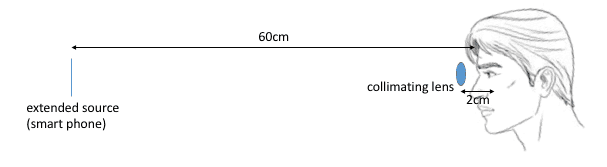
The collimator lens is about 2cm from the eye and the extended source is about 60cm from the eye. My understanding is that a collimator lens with a focal length of 60cm (58cm in this case) would do the job. I have some double convex lenses with focal length of 50cm and 100cm. I experimented with them by placing the extended source at the corresponding focal length and then looking though the lenses with one eye and the other eye closed. In general the virtual image appears a little larger but also a little blurry. However I did not get the sensation that the virtual image was located at infinity or anywhere close to infinity. I felt that the virtual image was only slightly farther out proportional to the amount of magnification. For example, if the image was magnified by 1.3 times (it appeared about 1.3 times larger when looking through the lens compared to when looking without the lens) the location of the virtual image was 1.3 times father out. This seems to be consistent with the mathematic of the lens equations (https://www.physicsclassroom.com/class/refrn/Lesson-5/The-Mathematics-of-Lenses):
M = hi/ho = di/do
Can I collimate an extended source as shown above and if yes will the collimated image be at infinity? If the above setup is correct then why do me eye doesn't get the sensation that the virtual image is located at infinity?
The collimator lens is about 2cm from the eye and the extended source is about 60cm from the eye. My understanding is that a collimator lens with a focal length of 60cm (58cm in this case) would do the job. I have some double convex lenses with focal length of 50cm and 100cm. I experimented with them by placing the extended source at the corresponding focal length and then looking though the lenses with one eye and the other eye closed. In general the virtual image appears a little larger but also a little blurry. However I did not get the sensation that the virtual image was located at infinity or anywhere close to infinity. I felt that the virtual image was only slightly farther out proportional to the amount of magnification. For example, if the image was magnified by 1.3 times (it appeared about 1.3 times larger when looking through the lens compared to when looking without the lens) the location of the virtual image was 1.3 times father out. This seems to be consistent with the mathematic of the lens equations (https://www.physicsclassroom.com/class/refrn/Lesson-5/The-Mathematics-of-Lenses):
M = hi/ho = di/do
Can I collimate an extended source as shown above and if yes will the collimated image be at infinity? If the above setup is correct then why do me eye doesn't get the sensation that the virtual image is located at infinity?
