nikosb
- 30
- 1
I have a spherical concave mirror with focal length of 65cm, radius of curvature of 130cm. I hold the mirror close to the eye at approximate 45 degrees and I reflect an object below it as shown in the image.
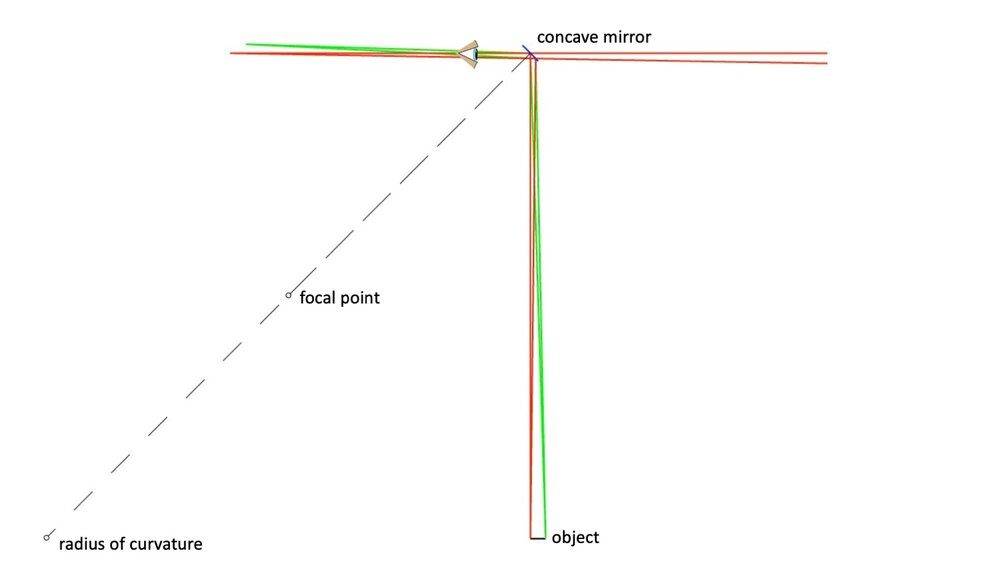
The distance between the object and the mirror is 90cm, that is more than the focal length. In such a case one would expect that a real image would be formed, the real image being inverted. I did a ray tracing diagram and indeed the rays converge to the left of the mirror. However when I look at the mirror I actually see a virtual image that is upright (a little blurry) and that appears to be behind (to the right) the mirror. How is this possible?
I understand that a real image is formed but the eye is located between the real image and the mirror and thus can not see the real image. Instead the eye sees an upright virtual image. What is happening? Isn't this contrary to basic optics law?
The distance between the object and the mirror is 90cm, that is more than the focal length. In such a case one would expect that a real image would be formed, the real image being inverted. I did a ray tracing diagram and indeed the rays converge to the left of the mirror. However when I look at the mirror I actually see a virtual image that is upright (a little blurry) and that appears to be behind (to the right) the mirror. How is this possible?
I understand that a real image is formed but the eye is located between the real image and the mirror and thus can not see the real image. Instead the eye sees an upright virtual image. What is happening? Isn't this contrary to basic optics law?