Collision between moving walls

  • Context: Undergrad 
  • Thread starter Thread starter Buffu
  • Start date Start date
  • Tags Tags
    Collision Mechanics
Join the discussion
Registration is free. Ask a follow-up in this thread, or start your own.
13 replies · 3K views
Buffu
Messages
851
Reaction score
147
https://www.physicsforums.com/attachments/upload_2017-6-17_4-22-26-png.205585/?temp_hash=f9f8d75085046fd530ad1071794d65c1

I have problem with the solution given of the (b) part of the question.
The given solution is :
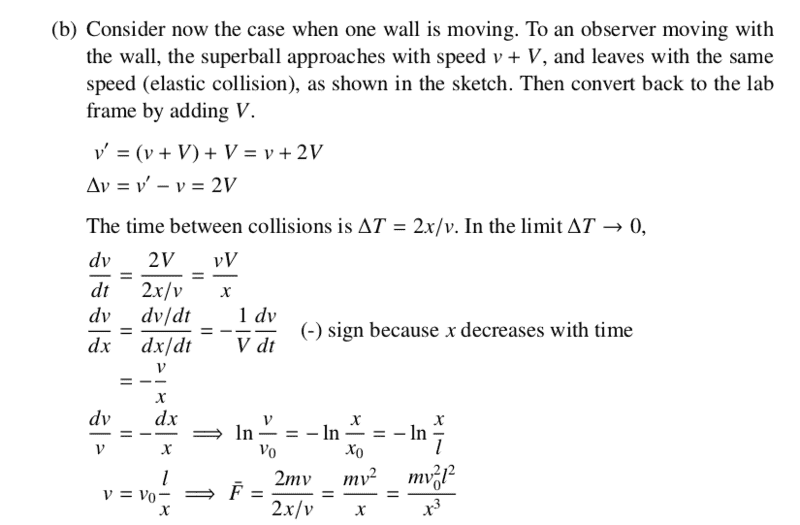
upload_2017-6-17_4-23-44.png


I did not understand why the value of ##\Delta T = 2x/v## even when ##\Delta T \to 0## ?
Since if the time taken for collision reduces so does the distance between the wall and the ball and since velocity is constant. The value should be ##0##. No ?
 
Physics news on Phys.org
jbriggs444 said:
The value of what should be zero? And why do you expect velocity to be constant?
Oh sorry, I mean the value of ##dv/dt## should be infinite.
I expect the value to be constat because it is given in the question that the ball moves with a constant velocity.
 
Buffu said:
Oh sorry, I mean the value of ##dv/dt## should be infinite.
I expect the value to be constat because it is given in the question that the ball moves with a constant velocity.
As I read the question, no such thing is given. The speed increases with each bounce.
 
jbriggs444 said:
As I read the question, no such thing is given. The speed increases with each bounce.

If v was not constant then how does we got ##\Delta T = 2x/v## in the first place ?
 
Buffu said:
If v was not constant then how does we got ##\Delta T = 2x/v## in the first place ?
Because V << v and because v is increasing, it is a good approximation that gets better and better.
 
jbriggs444 said:
Because V << v and because v is increasing, it is a good approximation that gets better and better.
I am sorry, I did not follow how does velocity of wall has to do anything with the velocity of ball ? Can you elaborate on it please.
 
Buffu said:
I am sorry, I did not follow how does velocity of wall has to do anything with the velocity of ball ? Can you elaborate on it please.
The velocity of the ball changes at each bounce from a moving wall. How much it changes depends on V.

Also, how much x changes during a round trip depends on V.
 
  • Like
Likes   Reactions: Buffu
jbriggs444 said:
The velocity of the ball changes at each bounce from a moving wall. How much it changes depends on V.

Also, how much x changes during a round trip depends on V.

I can buy that explanation.
If I wanted to find accelaration of ball without doing all this. Is it possible ?
 
Buffu said:
I can buy that explanation.
If I wanted to find accelaration of ball without doing all this. Is it possible ?
I suspect that treating the ball as an ideal gas under adiabatic compression would work.
 
jbriggs444 said:
I suspect that treating the ball as an ideal gas under adiabatic compression would work.

I intended to ask if there is some more mathematically accurate way to do this using mechanics.

Since you have mentioned, how should I go doing that ? I thought I will differentiate adiabatic work done but I don't know temperature, pressure and thing like that :((.
 
Buffu said:
If I wanted to find accelaration of ball without doing all this.
All what? It's a simple elastic collision situation at each bounce. This is the sort of situation that is built on in deriving the simple theory for the Gas Equations so I think it would be much easier to keep to simple Mechanics, rather than getting into thermodynamics.
 
sophiecentaur said:
All what? It's a simple elastic collision situation at each bounce. This is the sort of situation that is built on in deriving the simple theory for the Gas Equations so I think it would be much easier to keep to simple Mechanics, rather than getting into thermodynamics.

I also don't like to use thermodynamics. But I want to know if there is a different way to solve this question using mechanics ?
 
Buffu said:
I also don't like to use thermodynamics. But I want to know if there is a different way to solve this question using mechanics ?
As I said before, the gas laws can be derived using exactly the same idea of elastic collisions against the walls of a box. What more could you ask for? See this link and do some more searching. The Web is seething with information about the.