Science Advisor
- 1,406
- 1,164
It is a simple problem, but I think it is quite nice.
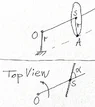
A disk of radius ##r## is connected to a shaft by means of a hinge ##S## located at the center of the disk. The hinge allows the disk to slide along the shaft and rotate around it, but maintains a constant angle ##\alpha\in(0,\pi/2)## between the disk and the shaft. The end of the shaft is connected to a fixed vertical post through a hinge ##O##. The shaft rotates around this vertical post while remaining horizontal. Meanwhile, the disk rolls without slipping on a horizontal plane. The point ##A## at the picture is the contact point between the disk and the horizontal plane.
What is the trajectory of point ##S## in this case?
A dynamic version of this problem is also possible. For example, suppose a constant torque ##M## directed vertically is applied to the shaft at point ##O##. Find the law of motion of the disk.
A disk of radius ##r## is connected to a shaft by means of a hinge ##S## located at the center of the disk. The hinge allows the disk to slide along the shaft and rotate around it, but maintains a constant angle ##\alpha\in(0,\pi/2)## between the disk and the shaft. The end of the shaft is connected to a fixed vertical post through a hinge ##O##. The shaft rotates around this vertical post while remaining horizontal. Meanwhile, the disk rolls without slipping on a horizontal plane. The point ##A## at the picture is the contact point between the disk and the horizontal plane.
What is the trajectory of point ##S## in this case?
A dynamic version of this problem is also possible. For example, suppose a constant torque ##M## directed vertically is applied to the shaft at point ##O##. Find the law of motion of the disk.
Attachments
Last edited: