Why would sailboat racers prefer a full keel over a fin keel?

  • Context: High School 
  • Thread starter Thread starter DaveC426913
  • Start date Start date
DaveC426913
Gold Member
2025 Award
Messages
24,538
Reaction score
8,847
TL;DR
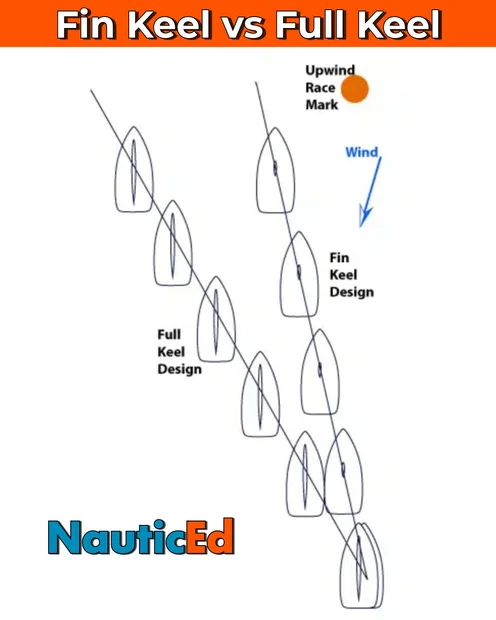
Fin keels are apparently *less* prone to leeway. Why?
I keep going back and forth on this. Apparently, fin keels are better (and preferred) than full keels for racing because they
1] are faster (less drag), and
2] can point higher, and finally
3] are apparently less prone to leeway?

1779731278257.webp


I first thought well sure that huge full keel would more easily be pushed off to leeward by the water, but duh - why would there be any pressure from the water pushing the keel to leeward? The boat is being pushed to leeward by the sails; the job of the keel is to prevent that and keep it on track. Ergo, a full keel would track better toward a mark because of its lesser leeway.
 
Physics news on Phys.org
Could you post some pictures or links or something about those 2 kinds of keels? Thanks.
 
Think of a fin keel more like an airplane wing. It generates lift in exactly the same way. So to some extent it isn't just resisting drift to leeward but pulling the boat to windward. Fins make more efficient lifting devices. So, "why do airplanes have long wings?" is a similar question. Lift vs. drag and weight favors long wings.

Of course there are other practical matters to consider, like draft, ruggedness, cost etc.

PS: There's also an advantage of having the weight lower to allow more force on the sails with deep keels, hence the keel bulbs that you see on modern racing boats. Also sometimes wings at the bottom to generate this righting force as well as improve efficiency (just like the winglets at the tip of modern airplane wings).
 
Last edited:
berkeman said:
Could you post some pictures or links or something about those 2 kinds of keels? Thanks.
Full/reef is long, fin is short (longitudinally - i.e. front-to-back).

The fin keel is not necessarily deeper than the full/reef keel:
1779747934467.webp


Both have zero camber (i.e. symmetrical), of course, since they need to work on both tacks.

They generate lift that opposes the force of wind. That's what keeps the boat on-track.
 
The full keel prevents quick changes in direction when the rudder is moved, and forces the boat to travel closer to the line of the hull. In effect the full keel is a single vertical axis foil, with the camber adjusted by the rudder position. The headsail-mainsail imbalance is important when changing direction.

A fin keel, with the rudder, makes for more dynamic control of the hull direction through the water, so some deliberate sideways motion in the water can be generated, that keeps the boat and sails more upright. In effect the fin keel, with the rudder gives two separated vertical-axis foils, giving more turning torque. The fin keel allows for rapid turns, with little loss of hull speed through the water.

The full keel is like a delta wing aircraft, while the fin keel is more like the typical aircraft configuration, with more control of the attitude, and the angle of attack of the wings.
 

Similar threads

  • · Replies 3 ·
Replies
3
Views
2K
  • · Replies 27 ·
Replies
27
Views
11K