Colour of engineering drawing board, sit or stand?

  • Thread starter Thread starter user079622
  • Start date Start date
Click For Summary

Discussion Overview

The discussion revolves around the characteristics and preferences related to engineering drawing boards, specifically their color and the choice between sitting or standing while drafting. Participants explore the historical context of drawing techniques and materials, as well as personal experiences with drafting practices.

Discussion Character

  • Exploratory
  • Technical explanation
  • Debate/contested
  • Historical

Main Points Raised

  • Some participants question why professional engineering drawing boards are predominantly white, suggesting that a brown board might provide better contrast with paper.
  • There is a clarification regarding the terminology used in the thread title, with participants correcting "seat" to "sit."
  • One participant reminisces about the transition from hand drafting to CAD, noting the inefficiencies of older methods and expressing nostalgia for the past.
  • Another participant shares their experience with the use of vellum paper and the Ozalid machine, explaining that the white background was beneficial for contrast with pencil lines.
  • Some participants reflect on their experiences with standing versus sitting while drafting, suggesting that personal preference and specific tasks influence the choice.
  • There are discussions about the historical use of transparent paper in engineering, with participants explaining the necessity of this material for certain printing processes.
  • Several participants express uncertainty about the current use of transparent paper and the evolution of drafting techniques, indicating a shift towards digital methods.

Areas of Agreement / Disagreement

Participants express a range of views on the color of drawing boards and the preference for sitting or standing while drafting. There is no consensus on whether a different color board would be more effective, and the discussion about drafting practices reflects both agreement on the nostalgia for past methods and disagreement on current practices.

Contextual Notes

Participants reference specific historical practices and materials, such as the use of vellum and the Ozalid machine, which may not be familiar to newer generations of engineers. The discussion highlights the limitations of personal experience and the evolution of technology in engineering drawing.
user079622
Messages
449
Reaction score
29
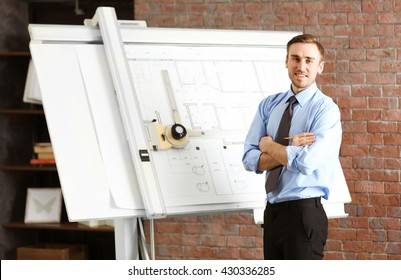
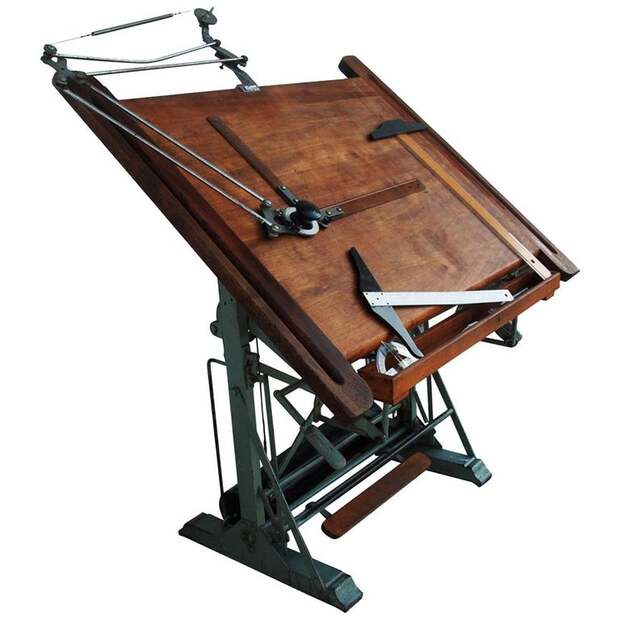
Is any reason why proffesional engineering drawing board are all white, wouldnt be better if it is brown so more contrast in paper and background?
Is it easier to seat or stand while drafting?
gineer-working-panel-board-indoors-260nw-430336285.jpg


18865542_master.jpg
 
Last edited:
Engineering news on Phys.org
Why is topic is moved, this is engineering topic?
 
user079622 said:
Why is topic is moved, this is engineering topic?
No, it is a simple discussion, not involving engineering calculations. And what do you mean by the word "seat" in your title?

Oh, I see this now in your OP:
user079622 said:
Is it easier to seat or stand while drafting?
I think you mean "sit or stand".
 
  • Like
Likes   Reactions: Vanadium 50
A related question: Does ANYONE still use these for technical drawings?

Our lab gave one (the only one) away in about 1995. Switched it to a light table for checking PCB layouts. Then we got rid of that about 10 years later.

On a related, related note: This december is the 41st anniversary of the first version of AutoCAD. Although that was certainly not the first CAD SW.

PS - This takes me back to the days of hand drawn schematics on vellum and blueprint machines. I just caught the tail end of that time. Then I gave the prints to a draftsman who put it in a PCB CAD program for us. Really inefficient by today's standards. It's funny how you can get nostalgic about things that weren't so great, like the smell of ammonia at the blueprint machine.
 
Last edited:
  • Like
Likes   Reactions: Rive, russ_watters and berkeman
berkeman said:
No, it is a simple discussion, not involving engineering calculations. And what do you mean by the word "seat" in your title?

Oh, I see this now in your OP:

I think you mean "sit or stand".
yes sit
 
I only ever hand drafted 30 years ago in high school, but I remember standing and would expect it to be better so you have more mobility when working on large drawings. But that would depend on what you are doing/if you need to access the whole thing or a small part. Also, dependent on back problems.
 
  • Like
Likes   Reactions: Tom.G
DaveE said:
like the smell of ammonia at the blueprint machine.
Ah, yes. The old Ozalid machines. I remember those well from my days at NASA in the 60's and 70's. GOD that ammonia smell was awful but that's what was used to print large circuit diagrams (as I recall, about 3' x 5') of our digital electronics.

Actually, it was also used to print circuit diagrams of analog electronics as well, but I considered that stuff to be mostly part of the Black Arts so the Ammonia smell seemed more appropriate for them :smile:
 
Last edited:
user079622 said:
Is any reason why proffesional engineering drawing board are all white,
Well, when I worked with circuit draftsmen in the 60's and 70's the drawings were on velum (semi-transparent) paper drawn with pencils so the white background made a good contrast with the pencil lines. These sheets were then put through an Ozalid Machine (see post #7) to produce a blue-line drawing on a light blue background (along with a HUGE stink of ammonia).

I believe this was also done in the construction industry but I'm less sure about that.

A dark color board would have been useless.

I couldn't find any old circuit diagrams but here's part of an architectural diagram that was produced using the process:
1701910262322.png
 
Last edited:
  • Like
Likes   Reactions: Lnewqban
user079622 said:
Is it easier to seat or stand while drafting?
A lot of it boils down to personal preference. Usually (always?) there was a very high seat chair/stool (much like a bar stool) available that one could sit on and still reach most of the drawing surface so as I recall, the draftsmen sometimes sat and sometimes stood. Most probably sat most of the time.
 
  • #10
phinds said:
it was also used to print circuit diagrams of analog electronics as well, but I considered that stuff to be mostly part of the Black Arts so the Ammonia smell seemed more appropriate for them
Me. That was me. But around 1982. My exposure (in years) was brief, the tail end of ancient copiers. I also recall mimeographs from grade school.
phinds said:
along with a HUGE stink of ammonia

phinds said:
GOD that ammonia smell was awful
I don't remember it as being THAT bad. Unless you had to stay there and make a bunch of copies. As I recall you adjusted the "exposure" which resulted in more or less stink along with more or less blue. It did have it's own separate room though. Maybe by 1980 they had figured out about ventilation.

This is the machine I recall, they say it isn't as stinky as others, but IDK.
https://www.ejmotiwalla.com/Codes/Maxphotos/Geomatictools/Previews/ammonia_printer.htm

phinds said:
I couldn't find any old circuit diagrams
I really, really, really wish I'd kept one of these blue-line schematics. Suitable for framing, or maybe the computer history museum now.

Just a year or so later I was walking to a "computer room" to draw schematics on a Lisa. Rule #1: save your work AT LEAST every 5 minutes because that program (whatever it was) will crash; soon. Still much better than a drafting board though.

It's amazing how fast the technology environment changes. All of your old digital schematics, hand drawn on vellum, are Verilog or VHDL code now; or C++. Probably C++ on a platform unimaginable to an EE in 1970. Probably created by someone that has no idea how a transistor works.
 
  • Like
Likes   Reactions: berkeman
  • #11
I'll also add that if you ever used one of these machines, you'll understand the old Mil-Spec rule that schematics never had junctions of more than three lines. Two lines crossing meant no connection because low fidelity copies would put a dot there; dots only count at tee intersections. i.e. don't trust the dots.

PXL_20231207_020441219.jpg
 
  • Like
  • Wow
Likes   Reactions: russ_watters and berkeman
  • #12
DaveE said:
I really, really, really wish I'd kept one of these blue-line schematics. Suitable for framing, or maybe the computer history museum now.
I doubt if one would still be legible by now unless you had kept it hidden away in a carboard box inside a closet.
 
  • Like
Likes   Reactions: DaveE
  • #13
phinds said:
Well, when I worked with circuit draftsmen in the 60's and 70's the drawings were on velum (semi-transparent) paper drawn with pencils so the white background made a good contrast with the pencil lines. These sheets were then put through an Ozalid Machine (see post #7) to produce a blue-line drawing on a light blue background (along with a HUGE stink of ammonia).

I believe this was also done in the construction industry but I'm less sure about that.

A dark color board would have been useless.

I couldn't find any old circuit diagrams but here's part of an architectural diagram that was produced using the process:
View attachment 336793
Why engineers use semi transparent paper?
 
  • #14
user079622 said:
Why engineers use semi transparent paper?
Because that's what the printing process required. The light had to go THROUGH the paper, and not through the pencil lines.

If you never needed any copies, you could just do it on paper and use the original.
 
  • #15
user079622 said:
Why engineers use semi transparent paper?
Like a film negative, except the development process meant it was a positive. Where light couldn't get through to the paper, the development process made dark areas.
 
  • #16
phinds said:
Because that's what the printing process required. The light had to go THROUGH the paper, and not through the pencil lines.

If you never needed any copies, you could just do it on paper and use the original.
In machine you put original pencil work and you get out blue or black pen lines on new paper and original pencil work remain in pencil?
Is new paper with pen lines transparent or not?Today this machine dont use any more, original pencil work is just put in printer to photocopy?
so they dont draw at transparent paper any more if they need it?
 
Last edited:
  • #17
user079622 said:
so they dont draw at transparent paper any more
It's all about clickety-click-click these days :wink:

Though I still set the layers semi-transparent during PCB-design... But for completely different reasons o0)
 
  • #18
Last time I had anything to do with transparent paper was when I was asked about the old way to DIY PCBs.
I directed the guy to some chinese manufacturers. That old stuff with Fe(whatever)Cl(dunno) and photosensitive stuffs and transparent paper is just not around anymore.

I think it's a safe bet that our (office) supplier would have to ask for help would they ever get such request (transparent paper) from us.

So - we don't use any. Not the electronics guys (that's us) nor the mechanicals.
 
Last edited:
  • #19
user079622 said:
But today we can photocopy so no need for transparent paper?
Photocopy didnt exist then or this technique have some benefits?
I'm not sure a Xerox type photocopier was ever used/common for large format copies. Such a machine would have been huge. And there were several competing technologies for small format (letter size paper). But either way for at least the last 20 years it's been optical scanners and inkjet or laserjet printers. And of course since the drawings are digital to begin with there's less of a need for photocopies.
 
  • #20
russ_watters said:
I'm not sure a Xerox type photocopier was ever used/common for large format copies. Such a machine would have been huge. And there were several competing technologies for small format (letter size paper). But either way for at least the last 20 years it's been optical scanners and inkjet or laserjet printers. And of course since the drawings are digital to begin with there's less of a need for photocopies.
This genius still use drawing board with mechanical pencil.
His words:
“I love the drawing board because most of the work I do is of half scale, so I can have the complete car in front of me, whereas the CAD system limits you to the size of the screen.”
(They must use half scale in wind tunnel, regulated by FIA)

" I just feel at home in that form of expression, I always compare it to a language. The board is the language I am most familiar with and in which I can express myself best. I think drawing has to come from the subconscious, and that's how it is with me."

https://www.speedweek.com/amp/forme...Zeichenbrett-Bin-ein-Dinosaurier.html?lang=en

1.From picture it seems paper is not transparent vellum paper, this is universal bond paper or white board make this look?
2.If he want put his drawing into ink for archive, what machine/technique today is used?
Scan then print, photocopy or Ozalid ?
ppp-newey.jpg

 
  • #21
user079622 said:
Scan then print, photocopy or Ozalid ?
Ozlaid machines haven't been used for many years, I'm pretty sure.
 
  • #22
phinds said:
Ozlaid machines haven't been used for many years, I'm pretty sure.
That mean we dont need transparent paper any more?
But we need some paper that lots of eraser work will not damage paper
 
  • #23
user079622 said:
That mean we dont need transparent paper any more?
But we need some paper that lots of eraser work will not damage paper
This is beginning to sound like you are a troll, just stringing us along to see how many questions you can get answered about paper. I'm done.
 
  • Like
Likes   Reactions: BillTre, berkeman, Bystander and 1 other person
  • #24
I find this
Someting like this, this mean today you can draw on whatever you want ..

 
Last edited:
  • #25
phinds said:
This is beginning to sound like you are a troll, just stringing us along to see how many questions you can get answered about paper. I'm done.
I am not troll, just nobody confirm that transparent paper is not need any more because we have modern scanners.
 

Similar threads

Replies
5
Views
3K
  • · Replies 6 ·
Replies
6
Views
2K
  • · Replies 13 ·
Replies
13
Views
2K
  • · Replies 22 ·
Replies
22
Views
4K
  • · Replies 43 ·
2
Replies
43
Views
11K
  • · Replies 3 ·
Replies
3
Views
3K
  • · Replies 21 ·
Replies
21
Views
5K
  • · Replies 13 ·
Replies
13
Views
3K
  • · Replies 6 ·
Replies
6
Views
2K
Replies
11
Views
4K