Common Core Math in Elementary School

Click For Summary

Discussion Overview

The discussion centers around the teaching methods of mathematics in elementary schools, particularly focusing on the Common Core approach compared to traditional methods. Participants explore the implications of these changes, the reasoning behind them, and their effectiveness in fostering understanding of mathematical concepts.

Discussion Character

  • Debate/contested
  • Conceptual clarification
  • Exploratory

Main Points Raised

  • Some participants assert that traditional methods are still taught alongside Common Core, emphasizing the utility of algorithmic processes for certain tasks.
  • Others argue that the Common Core method is more intuitive and aligns better with mental arithmetic strategies used by individuals in STEM fields.
  • A participant describes a personal approach to mental arithmetic that breaks down problems into manageable parts, suggesting that understanding the meaning behind operations is crucial.
  • Another participant, who teaches Common Core, notes that the method is easier for children to grasp and criticizes adults for struggling with the new approach.
  • One participant highlights the importance of accuracy in mental calculations and shares a personal anecdote about learning arithmetic strategies outside of formal education.
  • A different perspective is introduced, suggesting that visual aids can simplify understanding of subtraction problems.

Areas of Agreement / Disagreement

Participants express a mix of support and skepticism regarding Common Core methods. While some appreciate the intuitive nature of the approach, others maintain that traditional methods have their place. The discussion remains unresolved, with multiple competing views on the effectiveness and acceptance of these teaching methods.

Contextual Notes

Participants express varying degrees of familiarity with both Common Core and traditional methods, and there is a lack of consensus on the overall effectiveness of the changes in teaching mathematics. Some contributions reflect personal experiences rather than formal educational standards.

GladScientist
Messages
44
Reaction score
0
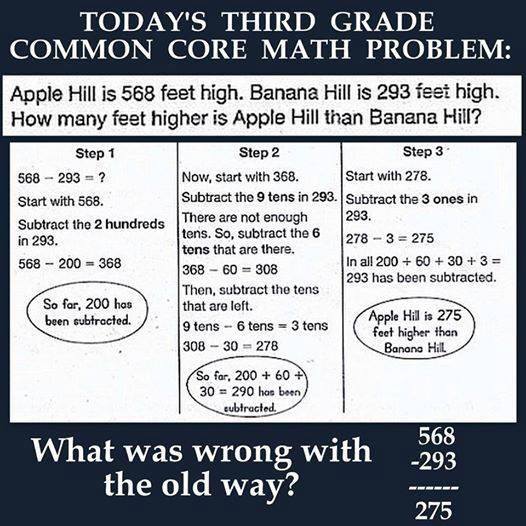
Hi everyone. I've been seeing certain posts circulate around social media, claiming that math is now taught differently in school than it was before. Here is one such image:

2gy4wt3.jpg


I'm not sure if this is true, or if it's just one of those "back in MY day" rants.

Anyways, I'd like to see discussion on whether or not this is true, and if it is, what are the reason(s) for this change?
 
Science news on Phys.org
First of all, let me point out that yes, the old way is still taught. Sometimes, you just need mindless, algorithmic processes to get a job done.

That said, the second method is more intuitive, and when I (and many other people who study in STEM fields) do mental arithmetic, this method is the method I use. It's highly unfeasible to imagine doing it the "old way" in your head--it's too easy to lose your place!

But it's much easier to take it one step at a time to simplify things. And this is exactly what I do: I subtract using a bunch of easy steps, and then take the total amount I subtracted. I don't pull out a sheet of paper and say "okay, now carry the one..."

Now, the old way is great. It works, but at the same time, it really isn't that necessary. Any sufficiently complicated problem can be solved with a calculator or computer. There's never any need to subtract a 13-digit number from a 14-digit number unless you just want to practice. What's more important when applying math is to understand intuitively what you're doing, and getting an intuitive feel for numbers is how you come up with those little tricks to make mental arithmetic easier.

For instance, what's 15 \times 17? I could pull out a sheet of paper and calculate it. I could also line the two up in my head and try to remember what the individual products are and then add them together, but that's the same as doing the following!

Notice that 17 = 10 + 7, then 15 \times 17 = 15 \times (10 + 7). That's much more manageable. Right away I know 15 \times 10 = 150, and I can further divide 7 into 7 = 5 + 2. Then I multiply 15 by each of those. That's fairly easy: 15 \times 5 = 75 and 15 \times 2 = 30, and in my head, I can add 150 + 75 + 30 = 225 + 30 = 255. I can do that in my head in about 5 seconds (or faster, if I'm in the zone!), because I know intuitively what it means to perform those operations. I don't need to rely on some algorithm without understanding what I'm doing.

Another example of a similar thought process. You're at the store, and you buy something that costs $3.72. You pay with a 20$ bill. How much change do you get? I'm not going to pull out a sheet of paper and calculate 20.00 - 3.72. I'm going to note that 3.72 + .28 = 4. Then note that 4 + 16 = 20. So my change is 16.28$. Again, it's hard to get that insight by just following a set of rules called subtraction. It requires understanding the meaning of subtraction.

And the beauty is that (I feel) those skills extend to higher level mathematics when you're no longer dealing with constants. That's where you're at an advantage when you understand what things mean as opposed to just how to do things. Understanding how to take a derivative is nearly useless unless your job requires you to analytically find derivatives. Understanding what a derivative is and how rates of change are all around us is the important skill.
 
  • Like
Likes   Reactions: ELB27, epenguin, brainpushups and 3 others
That image has been spreading around social media. My wife teaches common core to 1st and 2nd grade. It took me several minutes to figure out the different approach, but I learned it's much closer to the method you likely use in your head as an adult. Breaking up the problem into easier units is much easier in your head than using remainders and carrying over tens. I'm a big fan of common core and the kids seems to pick it up just fine. It's the adults who are stuck in their ways who have a problem with it.
 
  • Like
Likes   Reactions: BobG
I'm so impressed by the fact that the example you posted is actually correct. The worst are the posts where they don't do the steps correctly because they don't understand the concept they're criticizing.

Actually, in the example you posted, I'd go 568-300+7. If you're doing arithmetic in your head, at least make sure you get close to the right answer (-300). Then refine your answer to make it more exact (+7). But I was taught by my dad, not by a school system using common core. At the time, I thought that incredibly edgy that my dad, who always stressed playing by the rules, suddenly broke the rules (at least the rules I learned in school) when it came to doing quick calculations in your head.
 
Slightly off-point, but one can take the trouble to draw a picture, label the parts, and see immediately that the simple subtraction is what is really wanted:
568-293=275
and the units can be included if one wants to show them.
 

Similar threads

Replies
97
Views
16K
  • · Replies 27 ·
Replies
27
Views
4K
Replies
12
Views
3K
  • · Replies 15 ·
Replies
15
Views
5K
Replies
13
Views
12K
  • · Replies 76 ·
3
Replies
76
Views
8K
  • · Replies 5 ·
Replies
5
Views
3K
  • · Replies 1 ·
Replies
1
Views
2K
  • · Replies 15 ·
Replies
15
Views
3K
  • · Replies 15 ·
Replies
15
Views
4K