QuantumRose
- 11
- 1
Here is the question:
By using the equality (for boson)
 ---------------------------------------- (1)
Prove that

Background:
Currently I'm learning things about second quantization in the book "Advanced Quantum Mechanics"(Franz Schwabl).
Given the creation and annihilation operators(
 ), define field operators as
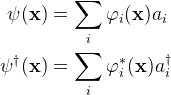
The following 3 commutator relations are for Boson.
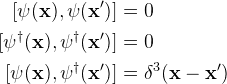 -----------------------------------(2)
And here is my attempt (but it doesn't work):
First step, using equality (1) to expand the commutator:
 -------------(3)
since the nabla operator is an operator, so I think the first term of (3)'s right-hand-side can be expressed as following

also, I expressed the second term of (3)'s right-hand-side by using the same method

So, by inserting those commutators in (2), I found

By using the equality (for boson)
Prove that
Background:
Currently I'm learning things about second quantization in the book "Advanced Quantum Mechanics"(Franz Schwabl).
Given the creation and annihilation operators(
The following 3 commutator relations are for Boson.
And here is my attempt (but it doesn't work):
First step, using equality (1) to expand the commutator:
since the nabla operator is an operator, so I think the first term of (3)'s right-hand-side can be expressed as following
also, I expressed the second term of (3)'s right-hand-side by using the same method
So, by inserting those commutators in (2), I found
Last edited: