Undergrad Complex Fourier transform (represented by Σ)

Click For Summary
SUMMARY

The forum discussion centers on deriving Equation (2.3a) from the Fourier coefficients defined in Equation (2.2) in the paper "Fourier_techniques.pdf." Participants express confusion regarding the transition from integral representations of Fourier coefficients to their summation forms. The discussion emphasizes the approximation of integrals to discrete summations, particularly using the definitions of \( t_k = kT/N \) and \( \omega_j = 2\pi j/T \). The consensus suggests that understanding the general concepts presented in Section 2.1 is crucial before delving into detailed derivations.

PREREQUISITES
  • Understanding of Fourier Transform concepts
  • Familiarity with discrete summation and integration techniques
  • Knowledge of trigonometric identities involving \( \cos \) and \( \sin \)
  • Basic proficiency in mathematical notation and derivations
NEXT STEPS
  • Study the derivation of Fourier coefficients in both integral and summation forms
  • Learn about the properties of even and odd functions in Fourier analysis
  • Explore the concept of approximating integrals with discrete summations
  • Review Section 2.1 of "Fourier_techniques.pdf" for foundational concepts
USEFUL FOR

Mathematicians, physicists, and engineering students interested in Fourier analysis and its applications in signal processing and systems analysis.

arcTomato
Messages
104
Reaction score
27
TL;DR
I can't understand how to derive fourier transform(described by Σ).
Dear all.

I can't understand how to derive Eq.(2.3a).

Fourier coefficients, ##A_j## and ##B_j## are described by summation in this paper as (2.2). I think this is weird.
Because this paper said "In this section 2.1 ,the Fourier transform is introduced in very general terms".
and I understand Fourier coefficients as integral.( I think integral version is more general than ##Σ## version.) so I'm confused.

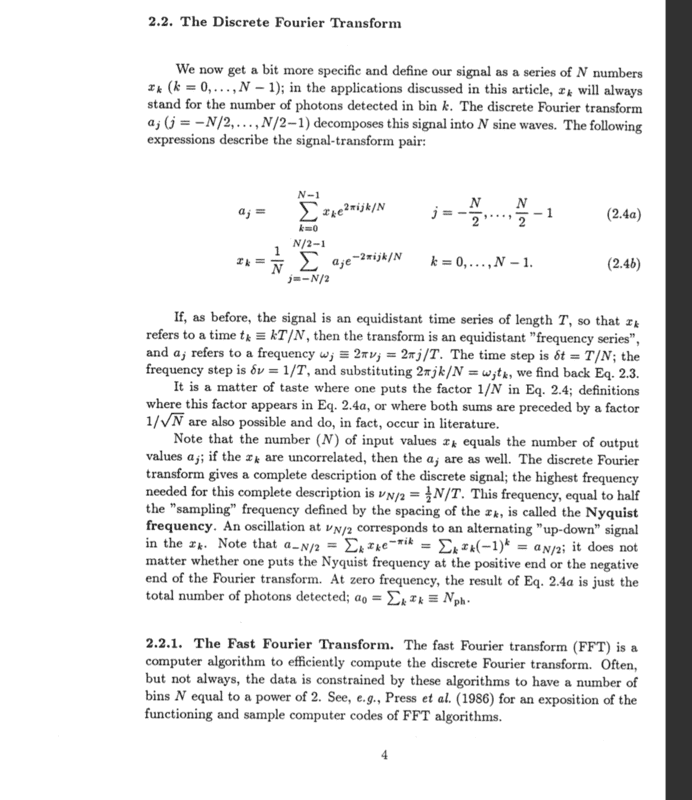
I would like to ask you how to derive (2.3a) in this paper( in ##Σ## version).
(this is the paper I readFourier_techniques.pdf)
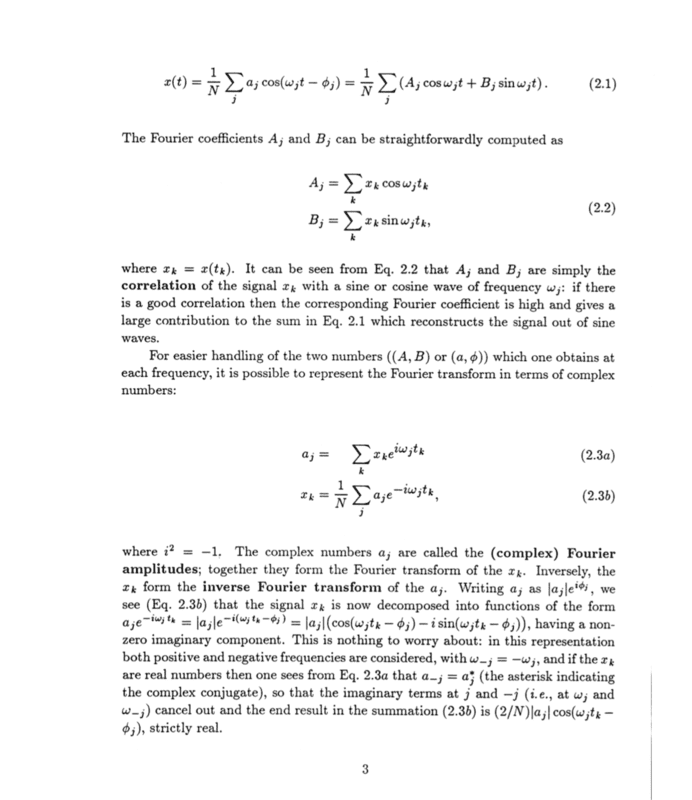
スクリーンショット 2019-10-21 9.40.02.png
スクリーンショット 2019-10-21 9.41.40.png
 
Physics news on Phys.org
Assume that you are integrating from ##-T## to ##+T##, and consider the evenness or oddness of ##\cos^2\omega_jt##, ##\sin^2\omega_jt##, and ##\sin\omega_jt\cos\omega_jt##. Then take the small step from integration to discrete summation.
 
I appreciate for you, @tnich.

Can I use ##t_k=kT/N,ω_j=2πj/T##in the process to derive (2.2)??
This paper does not say anything about ##ω_j## in section 2.1.
So you say like this??Can I approximate to Σ from integral?
1571622923271.png
 
Yes, I am saying that you can approximate the integrals with discrete summations. Try looking at the definition of an integral as a limit of discrete summations to see how to do the approximation.
I am having trouble reading your derivation, so I don't know if you got it right. I see that you kept ##k## and ##t_k## in the integral. I think you need to integrate over ##t## from ##-T## to ##+T##.
But, that said, on page 2 the author says that this section is a general overview and that he will go into the details later. If you understand the general idea, I would be tempted to just read on.
 
Ok, I think I got it😊
Thanks for your kindness,@tnich!
 
  • Like
Likes tnich

Similar threads

  • · Replies 7 ·
Replies
7
Views
2K
Replies
1
Views
2K
  • · Replies 1 ·
Replies
1
Views
2K
  • · Replies 3 ·
Replies
3
Views
2K
  • · Replies 1 ·
Replies
1
Views
3K
  • · Replies 3 ·
Replies
3
Views
4K
  • · Replies 3 ·
Replies
3
Views
3K
  • · Replies 3 ·
Replies
3
Views
2K
  • · Replies 5 ·
Replies
5
Views
2K
Replies
1
Views
2K