Complex Numbers - Forms and Parts

Click For Summary

Discussion Overview

The discussion revolves around identifying the real and imaginary parts of a complex number presented in rectangular form, specifically in the context of evaluating expressions involving Euler's relation and complex division. Participants explore methods for simplifying the expression and converting it into rectangular and polar forms.

Discussion Character

  • Technical explanation
  • Mathematical reasoning
  • Debate/contested

Main Points Raised

  • One participant expresses confusion about identifying the real and imaginary parts of a complex number, suggesting that σ = 2 and the rest is imaginary.
  • Another participant corrects the first by stating that the numerator is real, specifically e^{j3\pi} = -1, and not imaginary as initially thought.
  • Some participants suggest using Euler's relation to simplify the numerator and recommend multiplying by the conjugate of the denominator to obtain a real denominator.
  • There are repeated suggestions to use external tools like Wolfram Alpha to evaluate the expression and clarify the components of the complex number.

Areas of Agreement / Disagreement

Participants do not reach a consensus on the identification of the real and imaginary parts, as there are conflicting interpretations regarding the nature of the numerator and its evaluation.

Contextual Notes

Participants rely on assumptions about the nature of the variables involved, such as k being real, and there are unresolved steps in the mathematical evaluation process.

dotNet
Messages
2
Reaction score
0
Hi, I have a complex number and understand that the rectangular form of the number is represented by

s = σ + jω, where σ is the real part and jω is imaginary.

I am having trouble locating them in the number below:
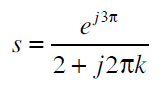
20koboi.png


I know that "2" is a real number, and the numerator is imaginary along with j*2*pi*k. Since the numerator is dividing both the elements at the bottom, does this number have a real and imaginary part? (This is where I am a little confused).

My guess would be that σ = 2 and the rest is imaginary.

If I could figure out what parts are real and imaginary, I can go on to find the rectangular form and the polar form.

Thanks
 
Physics news on Phys.org
dotNet said:
Hi, I have a complex number and understand that the rectangular form of the number is represented by

s = σ + jω, where σ is the real part and jω is imaginary.

I am having trouble locating them in the number below:
20koboi.png


I know that "2" is a real number, and the numerator is imaginary along with j*2*pi*k. Since the numerator is dividing both the elements at the bottom, does this number have a real and imaginary part? (This is where I am a little confused).

My guess would be that σ = 2 and the rest is imaginary.

If I could figure out what parts are real and imaginary, I can go on to find the rectangular form and the polar form.

Thanks

Euler's relation e^ix = cos(x) + i*sin(x) vastly simplifies the exponential in the numerator. Cos and sin have period 2pi so the numerator is -1. Then multiply numerator and denominator by the conjugate of the denominator (assuming k is real). That leaves you with a real number in the denominator and a complex number in the numerator whose real and imaginary parts can be readily evaluated.

By the way, multiplying numerator and denominator by the conjugate of the denominator is the standard thing to do with this kind of problem.
 
Last edited:
dotNet said:
Hi, I have a complex number and understand that the rectangular form of the number is represented by

s = σ + jω, where σ is the real part and jω is imaginary.

I am having trouble locating them in the number below:
20koboi.png


I know that "2" is a real number, and the numerator is imaginary along with j*2*pi*k.
No, the numerator is NOT imaginary. In fact it is real- it is e^{j3\pi}= cos(3\pi)+ jsin(3\pi)= -1.
Since the numerator is dividing both the elements at the bottom, does this number have a real and imaginary part? (This is where I am a little confused).

My guess would be that σ = 2 and the rest is imaginary.

If I could figure out what parts are real and imaginary, I can go on to find the rectangular form and the polar form.

Thanks
 
Last edited by a moderator:
Just try a look into www.wolframalpha.com and enter

Exp[3 Pi I] / (2 + 2 Pi k I)

what is the Mathematica version of your formula
 
as others have suggested, evaluate the numerator at the specific angle (3pi), and then multiply the resulting fraction by:

\frac{2 - j2\pi k}{2 - j2\pi k} (= 1)

to make the denominator real.
 

Similar threads

  • · Replies 13 ·
Replies
13
Views
2K
  • · Replies 0 ·
Replies
0
Views
3K
  • · Replies 20 ·
Replies
20
Views
3K
  • · Replies 5 ·
Replies
5
Views
3K
  • · Replies 21 ·
Replies
21
Views
2K
  • · Replies 2 ·
Replies
2
Views
2K
  • · Replies 5 ·
Replies
5
Views
3K
  • · Replies 1 ·
Replies
1
Views
1K
  • · Replies 8 ·
Replies
8
Views
2K
  • · Replies 2 ·
Replies
2
Views
2K