Computations with Tangent Vectors and Pushforwards - Lee

  • Context: Graduate 
  • Thread starter Thread starter Math Amateur
  • Start date Start date
  • Tags Tags
    Tangent Vectors
Click For Summary

Discussion Overview

The discussion centers around the nature of tangent vectors and pushforwards as presented in John M. Lee's "Introduction to Smooth Manifolds," specifically in Chapter 3. Participants explore the conceptual understanding of the coordinate vectors \(\partial / \partial x_i |_p\) and their characterization as maps or operators rather than traditional vectors with magnitude and direction.

Discussion Character

  • Conceptual clarification
  • Debate/contested

Main Points Raised

  • Peter questions how the vectors \(\partial / \partial x_i |_p\) can be considered vectors, suggesting they appear to be maps or operators rather than objects with magnitude and direction.
  • Brian explains that these objects can be understood as directional derivatives of functions along curves, indicating that different velocities yield different time derivatives of a function.
  • Brian asserts that these derivatives form an equivalence class for the vectors and satisfy the properties of a vector space, drawing parallels to tangent vectors on surfaces in Euclidean space.
  • Brian mentions that the definition of vectors as derivatives allows for generalization to non-Euclidean spaces and that in Riemannian manifolds, these vectors can possess magnitude as defined by the metric components.
  • Peter expresses appreciation for Brian's explanation and indicates ongoing reflection on the concepts discussed.

Areas of Agreement / Disagreement

Participants do not reach a consensus on the characterization of tangent vectors, with Peter expressing uncertainty and seeking clarification, while Brian provides a perspective that aligns with conventional definitions in differential geometry.

Contextual Notes

The discussion reflects differing interpretations of the nature of tangent vectors and their mathematical representation, with some assumptions about the definitions and properties of vectors in the context of manifolds remaining unresolved.

Math Amateur
Gold Member
MHB
Messages
3,920
Reaction score
48
I am reading John M. Lee's book: Introduction to Smooth Manifolds ...

I am focused on Chapter 3: Tangent Vectors ...

I need some help in fully understanding Lee's conversation on computations with tangent vectors and pushforwards ... in particular I need clarification on the nature of the 'vectors' \partial / \partial x_i |_p ... ...

The relevant conversation in Lee is as follows:
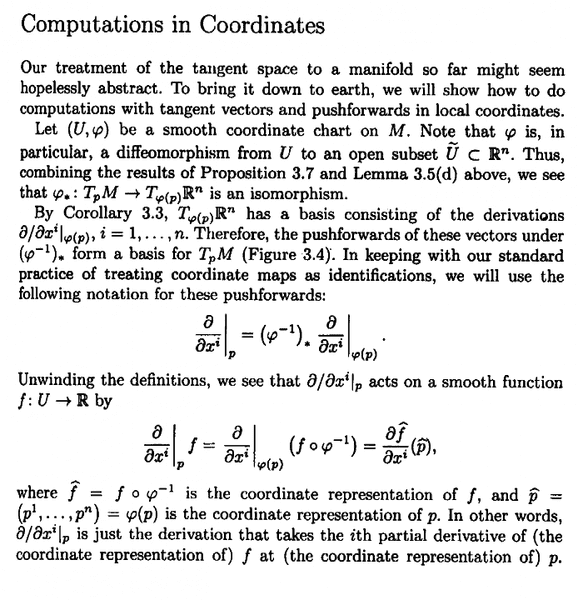
?temp_hash=d38902aecadea3102a6b77c889f2a0b0.png

?temp_hash=d38902aecadea3102a6b77c889f2a0b0.png

In the above text from Lee we read the following:

" .. ... The vectors \partial / \partial x_i |_p are called the coordinate vectors at p associated with a given coordinate system ... ... "

My question is as follows:

How or in what sense are the \partial / \partial x_i |_p vectors ... they are certainly not objects with a magnitude and direction ... they seem to me to be maps or operators ... ...

Indeed they are defined by Lee as follows:

\frac{ \partial }{ \partial x^i } |_p = ( \phi^{-1}_* ) \frac{ \partial }{ \partial x^i } |_{\phi(p)}Thus, the \frac{ \partial }{ \partial x^i } |_p are mappings ... put in a smooth function f and get out a real number ...

So ... how, or in what sense are these objects vectors ...

Hope someone can clarify this issue ...

Peter
 

Attachments

  • Lee - 1 - Ch 3 - Tangent Vectors - Computations in Coordinates - PART 1      ....png
    Lee - 1 - Ch 3 - Tangent Vectors - Computations in Coordinates - PART 1 ....png
    50.9 KB · Views: 789
  • Lee - 2 - Ch 3 - Tangent Vectors - Computations in Coordinates - PART 2      ....png
    Lee - 2 - Ch 3 - Tangent Vectors - Computations in Coordinates - PART 2 ....png
    21 KB · Views: 778
Physics news on Phys.org
Hi Peter,
To understand how the objects ##\frac{\partial}{\partial x^i}## are vectors, consider the following:
Take a function ##f## defined in a neighbor of ##p \in M##, and a curve ##\alpha(t)## which passes through ##p## at ##\alpha(0)##. The time derivative of ##f## on the path is given by the chain rule, explicitly
$$ \frac{d(f \circ \alpha)}{dt} |_{t=0} = \frac{dx^i}{dt}\frac{\partial f}{\partial x^i} |_{p} $$
From this, we see that different velocities will give different time derivatives of f (the components ##\frac{dx^i}{dt}## will be different). Consequently, we can say that the vectors are equivalent to these directional derivatives on functions, i.e. these derivatives form an equivalence class for the vectors themselves. Also, these derivatives satisfy the properties of a vector space. If you go back to a manifold in an ambient space, say 2d surfaces in ##\mathbb{R}^3##, this definition fits since for a surface parametrized by ##\vec{x}(u,v)##, the tangent vectors ##\vec{x}_u## and ##\vec{x}_v## satisfy ##\vec{x}_u[f] = \partial_uf## and ##\vec{x}_v[f] = \partial_vf##. This is a common theme in geometry to define objects in a way that agrees with our intuition from Euclidian space but also allows us to generalize to non-Euclidian spaces.
For an arbitrary vector acting on a function, we have
$$X[f] = X^i \frac{\partial f}{\partial x^i} $$
This gives the expression for X written in the coordinate basis ##\frac{\partial}{\partial x^i}##:
$$X = X^i \frac{\partial}{\partial x^i}$$
We can then define the tangent plane at this point ##T_p M## as the set of all velocity vectors at that point for all possible curves passing through ##p##. When you're dealing with vectors on a manifold, one cannot specify a "direction" in the Euclidian sense by referencing some ambient space; rather, we say that the vector pointing in a direction (say the ##u## direction) takes the ##u## derivative of a function. Also, these vectors do have a magnitude if we are working with a Riemannian manifold, where the components of the metric are given by
##g_{i j} = < \frac{\partial}{\partial x^i} , \frac{\partial}{\partial x^j}> ##
 
  • Like
Likes   Reactions: Math Amateur and fresh_42
Brian T said:
Hi Peter,
To understand how the objects ##\frac{\partial}{\partial x^i}## are vectors, consider the following:
Take a function ##f## defined in a neighbor of ##p \in M##, and a curve ##\alpha(t)## which passes through ##p## at ##\alpha(0)##. The time derivative of ##f## on the path is given by the chain rule, explicitly
$$ \frac{d(f \circ \alpha)}{dt} |_{t=0} = \frac{dx^i}{dt}\frac{\partial f}{\partial x^i} |_{p} $$
From this, we see that different velocities will give different time derivatives of f (the components ##\frac{dx^i}{dt}## will be different). Consequently, we can say that the vectors are equivalent to these directional derivatives on functions, i.e. these derivatives form an equivalence class for the vectors themselves. Also, these derivatives satisfy the properties of a vector space. If you go back to a manifold in an ambient space, say 2d surfaces in ##\mathbb{R}^3##, this definition fits since for a surface parametrized by ##\vec{x}(u,v)##, the tangent vectors ##\vec{x}_u## and ##\vec{x}_v## satisfy ##\vec{x}_u[f] = \partial_uf## and ##\vec{x}_v[f] = \partial_vf##. This is a common theme in geometry to define objects in a way that agrees with our intuition from Euclidian space but also allows us to generalize to non-Euclidian spaces.
For an arbitrary vector acting on a function, we have
$$X[f] = X^i \frac{\partial f}{\partial x^i} $$
This gives the expression for X written in the coordinate basis ##\frac{\partial}{\partial x^i}##:
$$X = X^i \frac{\partial}{\partial x^i}$$
We can then define the tangent plane at this point ##T_p M## as the set of all velocity vectors at that point for all possible curves passing through ##p##. When you're dealing with vectors on a manifold, one cannot specify a "direction" in the Euclidian sense by referencing some ambient space; rather, we say that the vector pointing in a direction (say the ##u## direction) takes the ##u## derivative of a function. Also, these vectors do have a magnitude if we are working with a Riemannian manifold, where the components of the metric are given by
##g_{i j} = < \frac{\partial}{\partial x^i} , \frac{\partial}{\partial x^j}> ##
Thanks Brian ... appreciate your help ...

Still reflecting on what you have said ...

Peter
 
Math Amateur said:
Thanks Brian ... appreciate your help ...

Still reflecting on what you have said ...

Peter

No problem, let me know if you have any explicit questions. It took me awhile to get used to the concept of a vector as a derivative as well.
 
  • Like
Likes   Reactions: Math Amateur
Thanks Brian ... most reassuring ...

Peter
 

Similar threads

  • · Replies 12 ·
Replies
12
Views
5K
  • · Replies 6 ·
Replies
6
Views
4K
  • · Replies 21 ·
Replies
21
Views
4K
  • · Replies 11 ·
Replies
11
Views
4K
  • · Replies 4 ·
Replies
4
Views
3K
  • · Replies 9 ·
Replies
9
Views
2K
  • · Replies 9 ·
Replies
9
Views
3K
  • · Replies 0 ·
Replies
0
Views
2K
  • · Replies 2 ·
Replies
2
Views
2K
  • · Replies 36 ·
2
Replies
36
Views
6K
