Math Amateur
Gold Member
MHB
- 3,920
- 48
I am reading John M. Lee's book: Introduction to Smooth Manifolds ...
I am focused on Chapter 3: Tangent Vectors ...
I have some further questions concerning Lee's conversation on computations with tangent vectors and pushforwards ...
The relevant conversation in Lee is as follows:
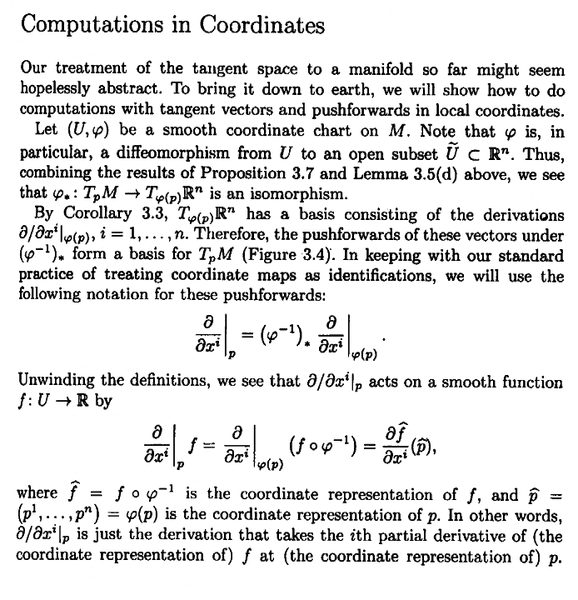
 In the above text we read:
" ... ... we see that [itex]\phi_* \ : \ T_p M \longrightarrow T_{ \phi(p) } \mathbb{R}^n[/itex] is an isomorphism ... ... "
and then further ...
" ... ... [itex]T_{ \phi(p) } \mathbb{R}^n[/itex] has a basis consisting of all derivations [itex]\frac{ \partial }{ \partial x^i } |_{\phi(p)} \ , \ i = 1, \ ... \ ... , n[/itex]. Therefore the pushforwards of these vectors under [itex]( \phi^{-1} )_*[/itex] form a basis for [itex]T_p M[/itex] ... ... "Question 1
Is [itex]( \phi^{-1} )_*[/itex] the inverse of [itex]\phi_*[/itex] and hence the isomorphism from [itex]T_{ \phi(p) } \mathbb{R}^n[/itex] to the tangent space [itex]T_p M[/itex]?
Why isn't the inverse [itex]( \phi_* )^{-1}[/itex] ?Question 2
Since [itex]( \phi^{-1} )_* \ : \ T_{ \phi(p) } \mathbb{R}^n \longrightarrow T_p M[/itex] and we know that [itex]T_{ \phi(p) } \mathbb{R}^n[/itex] is a vector space ... then since [itex]( \phi^{-1} )_*[/itex] is an isomorphism ... then ... [itex]T_p M[/itex] is a vector space ... is that correct? ... ...
Hope someone can help ... ...
Peter
I am focused on Chapter 3: Tangent Vectors ...
I have some further questions concerning Lee's conversation on computations with tangent vectors and pushforwards ...
The relevant conversation in Lee is as follows:
" ... ... we see that [itex]\phi_* \ : \ T_p M \longrightarrow T_{ \phi(p) } \mathbb{R}^n[/itex] is an isomorphism ... ... "
and then further ...
" ... ... [itex]T_{ \phi(p) } \mathbb{R}^n[/itex] has a basis consisting of all derivations [itex]\frac{ \partial }{ \partial x^i } |_{\phi(p)} \ , \ i = 1, \ ... \ ... , n[/itex]. Therefore the pushforwards of these vectors under [itex]( \phi^{-1} )_*[/itex] form a basis for [itex]T_p M[/itex] ... ... "Question 1
Is [itex]( \phi^{-1} )_*[/itex] the inverse of [itex]\phi_*[/itex] and hence the isomorphism from [itex]T_{ \phi(p) } \mathbb{R}^n[/itex] to the tangent space [itex]T_p M[/itex]?
Why isn't the inverse [itex]( \phi_* )^{-1}[/itex] ?Question 2
Since [itex]( \phi^{-1} )_* \ : \ T_{ \phi(p) } \mathbb{R}^n \longrightarrow T_p M[/itex] and we know that [itex]T_{ \phi(p) } \mathbb{R}^n[/itex] is a vector space ... then since [itex]( \phi^{-1} )_*[/itex] is an isomorphism ... then ... [itex]T_p M[/itex] is a vector space ... is that correct? ... ...
Hope someone can help ... ...
Peter
Attachments

